Phangan Sunset by Ryszard Wierzbicki
Captured on the shores of Baan Tai Beach, this photograph immortalizes the daily ritual of the sunset on Koh Phangan. The photographer skillfully framed the fleeting transition of light as the islanders gathered to witness nature’s spectacular performance. By utilizing a telephoto focal length of 140mm, the image isolates the warmth and atmosphere of the horizon, emphasizing the profound connection between the local community and the environment. This award-winning shot succeeds through its evocative composition, which transforms a familiar tropical scene into a timeless narrative of serenity and awe, perfectly reflecting the island's rhythmic, sun-drenched lifestyle.
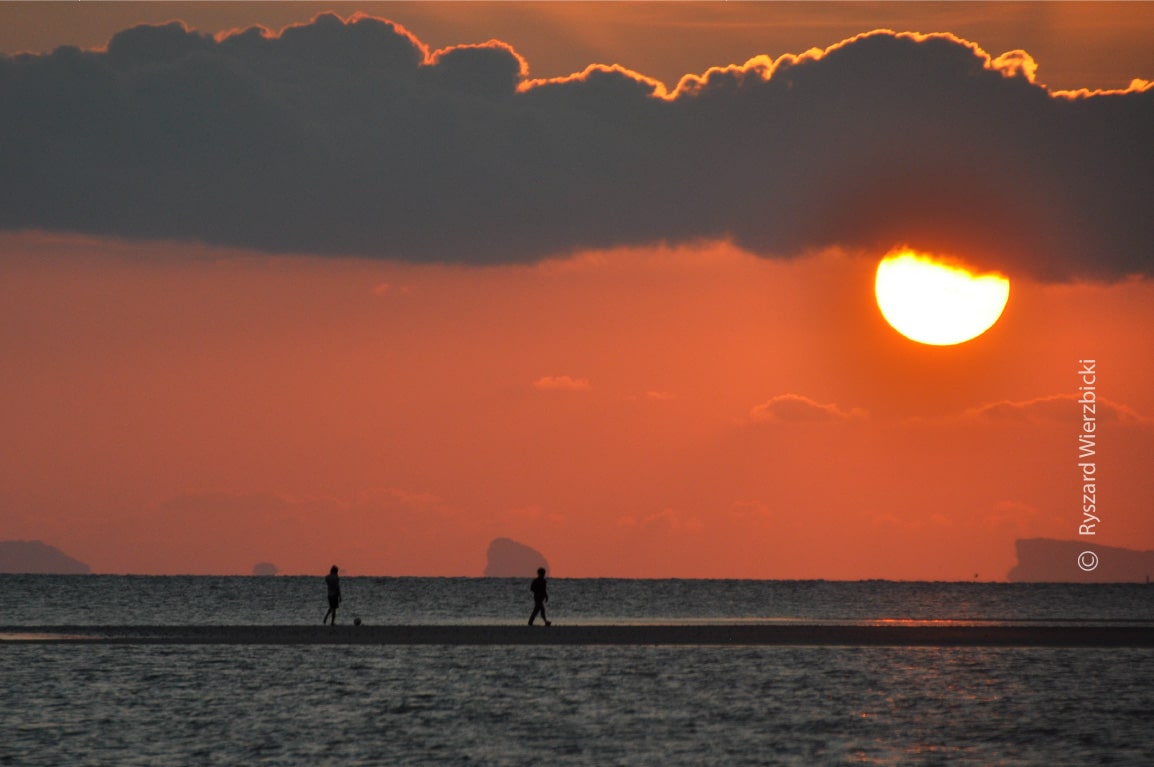
Exposure 1/500sec @ f/6.3 | ISO 220 | Focal Length 140mm
Ryszard Wierzbicki
Born in Poland in 1963, Ryszard Wierzbicki transitioned from a diverse career in education and marketing to a life dedicated to exploration and photography. After relocating to the United Kingdom in 2006, he shifted his focus toward documenting his extensive travels across South-East Asia and his passion for scuba diving. As a dedicated photographer and community builder, he founded multiple platforms for travelers and actively supports charitable causes for orphans in Thailand and Burma, blending his technical expertise with a deep, humanitarian curiosity for the world around him.
Resonance Score Breakdown
Transparency Note: The resonance score (11.7/20) is calculated based on social engagement metrics collected before the award announcement.
Expert Photography Reviews · 6
Salt on the Skin
The air at the edge of the day tastes of brine and cooling sand. I remember the feeling of walking barefoot where the tide has just retreated, the ground beneath my toes firm and slick, like cool silk pulled tight over bone.
Read the reflection →The Weight of the Horizon
The sun does not ask for permission to leave. It simply retreats, pulling the warmth from the stones and the color from the water until everything is rendered in shades of cooling iron.
Read the reflection →Reviews & Comments
Share your thoughts about this award-winning photograph. Your reviews contribute to the community engagement score.
The horizon line bisects the frame at a precise 1:3 ratio, anchoring the composition against the vertical thrust of the silhouetted palms. I’m struck by how the telephoto compression flattens the depth, forcing the figures into a tight, rhythmic sequence along the lower third. It’s a beautifully solved spatial equation where the negative space of the sky balances the dense, dark mass of the foreground. It’s rare to see such clean, geometric tension in a sunset.
The horizon line bisects the frame with clinical indifference. It’s a rigid anchor, yet the silhouettes lack the necessary geometric weight to balance the encroaching shadows. The telephoto compression flattens the spatial tension, rendering the foreground figures mere decorative noise against the gradient. It’s technically competent, but it doesn’t hold. I’ve seen this sunset a thousand times, and frankly, the lack of structural discipline here leaves me cold. The frame simply fails to resolve.
It’s a relief to see a landscape that doesn’t fight the physics of water. Up here, at 140mm, the light isn’t being stripped of its reds and oranges by the ocean’s density. I’ve spent so much time battling backscatter and the refractive index that this clarity feels like a luxury. It’s beautiful, really—the way the horizon holds its warmth. I find myself breathing easier just looking at it, free from the crushing weight of the deep.
The horizon bleeds into the bruised violet of a bruised plum, a chromatic dissonance that reminds one of Turner’s most feverish, late-period skies. It’s a humid, suffocating warmth, that specific ochre of a dying sun hitting wet sand, and I’ve found myself breathless, almost dizzy, before such heavy, saturated light. It doesn’t merely depict a sunset; it’s a visceral, molten collision of pigments that makes the air feel thick enough to swallow whole.
At 140mm, the compression of the horizon is striking. The lens struggles slightly with the diffraction limit near the sun’s disc, yet that subtle softening feels intentional, almost organic. It’s a delicate balance; the chromatic aberration at the edges of the silhouettes is barely perceptible, keeping the focal plane sharp. I’m genuinely moved by how the light bleeds into the atmosphere here. It’s not just a sunset; it’s a precise, beautiful manipulation of photons.
The horizon bleeds gold, and for a second, the world stops spinning. It’s a tight, 140mm compression that flattens the depth, turning the beach into a stage set. I’ve seen a thousand sunsets, but this one feels like the final shot of a long, wearying film. The cut would’ve been a mistake; the frame holds because it’s breathless. It’s quiet, heavy, and honestly, it makes me miss a home I’ve never actually visited.