Observing People by Ryszard Wierzbicki
Captured within the serene atmosphere of a Hindu temple in Pune, India, this photograph documents a poignant moment of quiet observation. The photographer encountered an elderly woman seated on the temple floor, her presence radiating a profound sense of dignity amidst the passing crowd. By utilizing a 200mm focal length, the photographer was able to isolate the subject from the bustling environment, creating an intimate portrait that emphasizes her weathered features and reflective gaze. The image is award-worthy for its masterful use of natural light and the respectful, candid approach that transforms a fleeting encounter into a timeless study of human character.
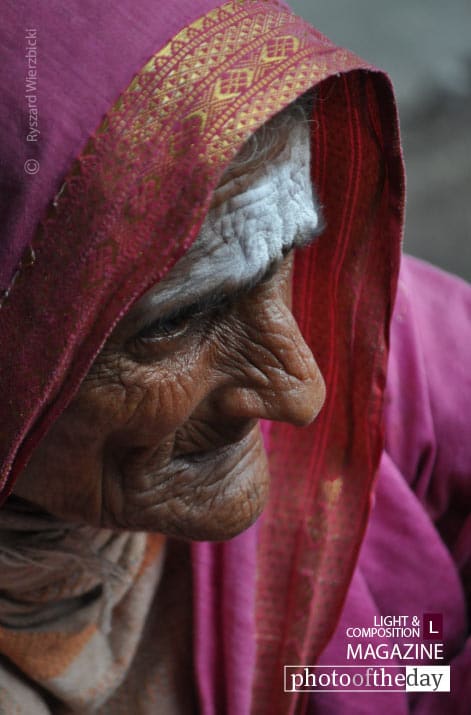
Exposure 1/500sec @ f/5.6 | ISO 1000 | Focal Length 200mm
Ryszard Wierzbicki
Born in Poland in 1963, Ryszard Wierzbicki relocated to the United Kingdom in 2006, where he established himself as a dedicated travel photographer. His work is deeply rooted in cultural observation, with a particular specialization in evocative portraits of children and the elderly. Through his extensive travels, particularly across South-East Asia, Wierzbicki captures the essence of human experience, blending technical precision with a compassionate eye for the stories etched into the faces of his subjects.
Resonance Score Breakdown
Transparency Note: The resonance score (13.0/20) is calculated based on social engagement metrics collected before the award announcement.
Expert Photography Reviews · 7
The Weight of Stillness
The smell of cold stone and old incense clings to the back of my throat, a dry, powdery scent that tastes like history. I remember sitting on floors just like this, where the ground is hard enough to press the shape of the earth into your shins.
Read the reflection →The Weight of Quiet
In the physics of a crowded room, we are taught to look for the loudest voice or the swiftest movement. We assume that importance is measured by the space one occupies or the speed at which one travels through the day.
Read the reflection →Reviews & Comments
Share your thoughts about this award-winning photograph. Your reviews contribute to the community engagement score.
The ochre of the temple floor bleeds into the woman’s sari, a dusty saffron that recalls the muted, chalky stillness of a Morandi canvas. It’s a palette of profound resignation, where the light doesn’t just illuminate but seems to weigh upon her skin like heavy, sun-warmed silk. I’ve felt my own breath hitch at the way those shadows pool in the folds of her fabric, creating a chromatic ache that feels entirely, devastatingly human.
The temple floor holds a stillness that only the patient find. He stood back with that 200mm lens, letting the light fall softly across her face, waiting for the world to stop moving around her. It’s a quiet, holy geometry. I’ve felt that same ache in my chest when the light finally settles just right. She isn’t just sitting there; she’s listening to the silence of the stone. It’s a beautiful, heavy peace.
The temple floor stretches. A vast, cool stone expanse. She sits, anchored in the stillness. The crowd blurs into a hum, yet she remains distinct. I’ve spent minutes watching her hands. They don’t fidget. It’s a rare, heavy quiet. Nothing here is accidental. The empty corner is not empty; it’s where the world falls away. I feel a sudden, sharp ache in my own chest. She knows how to wait. It’s a beautiful, hollow grace.
Most candid shots of the elderly in India fall into the trap of exoticism, but Wierzbicki avoids that. By using the 200mm lens to compress the temple space, he forces us to confront her eyes rather than the surroundings. It’s the stillness in her expression that hits me; I found myself holding my breath. It’s a rare, quiet dignity that will still matter in thirty years, long after the digital noise of 2012 fades away.
At 200mm, the compression of the focal plane isolates her features with clinical precision. Shooting at f/5.6, the lens avoids the diffraction limit while rendering the temple’s ambient light with a soft, organic roll-off. I’m genuinely moved by how the micro-contrast in her skin reveals a lifetime of narrative. It’s rare to see a consumer-grade zoom resolve such intimacy; the optics haven’t just captured a face, they’ve preserved the very texture of her quietude.
The 200mm compression flattens the temple floor into a singular, vertical plane. It’s a rigid geometry that forces the subject’s weathered features against the blurred, chaotic backdrop. The negative space doesn’t breathe; it constricts. I’m genuinely unsettled by how the frame traps her gaze within this narrow, claustrophobic corridor of light. The composition demands total stillness. It’s a brutal, disciplined architecture that refuses to let the viewer look away from the subject’s absolute, unyielding isolation.
Shadows here don’t merely frame; they consume the periphery, forcing us into the woman’s heavy, singular silence. It’s a brutal isolation. By pulling her from the Pune crowd with that long lens, Wierzbicki denies us the comfort of context. I’ve stared at her weathered skin for an hour, and I’m unsettled by how much darkness she holds. She isn’t just sitting; she’s enduring the light. It’s a quiet, crushing weight that I can’t escape.