Purple Sapphire by Anup Kar
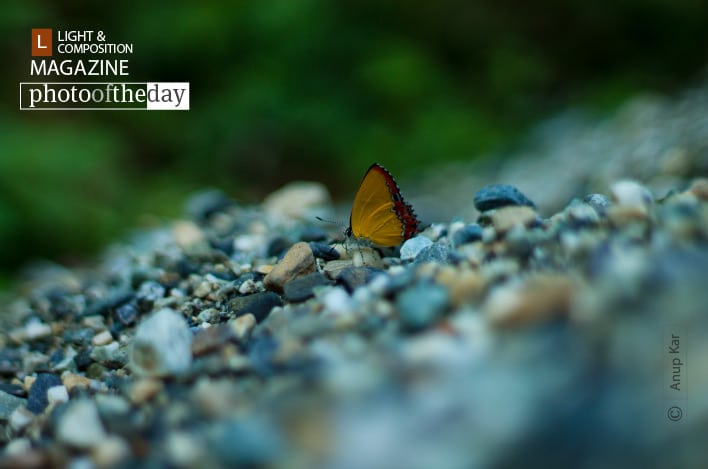
Captured during a journey through the Buxa Tiger Reserve Forest in India, this image showcases the delicate beauty of the Purple Sapphire butterfly. Spotting the vibrant insect along the roadside, the photographer halted their motorcycle to observe the creature in its natural habitat. By employing a wide aperture of f/1.8, the photographer successfully isolated the butterfly against a soft, dreamlike background, emphasizing its intricate wing patterns. This shot stands out for its spontaneous nature and technical precision, transforming a fleeting roadside encounter into a compelling macro study that highlights the subtle, hidden wonders of the forest ecosystem.
Anup Kar
Based in Cooch Behar, West Bengal, Anup Kar balances a professional career as a civil engineer with a deep-seated passion for the visual arts. Initially drawn to photography as a casual hobby, his creative journey evolved through meaningful collaborations with fellow enthusiasts, leading him to dedicate more time to the craft. Kar maintains a versatile portfolio that spans landscape, portrait, and street photography, consistently seeking to capture the authentic essence of his surroundings through a refined and observant lens.
Resonance Score Breakdown
Transparency Note: The resonance score (13.2/20) is calculated based on social engagement metrics collected before the award announcement.
Expert Photography Reviews · 7
The Weight of a Wing
In the quiet corners of a garden, or perhaps along the dusty edge of a forest road, there exists a scale of existence that we rarely stop to measure. We are creatures of heavy movement, of loud intentions and grand, sweeping gestures.
Read the reflection →The Weight of a Wingbeat
We often mistake stillness for absence, as if a thing must be moving to be truly alive. But there is a profound, quiet labor in the way a leaf holds the morning dew or how a root anchors itself into the dark, cool earth.
Read the reflection →Reviews & Comments
Share your thoughts about this award-winning photograph. Your reviews contribute to the community engagement score.
At f/1.8, the focal plane is razor-thin, barely containing the butterfly’s thorax. The EF 50mm’s spherical aberration softens the periphery, yet the diffraction of light across those iridescent scales is, in the strictest physical sense, extraordinary. I’m genuinely moved by how the lens resolves the wing’s structural color against that buttery, chaotic bokeh. It’s a fleeting, optical miracle. Most wouldn’t notice the chromatic fringing, but I’ve fallen for the way it captures the forest’s hidden, microscopic geometry.
The iridescent violet of these wings, reminiscent of a bruised Vermeer sky, vibrates against the verdant, bokeh-softened forest floor with such startling intensity that it’s impossible not to gasp. One finds the saturation here isn’t merely descriptive; it’s a visceral, chromatic collision that captures the fleeting, humid soul of Alipuduar. I’m utterly spellbound by how the light catches that sapphire edge, turning a simple insect into a luminous, living jewel suspended in the deep, emerald silence.
Most macro shots of insects are clinical, but this one breathes. I’ve seen thousands of butterfly studies, yet the way Kar used that f/1.8 aperture to dissolve the Buxa forest into a painterly violet blur is rare. It’s the precise focus on the wing’s iridescence that anchors the chaos. Honestly, it makes me want to pull over and look closer at the world. In thirty years, this delicate, fleeting encounter will still feel vital.
Stopping a motorcycle to snap a butterfly is a charming impulse, but it’s hardly a campaign. One suspects the light cooperated on the first attempt; it often does, for the lucky. While the f/1.8 bokeh is pleasant enough, I find myself wishing for the grit of a longer vigil. I’ve spent days in damp forests for a single frame, and frankly, I don’t see the sweat here. It’s a pretty roadside souvenir, nothing more.
The forest floor recedes. It’s a blur of green, a soft hum of light. The butterfly rests. It doesn’t demand the frame. It simply exists within the silence of the Buxa reserve. I’ve spent hours looking at this, and I’m struck by the stillness. Nothing here is accidental. The empty corner is not empty. It’s the breath between heartbeats. A rare, quiet grace. It’s enough.
The forest floor held its breath as he knelt. It’s a rare thing to find such stillness in the Buxa Reserve, where the air usually hums with movement. He didn’t force the frame; he waited for the light to settle on those delicate, sapphire wings. I feel a sudden, quiet ache in my chest looking at this. He didn’t just capture a butterfly; he listened to the forest’s small, hidden pulse until it finally spoke back.
The shallow depth of field creates a precarious spatial tension. It’s a gamble that pays off. The butterfly’s wing geometry anchors the frame, while the blurred foliage provides a necessary, rhythmic counterweight. I’ve grown weary of macro shots that lack this discipline, but here, the focus doesn’t falter. It’s clinical. The composition holds because the subject refuses to bleed into the bokeh. It’s a rare instance where the frame’s architecture actually earns its own existence.
Thanks Light n Composition