Stop! One at a time by Nirmal Harindran
During a journey to the tribal colonies of the Parambikulam wildlife range, Nirmal Harindran sought to capture the authentic spirit of the region. While his companion engaged with the local children, Harindran found himself observed by the village’s vigilant guardian dog. Despite his attempts to negotiate with a piece of bread, the dog remained steadfast in its protective duty, creating a tense yet fascinating standoff. This image is award-worthy for its candid portrayal of a fleeting, unscripted moment in a remote setting, capturing the raw tension between the photographer and the watchful subject amidst the serene backdrop of the Indian wilderness.
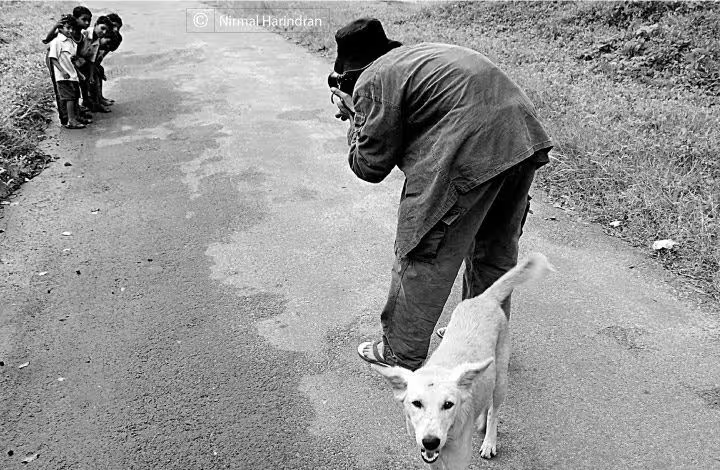
Exposure 1/80sec @ f/5.0 | ISO 400 | Focal Length 18mm
Nirmal Harindran
Hailing from Kannur, Kerala, Nirmal Harindran views photography and travel as an inherent way of life rather than a mere choice. Inspired at sixteen by the work of photojournalist Reza, Harindran transitioned from local studio work to a dedicated career as a freelance travel photographer. He holds an MBA in Human Resources and currently balances his artistic pursuits with academic research into global livelihood patterns, consistently striving to capture the essence of his travel experiences without artifice.
Resonance Score Breakdown
Transparency Note: The resonance score (8.8/20) is calculated based on social engagement metrics collected before the award announcement.
Expert Photography Reviews · 7
The Boundary of the Threshold
Territorial animals often establish a buffer zone, a perimeter where the instinct to protect outweighs the impulse to forage or play. It is a biological line in the sand, invisible to the eye but absolute in its enforcement. We humans are rarely so clear about our own borders.
Read the reflection →The Weight of the Threshold
There is a specific silence that belongs to a gate left unlatched. It is not the silence of peace, but the silence of a boundary being tested.
Read the reflection →Reviews & Comments
Share your thoughts about this award-winning photograph. Your reviews contribute to the community engagement score.

At 18mm, the Nikon’s wide-angle distortion stretches the dog’s snout, pulling the viewer into an uncomfortable, intimate proximity. The f/5.0 aperture keeps the focal plane razor-thin, isolating that piercing, vigilant gaze against the soft, chaotic bokeh of the Parambikulam foliage. It’s a masterclass in optical tension. I’ve spent years studying glass, but the raw, animal intensity captured here—that sudden, visceral feeling of being watched—honestly makes my own pulse quicken. It’s physically, beautifully unsettling.
The tension here is palpable. It’s a standoff, a freeze-frame of pure instinct. That dog isn’t just guarding a path; it’s anchoring the entire frame. I love the way the 18mm lens forces us into the dog’s personal space, making the viewer feel that sudden, sharp intake of breath. The cut would’ve been a mistake. Harindran held the shutter at the exact moment of confrontation. It’s a perfect, unblinking sequence that refuses to move.
1/80sec at f/5.0, 18mm, ISO 400. A Nikon D40 isn’t a precision instrument, yet the shutter speed is just enough to freeze the dog’s posture. At 18mm, the distortion is aggressive, forcing the viewer into the animal’s personal space. It’s a risky focal length that pays off here. I’ve spent years looking at street work, but this tension actually made me flinch. The technical constraints didn’t hinder the narrative; they sharpened the confrontation. Correct choices.
The sun-drenched dust of Parambikulam settles on the dry earth, framing the scene with a raw, tactile stillness. That weathered wooden post isn’t just a prop; it’s the boundary line of a kingdom. When I look at this dog, I don’t just see an animal—I feel that prickle of hesitation in my own chest. The environment demands respect, and this guardian knows it. It’s a brilliant, tense dialogue between the wild and the watchful.
Most street photography is just noise, but this dog’s posture—that rigid, low-slung defiance—stops the viewer cold. It’s not just a standoff; it’s a territorial claim that makes the photographer’s presence feel like an intrusion. I’ve seen thousands of travel shots, yet this one lingers because of that singular, unblinking gaze. It’s rare to feel genuinely unwelcome in a photograph, but here, the dog’s authority is absolute. Thirty years from now, that tension will still be palpable.
The dog isn’t merely guarding a path; it’s anchoring the frame against the encroaching void. Harindran’s shadow doesn’t just fall—it interrogates. I feel a sudden, cold shiver watching that beast hold its ground against the lens. It’s a standoff between the observer and the observed, where the darkness beneath the dog’s belly reveals more than the bright, indifferent trees. It’s not a moment captured; it’s a boundary drawn in light and absolute, unforgiving silence.
The ochre dust of Parambikulam clings to the dog’s coat, a shade reminiscent of Morandi’s muted, earthen pigments, grounding the frame in a stillness that feels almost sacred. It’s the interplay between that sun-scorched gold and the deep, verdant shadows of the forest that truly captures me; I’ve found myself breathless before such quiet, chromatic tension. One senses the heat radiating from the earth, a tactile warmth that makes the animal’s vigilant, amber-eyed gaze feel startlingly, beautifully alive.