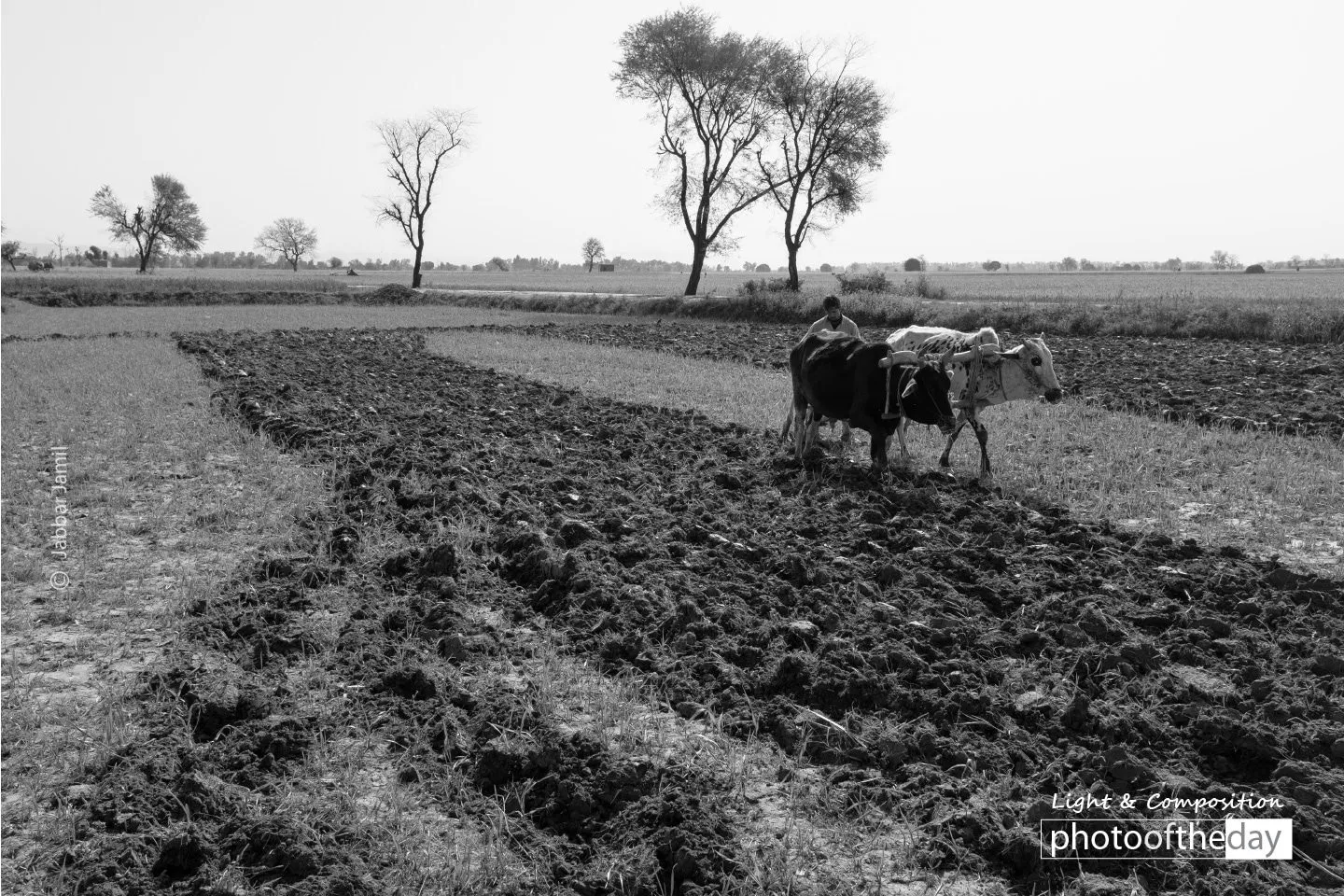
Ploughing by Jabbar Jamil
Captured on a crisp, sunny winter day in a rural village near Sialkot, this image documents the enduring tradition of ox-drawn ploughing. Despite the modernization of agriculture, the photographer highlights a poignant contrast between ancient methods and contemporary life. Navigating the field to find the perfect angle while managing the restless animals, the photographer successfully froze a moment of raw, authentic labor. The resulting composition is award-worthy for its cultural significance and the evocative, timeless quality it brings to a vanishing way of life, masterfully preserved in black and white.
Jabbar Jamil
Based in Sialkot, Pakistan, Jabbar Jamil is a dedicated street photographer who views the medium as a vital bridge between his personal creativity and the wider world. By stepping outside his comfort zone, he captures the unfiltered reality of his surroundings, finding both artistic expression and personal tranquility in the process. His work focuses on the honest, often unvarnished truths of daily life, aiming to forge meaningful connections through the lens that transcend the images themselves.
Resonance Score Breakdown
Transparency Note: The resonance score (11.6/20) is calculated based on social engagement metrics collected before the award announcement.
Expert Photography Reviews · 7
The Earth’s Slow Pulse
There is a quiet, rhythmic theology in the way the soil is turned. It is a conversation between the heavy iron and the sleeping roots, a dialogue of patience that has been spoken since the first seed was pressed into the dark.
Read the reflection →The Weight of the Earth
Seneca once remarked that we are like travelers who, in our haste to reach the end of the road, forget to notice the soil beneath our feet. We live in an age that prizes the swift and the automated, viewing the slow, rhythmic labor of the hands as a relic to be discarded.
Read the reflection →Reviews & Comments
Share your thoughts about this award-winning photograph. Your reviews contribute to the community engagement score.
It’s a scene echoing the agrarian romanticism of P.H. Emerson, yet Jamil’s Sialkot field lacks the soft-focus pictorialism of the Norfolk Broads. The high-contrast rendering of the oxen’s straining muscles against the dust feels strikingly modern, almost brutalist. I’ve spent decades tracking these rural motifs, but the raw, kinetic tension here genuinely quickened my pulse. It’s not just a record of labor; it’s a sharp, rhythmic dialogue between ancient toil and the relentless, unforgiving clarity of digital monochrome.
f/8 at 1/500s, 35mm. A sensible choice. The shutter speed freezes the ox’s gait, preventing motion blur from muddying the texture of the soil. It’s a sharp, clinical capture of labor. I’ve spent years looking at soft, romanticized rural shots, but this one doesn’t lie. The depth of field keeps the foreground and the distant village in focus. It’s technically sound. Honestly, the clarity of that dust cloud actually made me stop and stare.
Dust kicks up, suspended in the light like film grain. The ox muscles strain against the yoke; it’s a rhythm as old as the earth itself. I’ve watched a thousand scenes of labor, but this one hits differently. The shutter caught the exact tension of the pull, a frame the editor keeps because the cut would have been a mistake. It’s raw, kinetic, and perfectly held. I can almost hear the heavy breathing of the beasts.
The dust hangs. It’s a heavy, suspended curtain between the oxen and the edge of the frame. I’ve spent minutes watching that void. It doesn’t feel like an absence. It feels like breath. The animals pull, yet the stillness of the surrounding air holds the weight of the labor. Nothing here is accidental. The empty corner is not empty. It’s where the silence lives. I find myself holding my own breath, waiting for the soil to turn.
The oxen strain against the yoke, but I’m distracted by the photographer’s distance. Why does this frame feel like a museum exhibit rather than a living field? It’s technically sharp, yet it turns a man’s survival into a quaint, aestheticized relic. Does the black and white filter strip away the grit of Sialkot to make it palatable for us? I feel a cold detachment here. Whose tradition are we actually consuming, and at what cost?
Stripped of chromatic vibration, one finds the silvered dust of Sialkot’s fields echoing the monochromatic austerity of a Morandi still life, where the absence of hue forces the eye to dwell upon the tactile weight of light itself. It’s a haunting, rhythmic dance of shadow and soil that makes my heart ache for the lost warmth of the sun, yet the sheer intensity of these greys possesses a quiet, resonant dignity that colour rarely achieves.
Dust kicks up, the oxen strain, and for a heartbeat, time stops in Sialkot. It’s raw. I love the grit here. You can almost smell the earth. Did Jamil nail it? Yes. One tenth of a second later and the tension in those ropes would have gone slack, the frame collapsing into a blur. He caught the exact peak of the pull. It’s honest, it’s fast, and it’s exactly why we keep chasing the light.