Nizami Street by Fidan Nazim Qizi
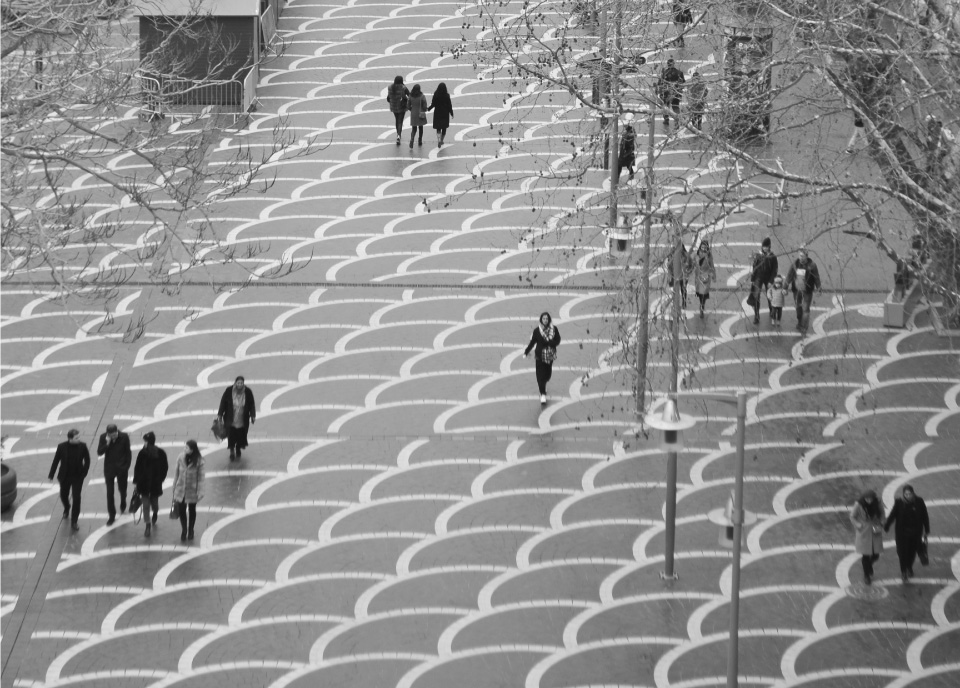
Nizami Street, a bustling artery in the heart of Baku, serves as a vibrant testament to the city's architectural evolution. By capturing this iconic pedestrian thoroughfare, the photographer highlights the seamless synthesis of late 19th-century charm and modern urban development. The image invites viewers to experience the energy of one of the world's most prestigious shopping districts, where history meets contemporary commerce. This photograph is award-worthy for its ability to distill the complex, layered character of Baku into a single, evocative frame, showcasing the street not merely as a location, but as a living narrative of Azerbaijani culture and architectural heritage.
Fidan Nazim Qizi
Born in Baku, Azerbaijan, Fidan Nazim Qizi continues to reside in her home city while frequently traveling to explore global landscapes. Deeply inspired by the evocative black-and-white work of Vivian Maier, she has dedicated her craft to monochrome photography as a primary medium. Her artistic practice is driven by a profound belief in the power of photography to convey energy, emotion, and inspiration. An avid hiker and nature enthusiast, she brings a keen sense of discovery and a refined aesthetic sensibility to her travel photography.
Resonance Score Breakdown
Transparency Note: The resonance score (11.2/20) is calculated based on social engagement metrics collected before the award announcement.
Expert Photography Reviews · 4
The Hum of Pavement
The smell of rain hitting hot stone is a scent that travels deeper than memory. It is the smell of a city exhaling after a long, feverish day.
Read the reflection →The Pedestrian’s Claim
We often mistake the city for its architecture, as if the stone and steel were the primary actors in our urban drama. But a street is not defined by the height of its facades or the prestige of its storefronts; it is defined by the right to linger.
Read the reflection →Reviews & Comments
Share your thoughts about this award-winning photograph. Your reviews contribute to the community engagement score.
Nizami Street echoes the rhythmic urban geometry of Atget’s Paris, yet it’s filtered through a distinctly post-Soviet lens. The interplay of ornate stone facades and modern glass creates a tension I’ve rarely seen handled with such restraint. It’s a delicate dance between heritage and commerce. I’m genuinely struck by how the light catches the pavement; it’s a quiet, sophisticated nod to the early street photographers who understood that a city’s soul hides in its shadows.
Nizami Street is a busy stage, but the people here feel like props. I’m looking for a connection, yet everyone is just passing through, unaware they’re being watched. It’s a clean shot, sure, but it lacks the pulse of a real encounter. I’d trade all this architectural polish for one person who actually looked back at the lens. It’s a shame; this face has a whole life in it, if only someone had stopped to ask.
The vertical axis of the street lamps creates a rigid, rhythmic grid that anchors the frame. I’m struck by the 1:2 ratio between the illuminated storefronts and the receding shadows; it’s a perfectly balanced equation of light. The converging lines of the architecture pull the eye toward a vanishing point that feels mathematically inevitable. It’s a clean, structural triumph. I’ve rarely seen such chaotic urban energy resolved into such precise, satisfying geometric order. It’s simply brilliant.
Nizami Street’s rhythm is lost here. By flattening the facade’s intricate fenestration, the frame ignores the critical threshold between the historic stone and the modern street life. It’s a static view that misses the movement of the city’s pulse. I’d love to see how the light hits those deep, carved cornices, but the composition feels too detached. It’s a shame, really; there’s a genuine, haunting beauty in how Baku’s layers collide that this perspective simply doesn’t capture.