The Cable Bridge by Sanjoy Sengupta
The Cable Bridge captures the architectural grandeur of Vietnam's first central-line cable-stayed bridge during the serene blue hour. By utilizing a long exposure of 25 seconds, the photographer masterfully balances the vibrant city lights against the darkening silhouette of the structure and the expansive backdrop of Halong Bay. This technical precision creates a smooth, ethereal quality in the water and sky, emphasizing the bridge's imposing scale. The image is award-worthy for its sophisticated composition and the evocative way it transforms a modern engineering marvel into a tranquil, atmospheric landscape that highlights the harmonious intersection of urban development and natural beauty.
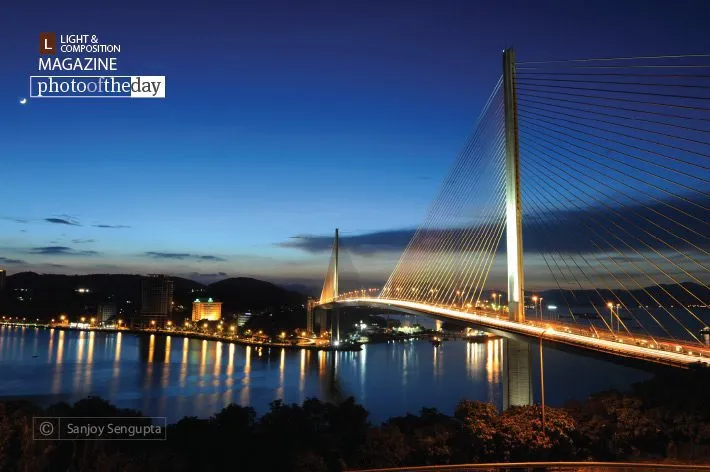
Exposure 25sec @ f/13 | ISO 100 | Focal Length 24mm
Sanjoy Sengupta
Based in Muscat, Oman, Sanjoy Sengupta is a dedicated photographer whose creative journey spans from early film experimentation to the mastery of modern digital systems. His evolution as an artist is defined by a persistent curiosity and a commitment to capturing life's fleeting, cherished moments with technical precision. Through his transition into professional-grade Nikon DSLR equipment, Sengupta has refined his ability to interpret light and landscape, consistently producing evocative imagery that resonates with audiences across international photography platforms.
Resonance Score Breakdown
Transparency Note: The resonance score (12.9/20) is calculated based on social engagement metrics collected before the award announcement.
Expert Photography Reviews · 5
The Architecture of Silence
We are taught that bridges are meant to carry us from one solid point to another, as if the earth were a series of islands and we were merely travelers seeking a firmer footing. But there is a deeper, quieter purpose to these spans.
Read the reflection →The Weight of the Night
I remember sitting on a rusted ferry crossing the Mekong, watching the lights of a distant town bleed into the black water. An old man sat beside me, his hands calloused from years of hauling nets, and he pointed toward the horizon.
Read the reflection →Reviews & Comments
Share your thoughts about this award-winning photograph. Your reviews contribute to the community engagement score.
At f/13, the diffraction limit begins to soften the finest structural edges, yet it’s exactly what renders those light trails into such creamy, viscous ribbons. The 24mm focal plane captures the bridge’s geometry with clinical sharpness, while the long exposure integrates the water’s micro-reflections into a singular, velvet plane. I’m genuinely moved by how the sensor resolves the blue hour’s subtle spectral shift. It’s a rare, quiet intersection where engineering meets the physics of pure light.
We look at this bridge and we don’t see steel; we see a conversation between the city and the tide. Sanjoy listened to the silence of Halong Bay before he opened his shutter for those twenty-five seconds. It’s a portrait of a structure finding its place in the dark. I feel a strange, quiet loneliness looking at those lights reflecting on the water. It’s a photograph that asks to be returned to, again and again.
Before the eye identifies the bridge, a sudden stillness settles in the chest. The long exposure turns the water into a dark, velvet void, pulling my pulse down to match the rhythm of the tide. It’s the blue hour’s specific melancholy—that quiet ache of transition. I’ve returned to this frame a dozen times, and each time, the bridge’s glowing cables feel like a tether holding the night together, keeping my own restlessness at bay.
25 seconds at f/13, ISO 100, 24mm. It’s a calculated risk that pays off. The aperture choice forces a diffraction limit I’d usually despise, yet here, it renders the bridge’s cables with clinical, razor-sharp precision. The long exposure flattens the water into a dead-calm surface, stripping away the bay’s chaotic texture. It’s cold, calculated, and technically sound. I’m actually impressed by the restraint shown here. It doesn’t try to be art; it just functions perfectly.
The bridge’s geometry dictates the frame, anchoring the composition against the void of the bay. It’s a rigid, calculated intersection. The long exposure flattens the water, creating a necessary stillness that offsets the cables’ aggressive diagonals. I’m genuinely unsettled by how the structure dominates the horizon; it doesn’t leave room for the sky to breathe. The tension holds, but it’s a cold, clinical victory. The architecture wins. It’s a precise, if somewhat suffocating, spatial arrangement.