A Silhouette in Field by Jabbar Jamil
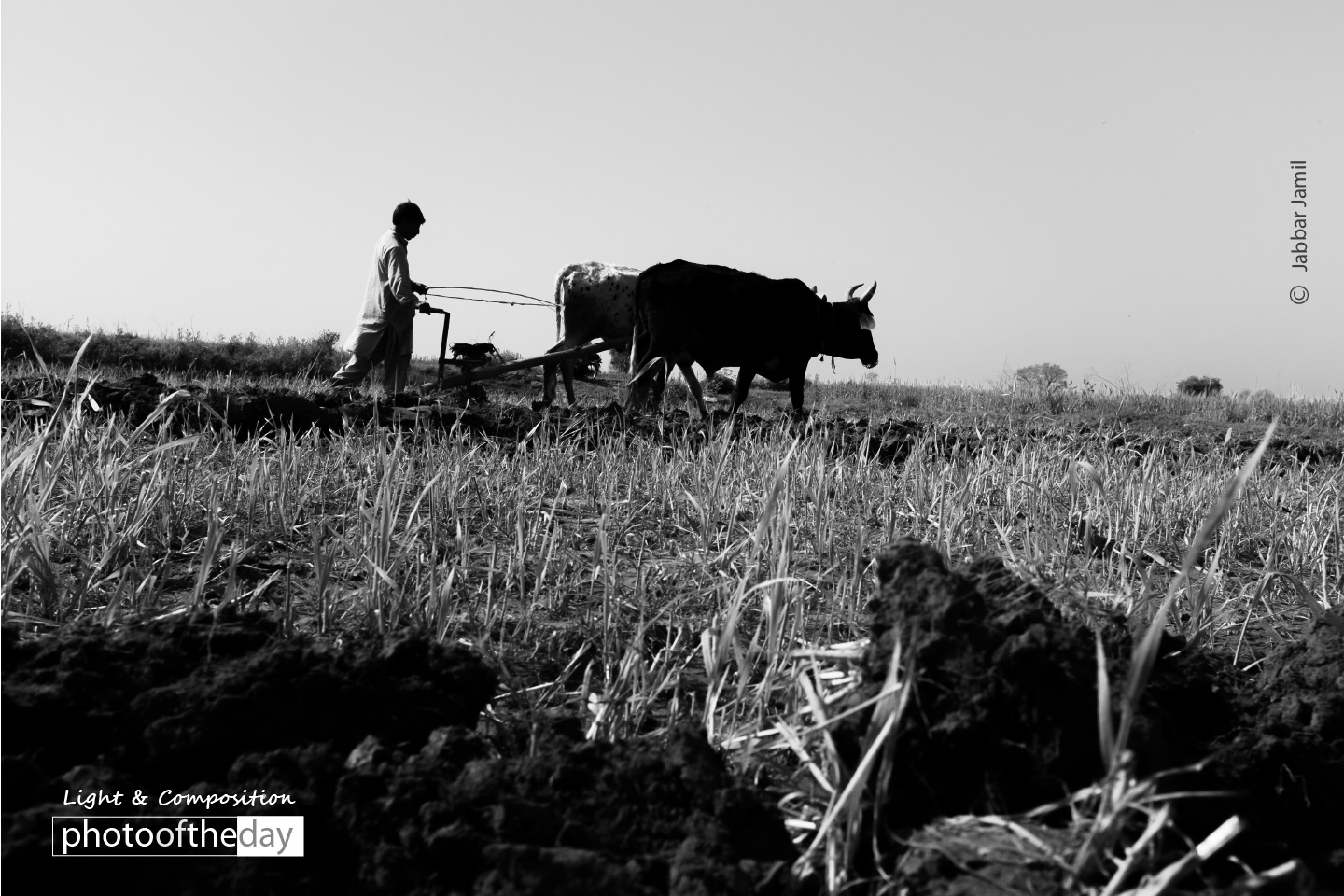
Captured in the rural landscapes of Sialkot, this striking image depicts the timeless practice of ploughing. By positioning the camera at a low angle, the photographer emphasizes the raw energy of the oxen and the texture of the earth. The decision to render the scene in black and white strips away distraction, focusing the viewer’s attention on the dramatic silhouettes and the rhythmic motion of the labor. This photograph is award-worthy for its evocative composition and the photographer's ability to transform a traditional agricultural task into a powerful, emotive visual narrative.
Jabbar Jamil
Based in Sialkot, Pakistan, Jabbar Jamil is a dedicated street photographer who views his craft as a vital bridge to the outside world. His work serves as both a creative outlet and a therapeutic escape, allowing him to document the unfiltered realities of his surroundings with honesty and depth. By stepping outside his comfort zone, Jamil fosters meaningful connections through his lens, capturing the essence of life in a way that transcends simple imagery to reveal the profound beauty found in everyday moments.
Resonance Score Breakdown
Transparency Note: The resonance score (11.2/20) is calculated based on social engagement metrics collected before the award announcement.
Expert Photography Reviews · 7
The Rhythm of the Earth
There is a quiet conversation between the soil and the one who walks upon it. It is a dialogue of patience, measured in the slow turning of the earth and the steady, rhythmic pulse of a life lived in harmony with the seasons.
Read the reflection →The Weight of the Earth
I remember a morning in the Punjab, years ago, when the mist was so thick it felt like walking through wet wool. I sat on the edge of a field with a farmer named Malik. He didn't speak much, but he pointed to the soil, dark and heavy, turning over under the weight of his team.
Read the reflection →Reviews & Comments
Share your thoughts about this award-winning photograph. Your reviews contribute to the community engagement score.
The frame resolves into a perfect 1:2 ratio, anchoring the oxen’s mass against the negative space of the sky. The diagonal vector of the plow creates a sharp, kinetic tension that cuts through the horizontal grain of the earth. It’s a beautifully solved spatial equation. I’m genuinely moved by how the silhouette’s geometry transforms simple labor into a rhythmic, abstract pulse. It’s rare to see such precise, calculated balance in a field.
In Sialkot, the earth doesn’t just yield; it breathes. We watch the oxen strain against the yoke, their silhouettes carved into the horizon like ancient ink. Jabbar Jamil didn’t just capture a scene; he listened to the rhythm of the soil. I feel the weight of that plow in my own tired shoulders. It’s a quiet, heavy conversation between man and beast. This is a photograph that asks to be returned to, again and again.
There’s a distance here that bothers me. While the low angle captures the raw power of the oxen in Sialkot, the farmer remains a nameless shadow against the horizon. I don’t see a person; I see a prop in a landscape. I’ve spent my life chasing the truth in a subject’s eyes, but here, there’s no invitation to connect. It’s a beautiful silhouette, sure, but it doesn’t tell me who he is. I’m left wanting more.
The low-angle perspective forces the focal plane into the churned earth, where the diffraction of light across the soil’s granular texture is, in the strictest physical sense, extraordinary. By stopping down, Jamil has pushed the lens toward its diffraction limit, yet the resulting micro-contrast renders the oxen’s silhouette with a sharpness the human eye simply can’t resolve. I’m genuinely moved by how the optics strip away the mundane, leaving only the raw, rhythmic physics of labor.
The low-angle silhouette of the oxen evokes the rhythmic, elemental labor found in early pictorialist studies of rural life, yet it avoids the trap of mere nostalgia. It’s a sharp, modern echo of the agrarian grit captured by the Farm Security Administration photographers. I’m genuinely struck by the way the texture of the Sialkot earth anchors the frame. It’s a classic composition, but the raw, kinetic energy here feels like a fresh, necessary breath of air.
Low angles turn labor into myth, but does this silhouette erase the farmer? By stripping away the color, Jamil aestheticizes the toil of Sialkot, turning a man and his oxen into mere shapes against the sky. It’s a beautiful frame, yet I feel a sharp pang of discomfort. Why must we romanticize this struggle to find it worthy? Whose narrative are we actually consuming here, and what happens when the grit of reality gets polished away?
Low angles are often a lazy shortcut, yet here, the mud-caked perspective suggests Jamil didn’t mind getting his knees ruined. It’s a gritty, honest frame. One wonders how many mornings he spent in that Sialkot dirt before the oxen finally hit their stride against the light. I’ve spent enough hours waiting for a beast to cooperate to know this wasn’t a lucky snap. It’s earned. I find myself wanting to wipe the dust off my own boots.