Masai’s Handicraft by Ryszard Wierzbicki
Captured during a journey through the Serengeti in September 2011, this image documents the vibrant cultural intersection between local tradition and tourism. The photographer focused on a collection of handcrafted goods displayed prominently before a traditional Masai hut, using the natural light to highlight the intricate textures and colors of the wares. By framing these objects against the rustic backdrop of the village, the image offers a poignant look at the daily commerce and artistic heritage of the Masai people. The photograph is award-worthy for its authentic storytelling and its ability to transform a simple market scene into a compelling cultural narrative.
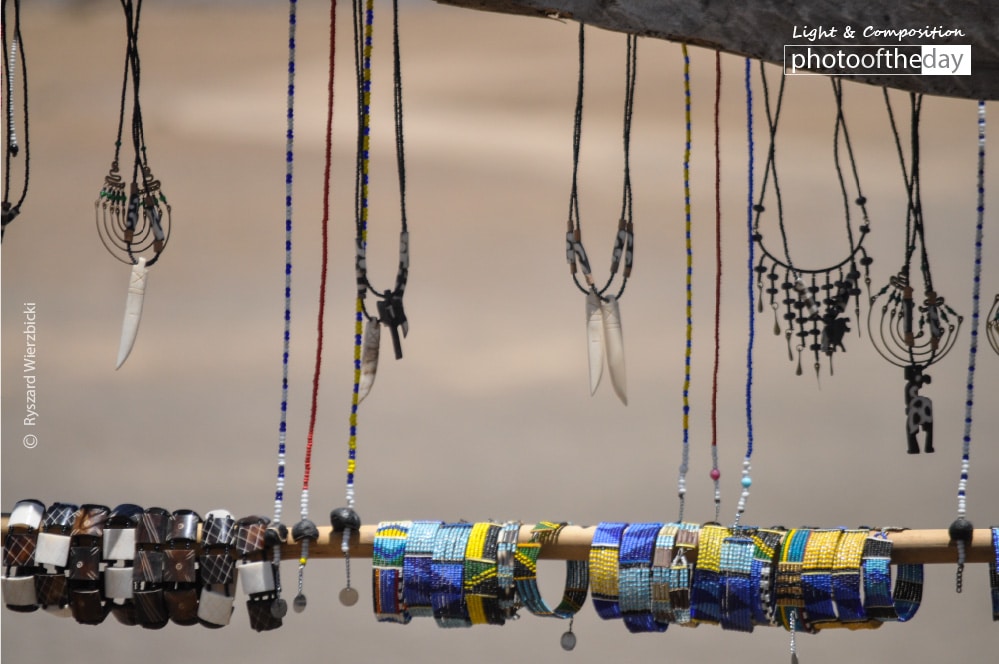
Exposure 1/500sec @ f/11 | ISO 200 | Focal Length 85mm
Ryszard Wierzbicki
Born in Poland in 1963, Ryszard Wierzbicki is a dedicated traveler and photographer currently based in Swindon, United Kingdom. After a diverse professional career in education and marketing, he transitioned into a life of exploration, focusing his lens on the diverse cultures of South-East Asia and beyond. A passionate scuba diving instructor and humanitarian volunteer, Wierzbicki channels his worldly experiences into his photography, seeking to document the human spirit through his travel-focused projects and online communities for fellow explorers.
Resonance Score Breakdown
Transparency Note: The resonance score (12.9/20) is calculated based on social engagement metrics collected before the award announcement.
Expert Photography Reviews · 7
The Weave of Memory
We are all collectors of small, tangible histories. We gather the threads of where we have been, knotting them into patterns that hold the heat of the sun and the dust of the road.
Read the reflection →The Currency of Culture
We often mistake the marketplace for a neutral zone, a simple stage where goods are exchanged for coin. But every market is a social document, a map of power and necessity. When traditional crafts are laid out for the passing stranger, the geography of the space shifts.
Read the reflection →Reviews & Comments
Share your thoughts about this award-winning photograph. Your reviews contribute to the community engagement score.
The beads rest against the mud wall. They don’t clamor for attention. I’ve spent minutes watching the light settle on the clay. It’s quiet here. The frame isn’t crowded by the commerce, but defined by the stillness surrounding the craft. Nothing here is accidental. The empty corner is not empty. It holds the heat of the Serengeti. I feel a sudden, sharp ache for that silence. It’s a rare, honest pause.
It’s a familiar ethnographic trope, echoing the colonial gaze of early twentieth-century travelogues, yet Wierzbicki’s framing avoids the usual sentimentality. The textures of the beadwork, rendered with the sharp, clinical precision of the D5000, remind me of Walker Evans’s focus on the vernacular object. I’m genuinely struck by the way the hut’s mud-caked geometry anchors the frame. It’s not revolutionary, but it’s a crisp, honest dialogue between ancestral craft and the encroaching modern marketplace.
The ochre of the sun-baked earth, reminiscent of a Morandi still life, anchors these beaded treasures in a dusty, golden heat that makes my own skin ache for the Serengeti’s dry wind. It’s a chromatic dialogue where the vibrant, primary-hued glass beads quarrel beautifully against the muted, parched backdrop of the hut, creating a tension that feels less like commerce and more like a fever dream of light caught in the high, unforgiving Tanzanian sun.
At f/11, the diffraction limit begins to soften the micro-contrast, yet the 85mm focal length renders these beads with startling clarity. I’m genuinely moved by how the light catches the uneven glass surfaces; it’s a tactile revelation the naked eye would surely miss. While the depth of field is generous, the lens’s resolution doesn’t quite resolve the finest fibers of the weave. It’s a beautiful, honest look at optics meeting the raw, dusty Serengeti sun.
Most travel photography is disposable, but this holds up. Of the thousands of market scenes I’ve reviewed, this avoids the usual tourist trap aesthetic because Wierzbicki didn’t focus on the people; he focused on the goods. The way the beads catch the harsh Serengeti sun against that mud-walled hut creates a tension between survival and art. It’s haunting. I’d hang this in my own home because it captures a vanishing reality that’ll matter in thirty years.
Beaded necklaces drape over mud walls, but where are the hands that made them? Wierzbicki frames these goods as static artifacts, stripping the Masai of their agency. It’s a sterile transaction. I feel a sharp, cold discomfort looking at this. Why does the photographer prioritize the commodity over the human presence? Does this composition serve the culture, or does it simply package a Serengeti souvenir for our consumption? It’s a hollow gaze, ignoring the people behind the craft.
The vibrant beads scream for attention, yet they’re hollow. Wierzbicki captures the commerce, but he’s missed the silence behind the hut. It’s a bright, shallow surface. I’ve spent hours staring at these textures, hoping for a flicker of the profound, but the shadows here don’t think; they merely hide. It’s a tragedy of light. When you refuse to let the darkness speak, you’re left with nothing but the dust of a souvenir shop.