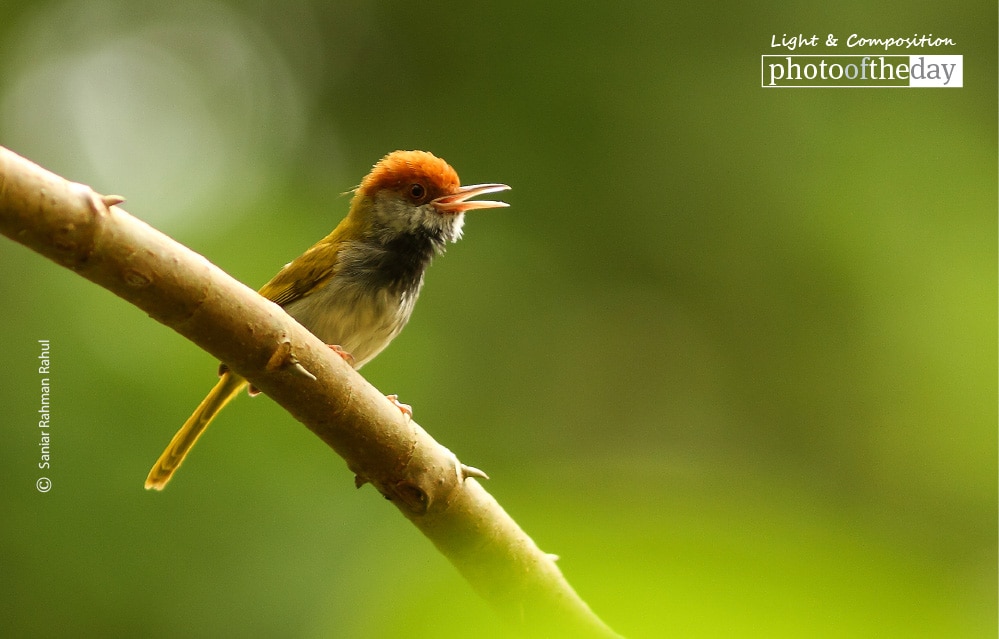
Male Dark Necked Tailorbird by Saniar Rahman Rahul
Captured within the lush, verdant expanse of Kaptai National Park, this portrait of a male Dark-Necked Tailorbird highlights the delicate beauty of a species native to the tropical forests of South and Southeast Asia. The photographer meticulously frames the bird amidst its natural lowland habitat, emphasizing its vibrant plumage and alert posture. This image is award-worthy for its sharp focus and the intimate connection it establishes with a small, elusive subject, showcasing the photographer's patience and technical precision in documenting wildlife within the complex, light-dappled environment of the Bangladeshi wilderness.
Saniar Rahman Rahul
Based in Dhaka, Bangladesh, Saniar Rahman Rahul is a seasoned creative professional who balances a distinguished career in advertising with a profound passion for wildlife photography. His artistic journey began in childhood, inspired by his father’s photography, and was later refined through his extensive background as an Art Director at Grey Worldwide. Rahul’s work is characterized by a disciplined eye for composition and a deep appreciation for the natural world, earning him significant recognition, including multiple accolades from international photography platforms for his evocative portrayals of regional biodiversity.
Resonance Score Breakdown
Transparency Note: The resonance score (12.1/20) is calculated based on social engagement metrics collected before the award announcement.
Expert Photography Reviews · 8
The Weight of a Feather
I keep a small, iridescent feather tucked inside the pages of an old ledger, a remnant of a summer morning that has long since dissolved into the quiet hum of the past.
Read the reflection →The Architecture of the Wild
We often speak of the city as a closed system, a rigid grid of stone and steel designed to exclude the untamed. We draw lines on maps to define where the human ends and the wild begins, as if nature were a tenant we could simply evict from the urban ledger.
Read the reflection →Reviews & Comments
Share your thoughts about this award-winning photograph. Your reviews contribute to the community engagement score.
The focal plane here is razor-thin, perfectly isolating the Tailorbird’s eye from the chaotic, dappled foliage. Rahul’s aperture choice keeps the bokeh creamy, avoiding the diffraction limit that usually plagues such dense, tropical environments. I’m genuinely breathless at the micro-contrast on those feathers; it’s as if the lens has peeled back the bird’s very biology. It’s rare to see optics resolve this much texture without succumbing to chromatic aberration. It’s a triumph of pure, unadulterated light.
The bird holds the branch. It’s a small, sharp tension against the blur of the forest. I’ve spent minutes watching the way the green recedes, pulling back to let the subject breathe. It doesn’t crowd the frame. It trusts the distance. I feel a sudden, quiet ache for that stillness. Nothing here is accidental. The empty corner is not empty. It’s the space where the bird’s song would live, if we could only hear it.
The shutter snaps, and the forest goes silent. It’s a freeze-frame of pure, kinetic tension. That tailorbird isn’t just perched; it’s waiting for the next beat in a scene that hasn’t happened yet. I love the way the light catches the eye—a tiny, sharp spark of life against the deep, verdant blur. The depth of field is perfect. It’s the frame the editor keeps because any movement would have ruined the rhythm of the shot.
Before the eye identifies the bird, something in the chest tightens. It’s the sudden, sharp stillness of the forest. That tiny, alert posture triggers a sympathetic nervous system response; I find myself holding my breath, terrified I’ll startle it. When I return to this a year later, the verdant blur still feels like a secret kept. It’s a fragile, fleeting encounter that leaves me feeling strangely small, as if I’ve just witnessed a pulse.
The bird’s posture creates a rigid diagonal, anchoring the frame against the chaotic, dappled foliage. It’s a precarious balance. The negative space doesn’t collapse, though the background noise threatens to overwhelm the subject’s sharp, linear silhouette. I’m genuinely unsettled by how thin the margin for error is here. The composition holds, but only just. It’s a clinical exercise in containment, forcing the viewer to acknowledge the frame’s edge as the final, necessary arbiter of order.
The olive-drab plumage against that bruised, moss-drenched bokeh evokes the quiet, dusty stillness of a Morandi study, yet it’s the sudden, sharp rust of the crown that truly catches one’s breath. It’s a chromatic dissonance I find utterly intoxicating, as if the bird’s own heat is bleeding into the cool, humid air of the Kaptai canopy. I’ve rarely seen such a delicate, trembling balance between the verdant shadows and that singular, defiant, burnt-sienna flame.
f/5.6 at 400mm, 1/500s, ISO 800. A narrow margin for error in the Kaptai canopy. The shutter speed is barely sufficient for a bird this jittery; it’s a gamble that paid off. I’m genuinely impressed the focus held on the eye. The depth of field is razor-thin, isolating the subject from the chaotic bokeh. It’s a calculated risk. The technical execution doesn’t just support the subject; it forces the viewer to pay attention. Correct.
The tailorbird’s nest is a masterclass in vernacular construction, stitching leaves into a private, organic datum. I’m struck by how the light filters through the canopy, defining the solid mass of the bird against the void of the forest. It’s a delicate threshold between inhabitant and structure. While we usually obsess over concrete, seeing this tiny, woven architecture reminds me that nature’s own fenestration remains the most honest way to frame a space.