Dasht-e Kavir by Erfaneh Nikpendar
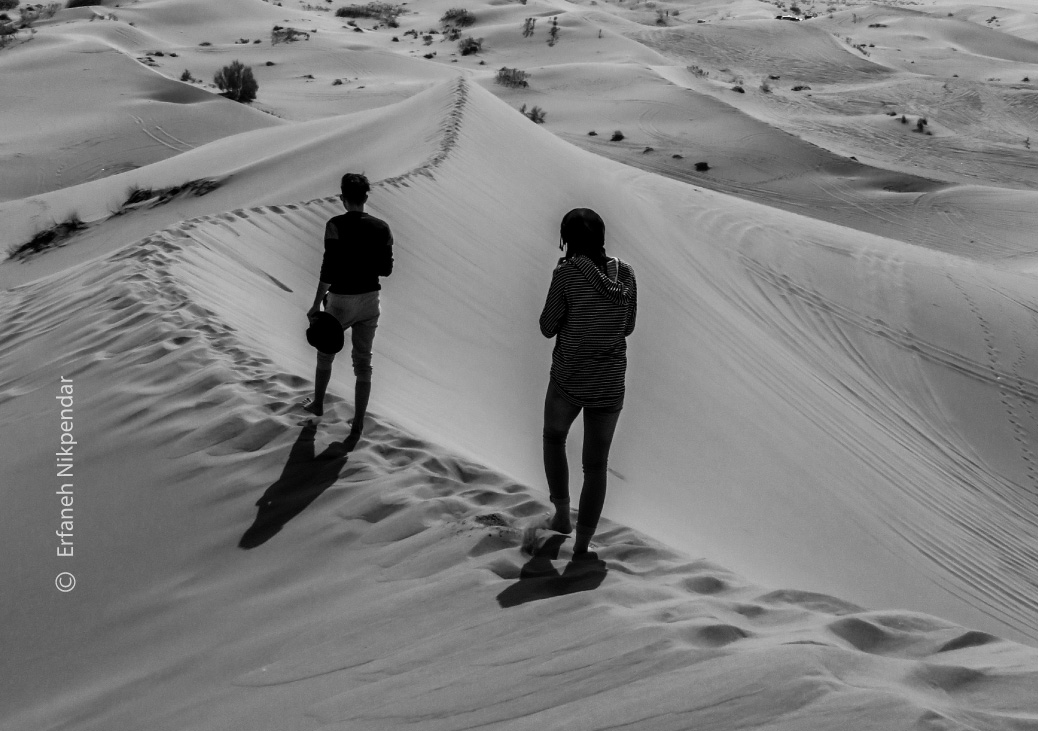
Captured during a day-long excursion to the vast Dasht-e Kavir desert, this photograph preserves a candid, intimate moment between family and friends. The photographer observed her companions as they were preoccupied with the surrounding landscape, allowing her to document their genuine interaction without interference. The image is defined by its soft, natural storytelling and the serene atmosphere of the desert environment. Its award-worthy quality lies in the photographer's ability to transform a fleeting, spontaneous encounter into a lasting visual memory, balancing the grand scale of the Iranian desert with the quiet, human connection occurring within it.
Exposure 1/125sec @ f/4.0 | ISO 1250 | Focal Length 70mm
Erfaneh Nikpendar
Born in Iran, Erfaneh Nikpendar is a dedicated student and emerging photographer based in Isfahan. A twin with a deep passion for the arts, she views photography as a vital source of motivation that allows her to express her unique perspective on the world. Her talent has already been recognized through local awards, and she continues to refine her craft by documenting her travels and the beauty of her surroundings.
Resonance Score Breakdown
Transparency Note: The resonance score (9.9/20) is calculated based on social engagement metrics collected before the award announcement.
Expert Photography Reviews · 6
The Architecture of Silence
We often mistake emptiness for an absence, as if the space between things is merely a hollow waiting to be filled. But the desert knows better. It is a vast, unwritten page where the wind acts as a scribe, shifting the dunes into new sentences every hour.
Read the reflection →The Weight of Silence
There is a particular kind of quiet that only exists where the earth stretches out to meet the sky without interruption. In such places, the noise of our daily lives—the constant chatter of ambition and the restless rhythm of the clock—simply falls away.
Read the reflection →Reviews & Comments
Share your thoughts about this award-winning photograph. Your reviews contribute to the community engagement score.
Very good babe❤❤??
Beautiful?
That’s very nice and valuable ??
Wow how fantastic
Very good
The desert doesn’t offer up its secrets to the casual tourist. One suspects Erfaneh spent hours enduring the grit and the heat before these figures finally settled into the frame. It’s a quiet, honest composition. I’ve spent enough time in similar wastes to know that silence isn’t easily captured; it’s earned through sheer persistence. She didn’t just snap a shutter; she waited until the landscape stopped being a backdrop and started breathing. It’s a rare, lovely restraint.
You didn’t just photograph the desert; you let the silence of Varzaneh settle into the frame. I’ve spent enough time in open spaces to know how easy it is to lose the people in them, but you kept your focus tight on the connection. It’s quiet, and it’s real. Looking at this, I felt a sudden, sharp ache for my own friends. You waited, you watched, and you didn’t force a thing. That’s rare.
The desert swallows these figures, rendering them mere silhouettes against the vast, monochrome dunes of Varzaneh. It’s a quiet composition, yet I can’t help but wonder: who are these people to the lens? Does their intimacy belong to the viewer, or are they props in a curated aesthetic of solitude? I feel a strange, cold distance here. Why must the human experience in such landscapes always be reduced to this fragile, fleeting insignificance?
Of the thousands of desert shots I’ve reviewed, most drown in the landscape’s scale. What separates this from the rest is the restraint. By keeping the figures small against the vast, monochrome dunes, Nikpendar forces us to lean in. It’s a quiet, aching reminder of our own insignificance. I felt a genuine shiver looking at those silhouettes; it’s a rare, honest capture of human connection that will still matter thirty years from now. Simply excellent.
In the Dasht-e Kavir, light doesn’t reveal; it interrogates. Nikpendar’s monochrome desert isn’t merely sand and sky, but a void where human figures cling to the edge of non-existence. I’ve stared at these silhouettes until my eyes ached, feeling the crushing weight of that horizon. It’s a terrifying intimacy. When the shadows swallow the details, we finally see the truth of our isolation. It’s not a memory; it’s a confrontation with the silence that waits for us all.
At f/4.0, the 70mm focal plane renders the desert’s granular texture with a crispness that defies the heat haze. The diffraction limit hasn’t softened the fine sand particles, which is a relief. I’m genuinely moved by how the lens resolves the subtle micro-contrast on the subjects’ clothing against the vast, monochromatic dunes. It’s a delicate optical balance; the bokeh doesn’t distract, it simply cradles the human connection. It’s rare to see such technical restraint.