Pied King – in the Hunt by Nirupam Roy
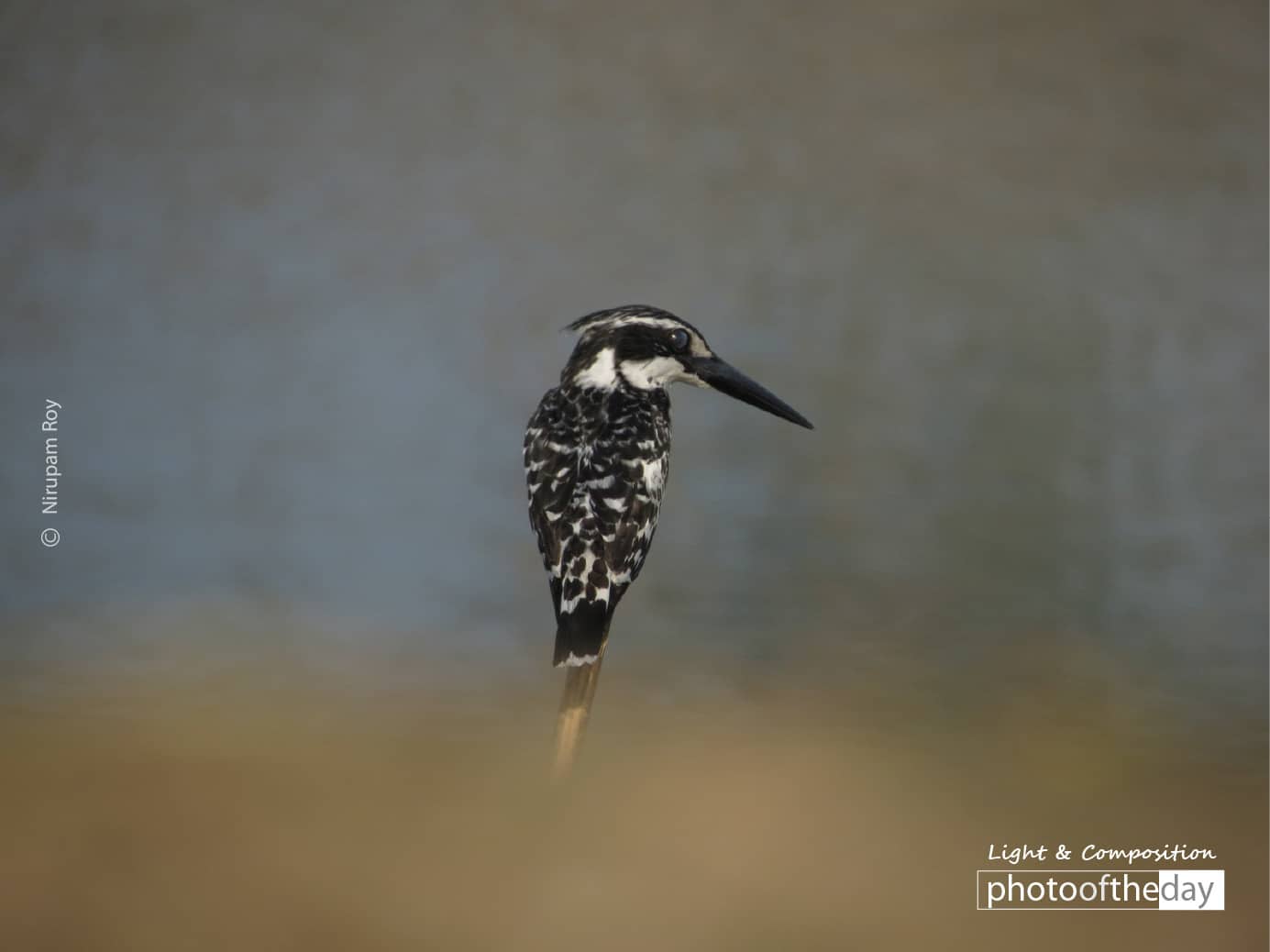
Captured in a secret location, this striking image of a Pied Kingfisher showcases the bird in a moment of intense focus. The photographer patiently observed the kingfisher as it perched, waiting for the perfect opportunity to strike. The bird’s sharp, alert eye—a telltale sign of its readiness to dive—is rendered with remarkable clarity. This photograph is award-worthy for its ability to transform a fleeting, quiet moment into a compelling wildlife portrait, highlighting the tension and precision inherent in the kingfisher's hunting behavior while maintaining a beautiful, natural composition.
Nirupam Roy
Based in Tufanganj, West Bengal, Nirupam Roy is a dedicated school teacher whose passion for photography was ignited during a family trip to the coast of Odisha. What began as a desire to document family memories and scenic landscapes evolved into a profound artistic pursuit that has transformed his perspective on nature and humanity. Through his lens, Roy finds a sense of peace and spiritual connection, capturing the intricate details of the natural world with a keen and observant eye.
Resonance Score Breakdown
Transparency Note: The resonance score (12.9/20) is calculated based on social engagement metrics collected before the award announcement.
Expert Photography Reviews · 8
The Sharpness of Stillness
There is a specific kind of silence that tastes like cold metal—the metallic tang of a held breath before a plunge. I remember standing by the riverbank as a child, the damp moss clinging to the soles of my feet, my skin prickling with the humidity of the coming rain.
Read the reflection →The Weight of the Wait
I keep a small, silver thimble in my desk drawer that belonged to my grandmother. It is dented on one side, a tiny scar from years of pushing needles through heavy wool.
Read the reflection →Reviews & Comments
Share your thoughts about this award-winning photograph. Your reviews contribute to the community engagement score.
The shutter snaps, and the world freezes. That eye—it’s a lens within a lens, locked on a target we can’t see. It’s the tension before the dive, the frame an editor keeps because the motion is implied in the stillness. I’ve spent hours in edit suites chasing this exact rhythm. Roy didn’t just catch a bird; he caught the intent. It’s a perfect, silent cut. I’d give anything to see what happens next.
One suspects the damp in Coochbehar is as unforgiving as the kingfisher’s gaze. It’s a sharp, hungry eye, isn’t it? I’ve spent enough mornings shivering in reeds to know that stillness isn’t merely a lack of movement; it’s a tax paid in patience. Roy clearly didn’t just stumble upon this. He sat, he waited, and he likely got quite miserable doing it. That’s the price of admission. It’s a fine, earned bit of work.
We look at this Pied Kingfisher and we aren’t just seeing a bird; we’re meeting a hunter. It’s waiting, breath held, eyes locked on a ripple beneath the surface. I’ve spent my life listening to stories, and here, the silence is deafening. Nirupam Roy didn’t just snap a shutter; he sat in the tall grass until the bird forgot he was there. It’s a portrait of pure, trembling intent. I find myself holding my own breath.
The bird waits. A sliver of branch. The rest is just air and stillness. I’ve spent minutes looking at the space around the kingfisher. It’s heavy. It’s quiet. The eye doesn’t blink. It’s a sharp, cold point in a vast, grey void. I feel a sudden, sharp ache in my own chest, watching it hold its breath. Nothing here is accidental. The empty corner is not empty. It’s the weight of the hunt.
The palette here evokes a Morandi-esque stillness, where the kingfisher’s stark, monochromatic plumage cuts through the murky, olive-drab water like a shard of porcelain. It’s a quiet, chromatic tension that I find deeply moving; the way the bird’s obsidian eye anchors the desaturated greens of the Coochbehar marsh feels almost painterly. One can’t help but admire how the light, soft as a Vermeer interior, elevates this hunt into a sublime, suspended meditation on predatory grace.
The air in Coochbehar holds a heavy, expectant silence. I’ve felt that stillness myself, where the world narrows down to a single, sharp gaze. The light here isn’t just illumination; it’s a participant in the hunt. He stood there for hours, I’m sure, waiting for the kingfisher to decide the water was ready. It’s a quiet, piercing tension. Looking at that eye, I feel a sudden, sharp ache for the patience we’ve all forgotten.
The kingfisher perches on a weathered branch, a jagged datum line against the soft, out-of-focus void. It’s a study in tension, where the bird’s rigid posture mimics the structural integrity of a cantilever. I’m struck by how the light catches the plumage, defining mass against the atmospheric depth. It’s a quiet, spatial geometry. While I usually crave the human element, there’s an undeniable, sharp precision here that makes me hold my own breath.
1/400sec at f/8, ISO 100, 150mm. It’s a conservative, clinical choice. At f/8, the D5000’s sensor captures the plumage’s texture without the softness of wide-open glass. The shutter speed is barely enough to freeze a kingfisher’s twitchy anatomy, yet it holds. I’ve spent hours in blinds waiting for this exact stillness; it’s frustratingly rare. The technical execution is precise, even if the focal length feels a bit distant. It’s a correct, disciplined capture.
Thanks L&C for the precious space.