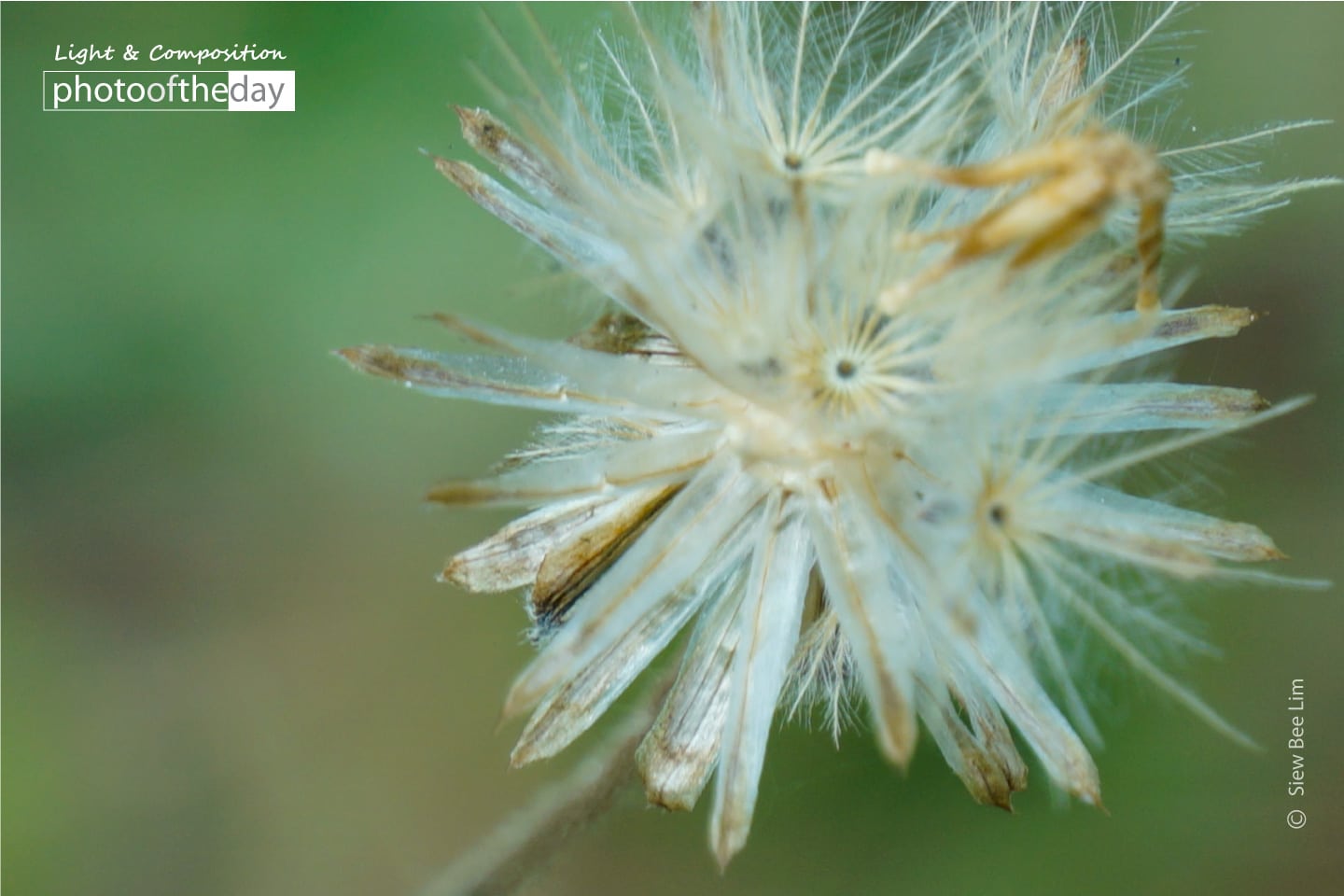
A Little Flower Stalk by Siew Bee Lim
Captured on a breezy September morning at the Chinese and Japanese Gardens, this image highlights the delicate beauty of a wild flower stalk. The photographer opted for an aerial perspective, meticulously timing the shot to isolate the subject despite the constant movement caused by the wind. This close-up study transforms a humble piece of wild grass into a striking botanical portrait. The photograph is award-worthy for its precise composition and the photographer's ability to find elegance in a fleeting, natural moment, demonstrating a keen eye for detail amidst the challenging, shifting conditions of the park.
Siew Bee Lim
Born in Singapore in 1965, Siew Bee Lim is a dedicated photographer who rediscovered her passion for the lens later in life. Though she spent her professional career as a programmer, she has long nurtured an appreciation for the arts, particularly Chinese painting. After an early introduction to darkroom techniques during her youth, she has returned to photography with renewed focus, currently refining her technical and creative skills through the Light & Composition platform to capture the subtle beauty of the natural world.
Resonance Score Breakdown
Transparency Note: The resonance score (11.7/20) is calculated based on social engagement metrics collected before the award announcement.
Expert Photography Reviews · 8
The Quietest Things
I spent twenty minutes this morning trying to pull a stubborn weed from the cracks in my patio. I was frustrated, yanking at the leaves, wanting the space to be clean and empty. But then I stopped.
Read the reflection →The Unplanned Margin
In the rigid geometry of our modern cities, we often mistake the manicured for the meaningful. We pave, we prune, and we designate zones for leisure, assuming that nature must be curated to be acceptable.
Read the reflection →Reviews & Comments
Share your thoughts about this award-winning photograph. Your reviews contribute to the community engagement score.
Most macro work feels clinical, but this stalk breathes. I’ve seen thousands of floral studies, yet this one lingers because of the deliberate, precarious tension between the sharp focus and the blurred, restless background. It’s a quiet victory over the wind. I honestly felt a sense of relief looking at it; it’s a reminder that stillness exists if you’re patient enough to wait for it. In thirty years, this simplicity will still feel entirely necessary.
Wind is the enemy of the macro lens, yet here it’s been tamed. One suspects Siew Bee Lim spent a miserable morning hunched over this stalk, waiting for the breeze to surrender. It’s a quiet, disciplined bit of work. I’ve spent enough hours shivering in damp grass to appreciate the stillness she’s wrestled from that garden. It isn’t a lucky snap; it’s a photograph that’s been properly earned through sheer, stubborn persistence. A respectable result.
You waited for the wind to die, didn’t you? I’ve spent enough mornings in the field to know that kind of patience. It’s not just about the flower; it’s about the stillness you found in a restless garden. When I look at this, I don’t see a botanical study. I see a quiet breath held in the middle of a busy day. You caught a moment of grace. That’s a rare, honest thing.
Before the eye identifies the stalk, a sudden stillness settles in the chest. It’s a quiet, rhythmic suspension. I find my own breath mimicking the breeze Siew Bee Lim captured, that fragile oscillation between movement and poise. When I return to this, I don’t see a flower; I feel the ache of something small holding its ground against the wind. It’s a sharp, lonely grace that follows me into the quiet hours of the night.
There’s a quiet dignity in how this stalk holds its ground against the wind. It’s a botanical portrait, sure, but I find myself looking for the pulse of the thing. It doesn’t have the gaze of a human subject, yet it feels intentional, almost defiant. I’ve spent years chasing faces, but this little flower makes me stop. It’s a fleeting life, captured with a patience that’s rare. It’s beautiful, really. It feels like a secret shared.
Isolation is a choice, not a discovery. By stripping this stalk from the Chinese and Japanese Gardens, Lim renders the environment invisible. Is the landscape merely a backdrop for our aesthetic consumption? I find the clinical detachment here unsettling. Why must we sanitize nature to find it beautiful? It’s technically precise, sure, but it feels like a colonial specimen pinned to a board. Does the flower lose its soul when we refuse to see its home?
The pale, desaturated chartreuse of this stalk, reminiscent of a Morandi still life, vibrates against the muted, dusty taupe of the background with such quiet, aching precision that it’s impossible not to feel a sudden, sharp pang of longing for the stillness of that September morning. It’s a delicate, tonal symphony where the light doesn’t merely illuminate; it breathes, turning a humble, wind-tossed weed into a fragile, ephemeral masterpiece of soft, atmospheric grace.
The jury’s obsession with clarity here feels stifling. By freezing that stalk against the wind, Lim has opted for the safe, clinical route. I’d have preferred she let the breeze dictate the form, embracing the blur to capture the plant’s actual energy. It’s a missed opportunity to move beyond mere documentation. Why resolve every vein when the motion itself is the truth? I find myself wishing for a little less precision and more raw, kinetic chaos.