Loss! by Mehmet Masum
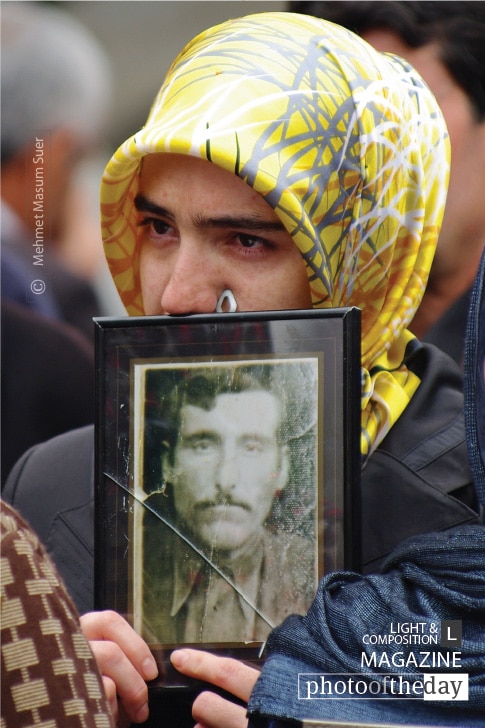
In this poignant documentary image, Mehmet Masum Suer captures the solemn resilience of the 'Saturday Mothers' in Diyarbakir. Taken with a 135mm focal length to isolate the subjects against the backdrop of their protest, the photograph documents the weekly gathering of women seeking justice for disappeared relatives. The composition emphasizes the raw emotional weight of their collective mourning, turning a political demonstration into a powerful human narrative. This image is award-worthy for its ability to transform a complex, tragic historical struggle into a singular, evocative moment of quiet defiance and enduring grief.
Mehmet Masum
Based in Diyarbakir, Turkey, Mehmet Masum Suer is an accomplished international photographer and former journalist with a career spanning several decades. Since transitioning to professional photography in 2005, he has focused on documenting historical architecture, cultural festivals, and the human stories defining the Kurdish region. His work, which has been featured in international exhibitions and various touristic publications, reflects a deep commitment to preserving cultural heritage and social history through a documentary lens.
Resonance Score Breakdown
Transparency Note: The resonance score (12.1/20) is calculated based on social engagement metrics collected before the award announcement.
Expert Photography Reviews · 7
The Weight of Silence
In the ancient world, it was believed that memory was a physical weight, a stone carried in the pocket of the soul. We speak of heavy hearts as if they were literal burdens, dragging us toward the earth, yet we rarely consider the anatomy of that heaviness.
Read the reflection →The Weight of Unspoken Seasons
Grief is not a sudden storm that passes; it is a slow, quiet winter that settles into the marrow of the bones. We often mistake stillness for an absence of movement, yet there is a profound, heavy labor in simply remaining.
Read the reflection →Reviews & Comments
Share your thoughts about this award-winning photograph. Your reviews contribute to the community engagement score.
Before the eye identifies the faces, a sudden, heavy stillness settles in the chest. It’s the weight of the held-breath moment. Masum’s frame doesn’t just document grief; it forces a physiological slowing of the pulse. I’ve returned to these women three times today, and each time, their collective silence feels louder. It’s an ache that follows me into sleep. You don’t just look at this; you carry the burden of their missing sons home with you.
The frame holds a heavy, grey stillness. These women aren’t just standing; they’re anchoring the void. The 135mm lens pulls them tight, pushing the world away. It’s a deliberate isolation. I’ve spent minutes staring at the negative space above their heads. It’s not empty. It’s thick with the weight of what’s missing. My chest tightens. Nothing here is accidental. The silence isn’t a lack of sound. It’s a demand for justice. They’ve mastered the pause.
At f/2.8 on the 135mm, the focal plane is razor-thin, isolating the subjects with a surgical precision that renders the background into a soft, atmospheric blur. It’s a beautiful application of bokeh as a function of aperture. I’m genuinely moved by how the lens resolves the fine, weathered textures of their skin against the diffraction of light across the scene. It’s optics capturing the exact weight of grief that the human eye would otherwise overlook.
Diyarbakir’s light doesn’t reveal; it interrogates. In these faces, the shadows aren’t merely absences, but the heavy, suffocating weight of the disappeared. Masum uses the 135mm lens to compress the distance between grief and the viewer, forcing us into an uncomfortable intimacy. I’ve stared at these women for an hour, and it’s the darkness pooled in their eyes that haunts me. It’s a brutal, necessary refusal to let the light offer any false, easy comfort.
The palette here, a somber symphony of charcoal and the bruised, dusty ochre of Diyarbakir’s stone, feels like a Morandi still life mourning the living. It’s the muted, chalky grey of their headscarves that truly undoes me; they’ve captured a light so heavy with grief that one feels the air thickening. It isn’t merely a protest, but a chromatic ache, where the shadows cling to the fabric like a persistent, unyielding, and deeply haunting memory.
1/160sec at f/2.8, 135mm. The choice of wide-open aperture at maximum focal length is a calculated risk. It isolates the subjects from the chaotic Diyarbakir street, forcing a singular focus on the grief. It’s a sharp, clinical separation. I’ve seen enough protest shots ruined by messy backgrounds, but this works. The shutter speed is just enough to freeze the emotion without losing the grit. It’s technically sound. Honestly, the precision here actually makes me uncomfortable.
Most entries in this category rely on the spectacle of protest, but this frame succeeds by ignoring the crowd. By compressing the space with a 135mm lens, Masum forces us into the suffocating intimacy of these women’s grief. It’s the way their eyes refuse to meet the camera that haunts me; I’ve looked at thousands of portraits, yet this one still makes me look away. It’s not just a protest; it’s a quiet, permanent ache captured in time.