Playing with Her Dolls by Shahnaz Parvin
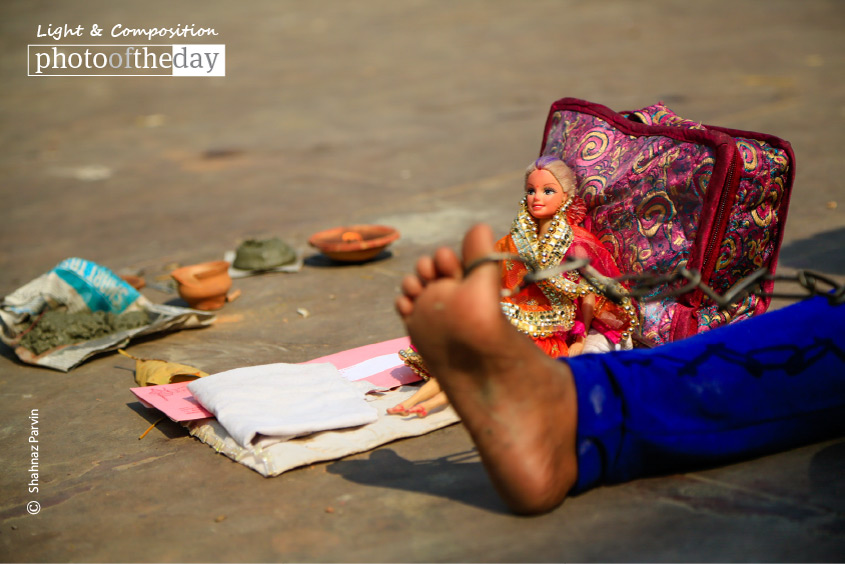
Captured near the iconic Howrah Bridge, this poignant documentary photograph observes a young girl deeply immersed in play with her dolls. The photographer skillfully frames this universal childhood ritual against the backdrop of the girl’s family, highlighting the subtle ways children rehearse the complexities of family life and resilience. The image is award-worthy for its authentic, candid narrative, transforming a fleeting moment of play into a profound reflection on human development. Through careful technical execution, the photographer captures the innocence of the subject, grounding the scene in a rich, cultural context that resonates with viewers globally.
Shahnaz Parvin
Based in Dhaka, Bangladesh, Shahnaz Parvin was a celebrated photojournalist whose work captured the essence of South Asian culture, conflict, and daily life. Recognized as one of the world's top photographers during her career, she was deeply committed to documenting the spirit of her homeland through a documentary lens. Her legacy remains defined by her prolific contributions to international photography and her unwavering passion for visual storytelling, which earned her numerous accolades and a lasting reputation as a master of her craft.
Resonance Score Breakdown
Transparency Note: The resonance score (13.5/20) is calculated based on social engagement metrics collected before the award announcement.
Expert Photography Reviews · 7
The Architecture of Small Worlds
Childhood is a kingdom built on the floorboards of the present, a geography where a scrap of cloth becomes a velvet gown and a chipped stone serves as a feast.
Read the reflection →The Rehearsal of Being
Is it possible that we never truly grow up, but merely trade the size of our toys for the weight of our responsibilities? We watch children arrange their small worlds with such gravity, unaware that they are practicing for a life they do not yet understand.
Read the reflection →Reviews & Comments
Share your thoughts about this award-winning photograph. Your reviews contribute to the community engagement score.
Near the Howrah Bridge, we find a girl lost in her dolls. She isn’t just playing; she’s rehearsing the weight of the world. Shahnaz Parvin didn’t just point a lens here—she sat in the dust and listened to the silence of that childhood. It’s a quiet, aching reminder that we all learn to carry our burdens through play. I find myself wanting to reach out and hold her hand. It’s a photograph that asks to be returned to.
Most documentary work from Kolkata leans on the grit of the Howrah Bridge to do the heavy lifting, but this piece succeeds because it ignores the landmark. By focusing on the girl’s domestic rehearsal, Parvin captures a universal truth about resilience. It’s the way the dolls mirror her own precarious reality that gets me—I actually felt a lump in my throat. It’s a quiet, enduring study of childhood that won’t lose its sting in thirty years.
Shadows here don’t merely frame the girl; they swallow the periphery of Kolkata, forcing us to confront the gravity of her domestic rehearsal. It’s a heavy, suffocating stillness. I’ve stared at the darkness pooling beneath her dolls, and it feels like a premonition of the life she’s destined to inherit. Beauty shouldn’t be this difficult, yet it resists our gaze. When the light fails to penetrate her solitude, I’m left mourning a childhood already eclipsed.
The ochre dust of Kolkata clings to these dolls like a memory, echoing the muted, sun-bleached palettes Morandi once coaxed from his bottles. It’s a symphony of terracotta and bruised umber that makes my heart ache with a sudden, sharp longing for the ephemeral. One finds here a chromatic weight that transcends mere documentary, as the girl’s vibrant, sun-drenched attire cuts through the atmospheric haze, creating a tension that feels, quite frankly, like a prayer.
1/250sec at f/10, ISO 200. A calculated choice. Stopping down to f/10 at 24mm keeps the Howrah Bridge context sharp without swallowing the subject. It’s a disciplined aperture. Most would’ve blown the background with a wide-open prime, but Parvin held the line. I’ve seen enough soft, lazy documentary work to appreciate this rigour. It’s technically sound, and frankly, the clarity of the dolls against that chaotic Kolkata backdrop actually made me stop and look twice.
You waited for the world to fall away, and it shows. Most people would have rushed this, but you let the chaos of Kolkata settle into the background. Watching her play with those dolls, I’m struck by how she’s rehearsing a life she hasn’t even lived yet. It’s quiet, it’s heavy, and it’s entirely real. You didn’t just take a picture; you sat with her. I can feel the dust and the heat. That’s rare.
The shutter speed is perfect. It freezes the girl’s focus, locking that tiny, fragile world in place before the chaos of Kolkata rushes back in. I’ve spent hours watching frames like this; it’s the silence between the dolls that gets me. She’s rehearsing a life she doesn’t yet understand. The composition holds, the depth of field is tight, and the cut would’ve been a mistake. It’s the frame the editor keeps because it breathes.