Going through the Mist by Shahnaz Parvin
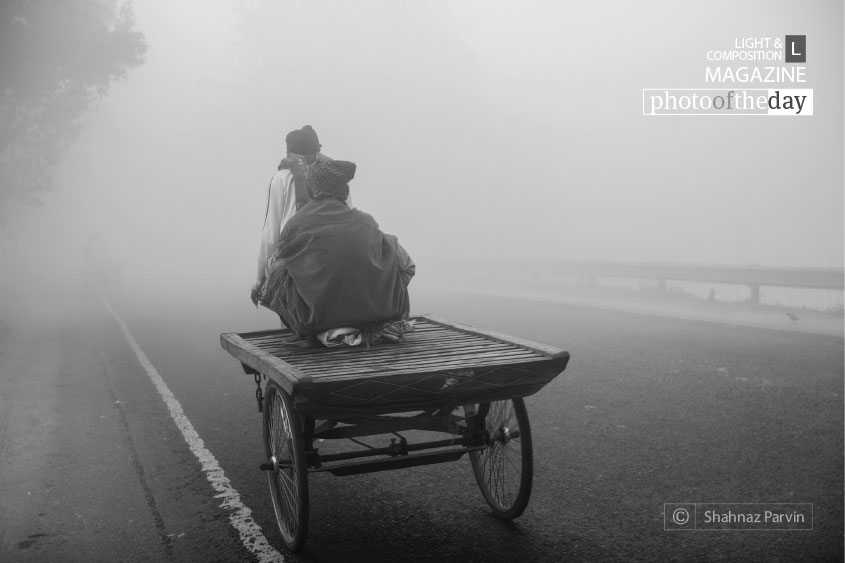
Captured on a dense, misty morning along the Maya highway, this photograph documents the resilience of those who labor regardless of the elements. While traveling to Faridpur for a documentary project, the photographer was struck by the ethereal atmosphere and the determination of workers navigating the heavy fog. By choosing to pause and observe, she transformed a routine commute into a poignant visual narrative. The image is award-worthy for its evocative use of natural light and mist to frame a human story, demonstrating a keen eye for finding profound beauty in the everyday struggles of the working class.
Shahnaz Parvin
Shahnaz Parvin was a highly acclaimed photojournalist based in Bangladesh, recognized as one of the premier photographers of her generation. Her work focused on documentary photography, capturing the culture, conflict, and daily life of her homeland with deep passion and technical precision. As a prolific contributor to Light & Composition, she achieved international acclaim and consistently ranked among the world's top photographers before her untimely passing in 2016. Her legacy remains defined by her dedication to representing the spirit of Bangladesh through her evocative and human-centered lens.
Resonance Score Breakdown
Transparency Note: The resonance score (13.0/20) is calculated based on social engagement metrics collected before the award announcement.
Expert Photography Reviews · 7
The Weight of the Unseen
In the high mountains of the Andes, the locals speak of the cloud forest not as a place, but as a living, breathing entity that decides when to reveal its secrets.
Read the reflection →The Architecture of Breath
We often mistake clarity for truth, believing that if we cannot see the horizon, we have somehow lost our way. But there is a quiet wisdom in the veil. When the world pulls a shroud of silver over the fields, the edges of our burdens soften.
Read the reflection →Reviews & Comments
Share your thoughts about this award-winning photograph. Your reviews contribute to the community engagement score.
Most commuters would have kept their heads down, eager to escape the damp chill of that Dhaka morning. Instead, Parvin stopped. It’s a rare thing to see someone actually commit to the fog rather than waiting for it to lift. I’ve spent enough shivering hours in similar conditions to know that f/4 at 1/125sec wasn’t a lucky snap; it was a deliberate choice. She earned this quiet, heavy atmosphere. It’s a proper bit of work.
We look at these figures emerging from the Dhaka mist and we understand that labor is a conversation with the elements. Shahnaz didn’t just capture a commute; she listened to the quiet rhythm of their struggle. It’s haunting how the fog softens their edges, yet their resolve remains sharp. I’ve stared at this for hours, and it makes me ache for the stories we walk past every day. This is a photograph that asks to be returned to.
Mist isn’t merely weather here; it’s an ontological veil. Parvin forces us to confront the erasure of the individual within the collective labor of Dhaka. I’m unsettled by how the figures dissolve into the grey, as if they’re being unmade by the very morning they navigate. It’s a haunting refusal of clarity. When the light fails to define the subject, the shadow doesn’t just linger—it consumes. It’s a cold, necessary reminder of our own fragility.
Most entries in this category rely on the fog to hide a lack of subject, but Parvin uses it to build a stage. The way the worker’s silhouette cuts through that thick, grey Mawashorok air isn’t just lucky; it’s a deliberate choice to isolate human endurance. I’ve seen thousands of commute shots, yet this one makes me shiver. It’s the quiet weight of that single figure that ensures we’ll still be looking at this in thirty years.
Before the eye identifies the figures, a sudden stillness settles in the chest. The mist acts as a sensory filter, dampening the world until only the rhythmic pulse of labor remains. It’s a quiet, heavy ache I recognize from my own mornings—that feeling of moving through a world that hasn’t quite woken up. When I return to this, the fog feels thicker, pressing against my skin. It’s not just a commute; it’s a haunting, beautiful endurance.
At f/4, the 30mm focal plane barely resolves the particulate density of the Dhaka mist. The light scatters across the sensor, creating a soft, veiling glare that renders the workers as ethereal silhouettes. It’s a beautiful manipulation of diffraction; the lens doesn’t just capture the scene, it breathes with the atmosphere. I’m genuinely moved by how the optics soften the harshness of their labor. It’s a rare, haunting intersection of physics and human endurance.
The frame opens on a ghost-white silence. A figure emerges from the Mawashorok fog, a slow tracking shot frozen in time. It’s haunting. I’ve spent hours staring at the way the 30mm lens compresses that heavy, damp air; it’s a masterclass in atmosphere. The cut would’ve been a mistake. She held the shutter just long enough to capture the rhythm of a life lived in the mist. It’s the frame the editor keeps. I’m breathless.