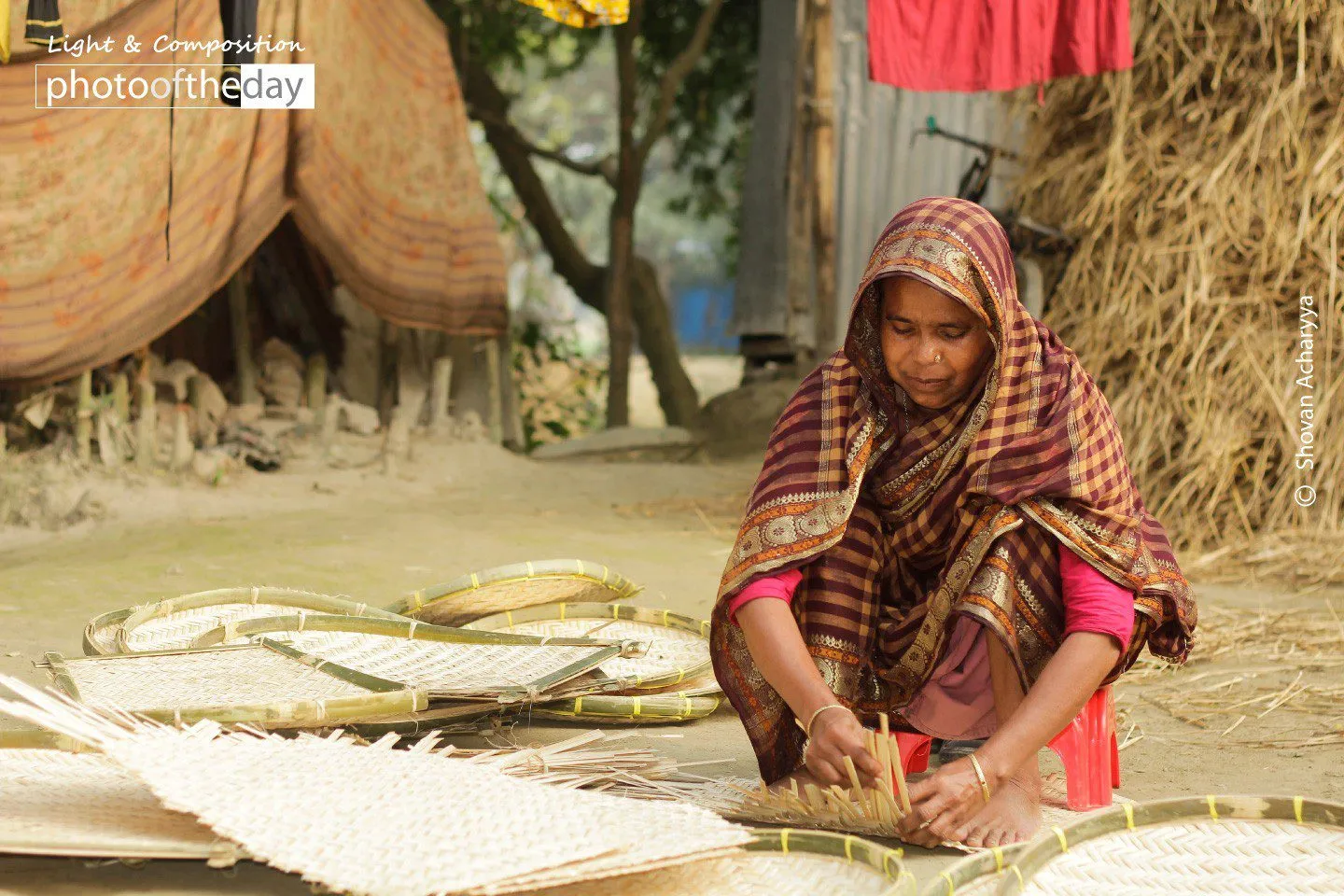
The “Kula” Artist by Shovan Acharyya
The photograph captures the intricate craftsmanship behind the 'Kula,' a traditional bamboo kitchen tool essential to rural life in Bangladesh. By documenting the labor-intensive weaving process, the image highlights the cultural significance of this handmade utensil as it faces the threat of being replaced by modern, unhygienic plastic alternatives. The photographer skillfully frames the artisan’s work to emphasize the texture and dedication involved in this fading craft. This piece is award-worthy for its poignant documentary approach, successfully preserving a vanishing tradition while shedding light on the environmental and social consequences of industrialization on local heritage.
Shovan Acharyya
Born in the small town of Sunamgonj, Shovan Acharyya is a Dhaka-based photographer with a background in Economics from the University of Chittagong. After honing his craft through foundational courses at Pathshala, he transitioned into a professional role at a literature and lifestyle magazine. His diverse portfolio spans landscapes, wildlife, and lifestyle photography, reflecting his deep commitment to documenting the human experience. Driven by a passion for visual storytelling, he continues to build his career by capturing the authentic essence of his surroundings.
Resonance Score Breakdown
Transparency Note: The resonance score (9.3/20) is calculated based on social engagement metrics collected before the award announcement.
Expert Photography Reviews · 5
The Rhythm of the Hands
Dear maker, I have been thinking about the things we discard. We live in a world that demands speed, where objects are born in molds and die in landfills, never having known the warmth of a human palm. There is a quiet violence in that efficiency.
Read the reflection →The Weave of What Remains
There is a specific silence that lives in the hands of a maker. It is the silence of a rhythm that has been practiced until it becomes a heartbeat, a way of folding the world into shape.
Read the reflection →Reviews & Comments
Share your thoughts about this award-winning photograph. Your reviews contribute to the community engagement score.
Nice work.keep it up.
Nice work. Good luck ahead.
May All your dreams come true.
Wow..Thats amazing…
Interesting story! and same with the photo.
You’ve captured the rhythm of those hands perfectly. I can almost hear the dry snap of the bamboo as the artisan works. It’s not just a craft; it’s a life being woven into shape. When I look at those calloused fingers, I feel a genuine ache for the world we’re losing to plastic. You didn’t just document a tool; you respected the person behind it. That’s the human truth I’m always looking for. Well done.
The artisan’s fingers are mid-weave, but the tension is gone. I’ve spent my life chasing the exact millisecond where muscle meets intent, and here, the hands are just resting. It’s a quiet study, sure, but it lacks the kinetic snap of a craft in motion. I wanted to see the bamboo strain under the pressure of a calloused thumb. It’s technically clean, but it’s missing the pulse. I’m left waiting for a movement that never happens.
The bamboo strips don’t just weave a tool; they trap the light, forcing it to surrender its clarity to the artisan’s calloused grip. It’s a brutal, honest geometry. I’ve stared at these deep, ink-stained crevices until my own eyes ached, feeling the weight of a world being slowly erased by plastic indifference. Acharyya understands that true craft isn’t found in the illumination, but in the dark, stubborn resistance of the shadow itself. It’s haunting.
One wonders how many hours Shovan spent in that workshop before the artisan stopped glancing at the lens. It’s easy to snap a frame; it’s quite another to become part of the furniture. The texture of that bamboo is rendered with a patience I rarely see these days. I’ve spent enough time in damp, cramped spaces to recognize the ache in the photographer’s knees. It’s a quiet, earned victory. Well played, indeed.
Before the eye identifies the bamboo, something in the chest tightens. It’s the rhythm of the weaver’s hands—a tactile, repetitive pulse that forces my own breath to slow. I’ve returned to this frame three times today, and each time, the scent of dry grass seems to rise from the screen. It’s a quiet ache, really. When I look away, I’m left with the phantom sensation of rough fibers pressing against my own tired palms.