Bodhgaya Young Monk by Ryszard Wierzbicki
Captured in the sacred surroundings of Bodhgaya, India, this candid portrait highlights a moment of pure, unscripted curiosity. While visiting local monasteries near the Mahabodhi Temple, the photographer encountered young novice monks whose natural inquisitiveness transcended the solemnity of their environment. By utilizing a telephoto lens, the photographer maintained a respectful distance, allowing the subject to remain unposed and authentic. The image is award-worthy for its ability to bridge the gap between a deeply spiritual setting and the universal, playful nature of childhood, rendered with sharp focus and a compelling, intimate composition.
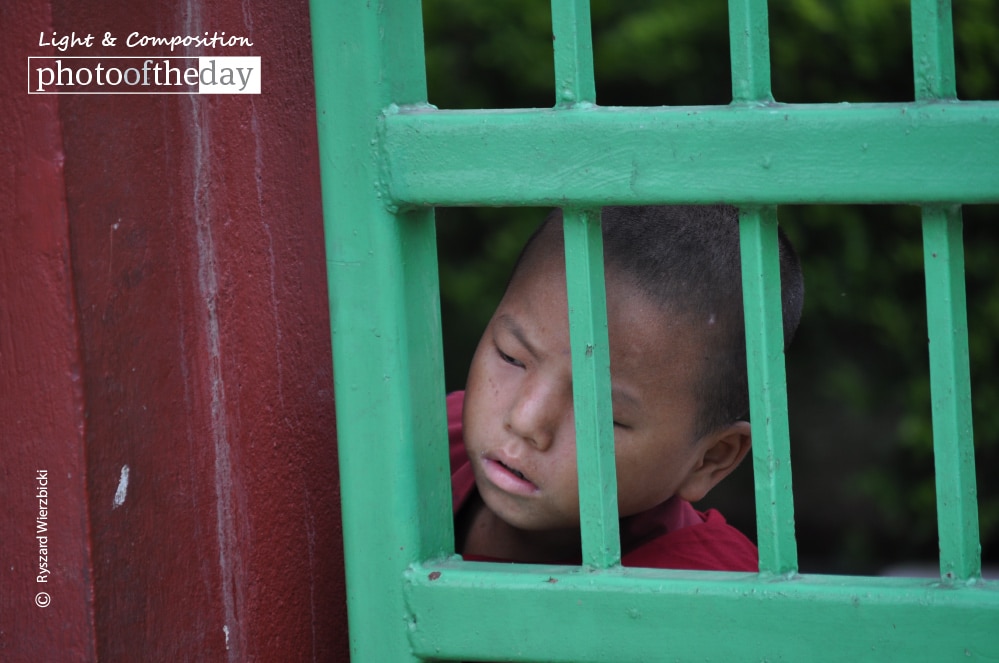
Exposure 1/750sec @ f/6.7 | ISO 200 | Focal Length 165mm
Ryszard Wierzbicki
Born in 1963, Ryszard Wierzbicki is a Polish-born photographer and traveler currently based in Swindon, United Kingdom. After a diverse professional career in social sciences, education, and marketing, he transitioned into a life of exploration, focusing his lens on the cultures and landscapes of South-East Asia. His work is deeply influenced by his humanitarian efforts with orphanages and his extensive experience as a PADI scuba instructor. Through his platforms, Instant Travelling and World Around, he shares his passion for photography, documenting the human experience with a keen eye for authentic, candid storytelling.
Resonance Score Breakdown
Transparency Note: The resonance score (10.8/20) is calculated based on social engagement metrics collected before the award announcement.
Expert Photography Reviews · 6
The Unfolding Season of Being
There is a particular grace in the early years of a life, a time when the spirit has not yet learned to build walls against the world. It is a season of pure arrival, where every sensation is met with an open heart and a gaze that does not judge, but simply wonders.
Read the reflection →The Weight of Stillness
There is a particular gravity to the silence of a child. We often mistake their quiet for an absence of thought, a blank slate waiting for the world to write upon it. But if you watch closely, you realize that silence is not empty.
Read the reflection →Reviews & Comments
Share your thoughts about this award-winning photograph. Your reviews contribute to the community engagement score.
The telephoto lens creates a wall, not a bridge. By hovering at 165mm, Wierzbicki captures a child’s curiosity while remaining safely detached. Does this distance protect the subject, or does it merely commodify his innocence for a Western audience? I find the boy’s gaze piercing, yet I feel uneasy about the power imbalance inherent in this candid extraction. Why must we exoticize childhood to find spirituality? It’s a sharp image, but it lacks genuine connection.
Bodhgaya’s light doesn’t just illuminate; it interrogates. Wierzbicki’s lens finds the boy caught between the temple’s heavy stone and the encroaching void. It’s the shadow clinging to his robes that truly speaks, anchoring his fleeting curiosity in a profound, existential stillness. I’ve stared at this frame for an hour, feeling the cold weight of the dark behind him. It’s not a portrait of a child, but a confrontation with the silence that eventually claims us all.
1/750sec at f/6.7, 165mm. ISO 200. The shutter speed is overkill for a static subject, but it’s a necessary insurance policy against the D5000’s sensor noise. At f/6.7, the depth of field is thin enough to isolate the monk, yet deep enough to keep the eyes sharp. It’s a calculated, clinical choice. I’ve spent years looking at sloppy bokeh, so this precision actually makes me breathe a little easier. The technical execution is correct.
At 165mm and f/6.7, the focal plane is razor-thin, isolating the monk’s gaze from the Bodhgaya heat haze. The lens resolves the fine texture of his skin against the soft, creamy bokeh—a perfect function of that aperture. I’m genuinely moved by how the diffraction of light across his eyes captures such profound, unscripted curiosity. It’s rare to see a sensor resolve this much humanity; it’s a beautiful, precise intersection of glass and spirit.
Of the thousands of portraits I’ve reviewed, most rely on forced solemnity to signal spirituality. Wierzbicki avoids that trap. By using a 165mm focal length, he captures a genuine, unguarded curiosity that feels rare. It’s the slight tilt of the monk’s head and that fleeting, mischievous glint in his eyes that caught me; I found myself smiling back at the screen. It’s a simple, honest moment that will still feel human thirty years from now.
The shutter snaps, and the frame holds its breath. That telephoto compression flattens the Bodhgaya heat, locking the monk’s gaze into a permanent, curious stare. It’s a perfect cut. The background blurs into a soft, sacred hum, leaving only that fleeting spark of childhood. I’ve seen thousands of portraits, but this one makes me want to reach out and touch the frame. It’s the shot the editor keeps, the one that refuses to move.