Pelican Rest by Barry Steven Greff
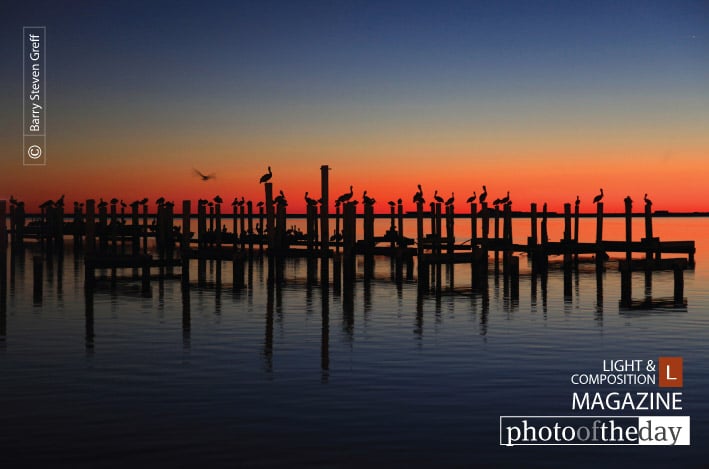
Pelican Rest captures a poignant moment of stillness along the Gulf Coast in Biloxi, Mississippi. As the sun dips below the horizon, local seabirds congregate on the weathered remains of a dock, a structure scarred by the passage of Hurricane Katrina. The photographer masterfully juxtaposes this serene, natural sanctuary against the bustling, neon-lit backdrop of the city’s gambling and entertainment district. This image is award-worthy for its evocative storytelling and the delicate balance it strikes between historical decay and the enduring, quiet resilience of nature, inviting the viewer to reflect on the passage of time and the beauty found in forgotten spaces.
Barry Steven Greff
Based in Weston, Florida, Barry Steven Greff is a distinguished fine art photographer dedicated to memorializing the pristine beauty of the natural world. His work spans ethereal landscapes and intimate wildlife portraits, earning him significant recognition in international competitions and exhibitions at prestigious institutions like the Center for Fine Art Photography. With a portfolio featured in prominent publications such as Black & White Magazine and Silvershotz, Greff has established himself as a respected voice in the photography community, sought after for his unique ability to capture the Earth's most evocative moments.
Resonance Score Breakdown
Transparency Note: The resonance score (14.1/20) is calculated based on social engagement metrics collected before the award announcement.
Expert Photography Reviews · 6
The Architecture of Waiting
There is a specific kind of patience found in things that have been left behind. We often think of ruins as endings, the final punctuation mark on a sentence that has run out of breath. But if you sit with them long enough, you realize they are actually beginning something else.
Read the reflection →The Weight of Remaining
We build things to last, yet the water and the wind have other intentions. There is a particular honesty in a structure that has surrendered its purpose. It no longer asks to be useful; it only asks to be present.
Read the reflection →Reviews & Comments
Share your thoughts about this award-winning photograph. Your reviews contribute to the community engagement score.
NICE++<3
It’s easy to snap a sunset, but capturing the precise moment those birds reclaimed that rotting timber requires a stubborn sort of patience. I’ve spent enough damp evenings waiting for a scene to settle to know when a photographer has actually put in the hours. The contrast between the neon hum and the quiet decay is sharp. I’ll admit, the stillness here almost makes me miss the salt air. He clearly returned until it worked.
Of the thousands of coastal shots I’ve reviewed, most drown in sentimentality. Greff avoids that trap. By anchoring those weary pelicans against the garish, artificial glow of the Biloxi casinos, he forces a confrontation between fragile survival and human excess. It’s a quiet, brutal honesty that makes me ache for the coast. In thirty years, the neon will have changed, but this tension between the rotting wood and the birds’ indifference will remain hauntingly relevant.
Shadows here aren’t merely the absence of sun; they’re the heavy, bruised silence of a coastline that refuses to forget. Greff forces the neon glare of Biloxi to bleed into the rotting wood, creating a friction that feels almost violent. I’ve stared at these pelicans for an hour, and it’s the darkness clinging to their feathers that haunts me. It’s a cold, existential ache—the realization that even in decay, nature doesn’t ask for our permission.
The horizon line bisects the frame with clinical indifference. It’s a rigid fulcrum. The weathered pilings provide necessary verticality, anchoring the chaos of the neon blur. I’m struck by how the negative space doesn’t collapse under the weight of the city’s glare. The composition holds because the birds occupy the precise intersection of decay and light. It’s a disciplined arrangement. Without that structural tension, the scene would simply dissolve into sentimental noise.
The light here doesn’t demand attention; it whispers. Barry waited until the sun surrendered, leaving the pelicans to claim the splintered wood of a broken dock. I’ve felt that same ache in my chest, watching the neon glow of the city bleed into the quiet salt air. It’s a fragile, holy stillness. He didn’t rush the shutter. He simply listened to the tide, letting the landscape reveal its own weary, beautiful resilience against the coming dark.
The bruised violet of the Gulf’s twilight bleeds into the harsh, synthetic amber of the Biloxi strip, creating a chromatic friction that aches. It’s a Morandi-esque study in decay, where the weathered wood’s desaturated grey hums against the neon’s electric intrusion. I’m utterly undone by that singular, sickly chartreuse glow—it’s the colour of a fading memory, and it’s haunting. One finds here a fragile, dissonant harmony that lingers long after the eye turns away.
Thanks Jimmy. I saw it coming and ran to the spot to set up. Knew it was going to be good. BSG
Wonderful capture Barry. Such beautiful light – jimmy