Riders of the Sea by Nirupam Roy
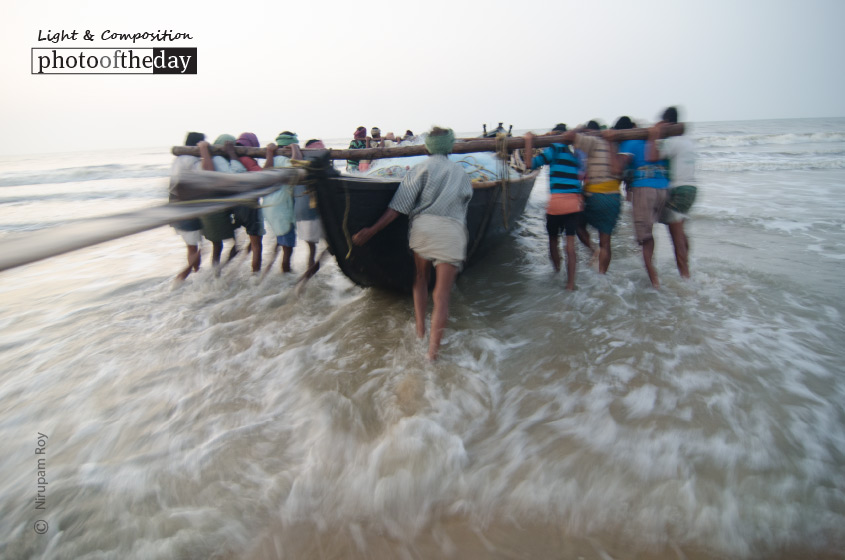
Captured at 5:40 a.m. on the shores of Udaypur, this evocative image documents the daily struggle of local fishermen preparing to set their 'Sareen' nets. The photographer timed the shot to coincide with the tide, highlighting the precarious balance between the fishermen's livelihood and the unpredictable sea. By focusing on these individuals as they brave the elements to support their families, the image transforms a routine labor into a poignant narrative of human resilience. The composition is award-worthy for its ability to turn a challenging, low-light environment into a powerful testament to the triumph of the human spirit over the odds of life.
Nirupam Roy
Hailing from the small town of Tufanganj in the Coochbehar District of West Bengal, India, Nirupam Roy balances a career as a school teacher with a profound dedication to photography. His transition into the visual arts was sparked by a desire to capture the scenic beauty of the Indian coastline, eventually evolving from a casual interest into a deep, all-consuming passion. Through his lens, Roy seeks to interpret the common yet beautiful aspects of society, finding in photography a sense of peace and a renewed perspective on both nature and the human experience.
Resonance Score Breakdown
Transparency Note: The resonance score (13.1/20) is calculated based on social engagement metrics collected before the award announcement.
Expert Photography Reviews · 6
The Rhythm of the Tide
There is a quiet agreement between the land and the water, a conversation that has continued since the beginning of time. We often think of our work as a struggle against the elements, a series of tasks to be completed before the sun reaches its peak.
Read the reflection →The Rhythm of the Tide
I remember a morning in a small coastal village where the darkness felt heavy, like a wool blanket you couldn't quite shake off. I sat on a wooden crate near the water’s edge, watching a group of men prepare their gear. They didn't speak much; there was no need.
Read the reflection →Reviews & Comments
Share your thoughts about this award-winning photograph. Your reviews contribute to the community engagement score.
Before the eye identifies the fishermen, a sudden coldness settles in the chest. That 1/5sec shutter speed blurs the tide into a ghostly, encroaching weight, forcing my own breath to hitch in sympathy with their struggle. It’s a visceral, kinetic anxiety. I’ve returned to this frame for years, and that grey, churning water still makes me feel small. It doesn’t just document labor; it pulls the salt air right into my lungs. I can’t look away.
The low horizon line forces a brutal confrontation between the vast, encroaching tide and the fishermen’s silhouettes. It’s a precarious geometry. The wide-angle distortion stretches the foreground, yet the figures maintain a necessary, rigid verticality against the sweeping motion of the surf. I’m genuinely unsettled by how the negative space threatens to swallow them whole. The frame holds, but only just. It’s a disciplined study in spatial tension that refuses to collapse into mere sentimentality.
Most entries in this category rely on the drama of the crashing surf to do the heavy lifting. Roy avoids that trap. By choosing a 1/5sec shutter speed, he turns the water into a blurred, ghostly force that makes the fishermen’s stillness feel defiant. It’s a quiet, aching contrast. I’ve stared at this for years, and it still makes me hold my breath. It’s not just labor; it’s a permanent record of a vanishing rhythm.
At 5:40 a.m., the tide doesn’t just pull at the nets; it pulls at the lives of these men. We look at their silhouettes against the gray Talsari dawn and we feel the weight of their daily gamble. Nirupam Roy didn’t just capture motion; he listened to the rhythm of their struggle. It’s haunting. I find myself shivering, imagining the cold water against their skin. It’s a portrait of survival that stays with you long after.
You stood in that cold, pre-dawn water at 5:40 a.m. and waited. I can feel the weight of those nets in your frame. It’s not just the motion blur; it’s the way you caught the exhaustion in their posture against the tide. I’ve been on shores like that, and you didn’t look away from the struggle. There’s something honest happening here. You didn’t just take a picture; you felt the pull of their daily life.
The frame resolves into a precise 1:2 ratio of dark, wet sand to the kinetic blur of the surf. Roy’s use of a 12mm focal length creates a forced perspective, pulling the fishermen toward the vertical axis where they anchor the composition. I’m genuinely struck by how the diagonal vectors of the nets intersect the horizon line, creating a perfect tension. It’s a beautifully solved spatial equation; the geometry doesn’t just hold the narrative—it defines it.
Beautiful.
Thank You.
66 is poor score for a photograph like this.
Thank You but it is up to the judges.
Combination of Nikon D7000 with Tokina 12-24mm seems going well? Have you taken any other photographs in that combination?
Yes. Actually, I wished to take Tokina 11-16 f2.8, but at that time due to my monetary condition I took that one. Yes, I am using it for 2 years. In Light and Composition, few of my selected photographs are taken by that lens. It works. Thank You.
Is this their daily routine? If I travel there, do you think I can get photographs like this?
Don’t go there, it’s really dirty. Indian people don’t know how to keep their sea beaches clean.
No, it is not completely true.I admit, but there are also some clean beaches in India.
I hate sea beaches of India. Don’t go for a photo shoot, it’s complete waste of time.
Indian tourists will not let you take photos. Don’t go.
No, this is not correct. Actually out of curiosity, perhaps they created trouble in your shoot. And you faced the problem. But it does not happen everywhere. People are friendly here. I hope that your next tour will be smooth enough. Thank You.
Yes, of course. You can get. It is their daily activity. But the time depends on the ‘sea tide’. I was lucky that it happened in dawn.
I never heard the name of this sea beach. Everyone talks about Cox Bazaar.
Yes, it is in Bangladesh. My one is in India, WestBengal. It is on the border of two states – Orrisa and WestBengal in India by the side of Bay Of Bengal.
I think Tokina 12-24mm does the tricks. I am going to have that lens.
In my opinion, Tokina 11-16 f2.8 will be more effective than it.
Well done.
Thank You
How did you make your hand steady at 1/5 second?
It was very tough though I managed it somehow. Perhaps at that time my determination to take that shot helps me a lot. Infact, at that time I have no other choices and in rushing and splitting using of tripod was next to impossible. Thank You.
Roy, this surely is an amazing capture.
Thank You.