Before Going to School by Shahnaz Parvin
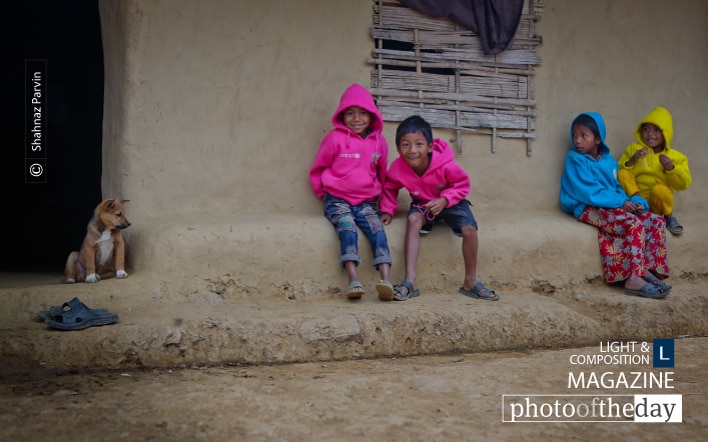
Captured in the remote village of Remarki, this poignant image documents a quiet, universal moment of childhood. While traveling toward the Amiyakum waterfall, the photographer stepped out of her cottage at dawn to find a group of local children gathered together, playing in the soft morning light before heading to school. The photograph is award-worthy for its intimate, candid portrayal of rural life in the Thanchi region. By focusing on the children's shared connection, the image transcends its geographical setting, offering a timeless and evocative glimpse into the simple joys of youth in Bangladesh.
Shahnaz Parvin
Based in Dhaka, Bangladesh, Shahnaz Parvin was a celebrated photojournalist whose work captured the essence of South Asian culture, conflict, and daily life. Recognized as one of the world's top photographers, she dedicated her career to documenting the beauty and struggles of her homeland through a documentary lens. Her legacy remains defined by her prolific contributions to international photography platforms and her profound ability to represent the human experience with sensitivity and technical mastery.
Resonance Score Breakdown
Transparency Note: The resonance score (13.1/20) is calculated based on social engagement metrics collected before the award announcement.
Expert Photography Reviews · 7
The Morning Unfolding
There is a particular quality to the light just before the world fully wakes. It is soft, hesitant, and carries the scent of dew and anticipation.
Read the reflection →The Weight of a Satchel
I remember the smell of my own school bag—a mix of damp canvas, pencil shavings, and the lingering scent of a bruised apple. It was a heavy thing, filled with books that promised worlds I hadn't yet visited.
Read the reflection →Reviews & Comments
Share your thoughts about this award-winning photograph. Your reviews contribute to the community engagement score.
Most travel photography is just tourism masquerading as art, but this captures a stillness that’s rare. Of the thousands of submissions I’ve reviewed, few manage to make the mundane feel monumental. The soft morning light hitting their faces doesn’t just illuminate; it anchors them in a moment that feels eternal. I’d hang this on my wall just to remember that childhood is the same everywhere. It’s a quiet, honest piece that will absolutely endure thirty years from now.
The light hits them like a soft, morning dissolve. It’s that fleeting, quiet rhythm before the day’s narrative truly begins. I’m struck by the stillness; it’s a frame the editor keeps because the cut would have been a mistake. Parvin caught the exact second where childhood isn’t performing for the lens. It’s honest, unscripted, and I’d give anything to have been standing there in that Thanchi dawn. The composition holds the weight of a perfect opening sequence.
At f/2.8, the 50mm focal plane is razor-thin, isolating the children against a soft, creamy bokeh that’s a function of the lens’s wide aperture. I’m struck by how the morning light refracts through the atmospheric haze, rendering the skin textures with such delicate resolution. It’s a beautiful optical dance; the diffraction limit hasn’t softened the fine details in their eyes. Honestly, it’s the way the light catches their expressions that makes my heart ache.
1/160sec at f/2.8, ISO 1250, 50mm. The aperture choice is aggressive for a group shot, leaving the peripheral subjects in a soft, distracting blur. It’s a technical gamble that barely pays off. I’ve seen enough soft focus to know when it’s laziness, but here, the isolation of the central child is sharp enough to hold the frame. It’s technically imperfect, yet I find myself lingering on the eyes. The math is flawed, but it works.
The frame’s geometry relies on the central cluster of figures, yet the peripheral negative space remains underutilized. It’s a missed opportunity for structural depth. While the soft morning light softens the edges, the composition doesn’t quite lock into place. I’ve seen better balance in these remote settings. The verticality of the background elements fights the horizontal grouping of the children. It’s technically competent, but the visual architecture lacks the necessary rigor to truly hold my attention.
The ochre dust of Remarki clings to these children like a soft, sun-drenched veil, echoing the muted, chalky palettes of Morandi’s still lifes. It’s a quiet, golden-hour alchemy where the light doesn’t merely illuminate; it saturates the skin with the warmth of a fading ember. I’m truly moved by how the shadows hold such tender, bruised violets, grounding the fleeting innocence of their morning ritual in a chromatic harmony that feels entirely, achingly eternal.
Dawn in Remarki. The children gather, yet the frame doesn’t crowd them. It’s the space around their small forms that holds the weight. I’ve spent minutes watching the light settle on the dirt. It’s quiet. The distance between the figures isn’t a gap; it’s a breath. I feel a sudden, sharp ache for my own childhood mornings. Nothing here is accidental. The empty corner is not empty. It’s the silence before the day begins.