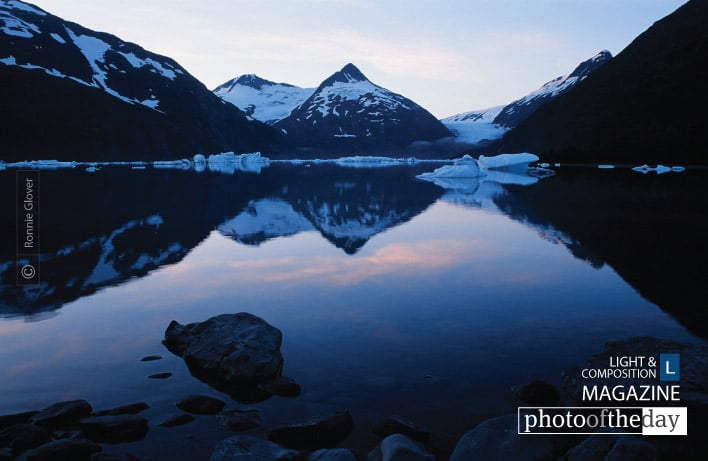
Portage Lake by Ronnie Glover
Captured just moments before sunrise, this photograph of Portage Lake in Alaska showcases the serene beauty of a landscape shaped by glacial retreat. The photographer carefully timed the shot to catch the soft, early light reflecting off the surrounding mountains, while distant icebergs drift across the water’s surface. By focusing on the interplay between the retreating glacier and the stillness of the lake, the image highlights the fragile majesty of the Alaskan wilderness. Its technical precision and evocative composition make it a standout example of landscape photography, successfully conveying the quiet, profound atmosphere of a morning in the North.
Ronnie Glover
Based in Gig Harbor, Washington, Ronnie Glover developed his professional photographic foundation through the Southeastern Center for the Arts in Atlanta. His extensive fourteen-year residency in Alaska provided him with a profound connection to nature, deeply influencing his landscape work. Beyond his focus on the natural world, Glover is an avid travel photographer dedicated to documenting diverse cultures. Through his evocative imagery, he strives to share the beauty of the global landscape and inspire a deeper appreciation for the environment among his international audience.
Resonance Score Breakdown
Transparency Note: The resonance score (13.4/20) is calculated based on social engagement metrics collected before the award announcement.
Expert Photography Reviews · 4
The Weight of Stillness
I woke up before the alarm this morning, which is rare for me. The house was completely silent, the kind of quiet that feels heavy, like a held breath. I didn't reach for my phone or start my mental to-do list.
Read the reflection →The Weight of Still Water
The ice does not hurry. It waits for the sun to decide its shape, a slow surrender that takes centuries to complete. We look at the water and see a mirror, but the water sees only the sky, indifferent to the mountains that lean over it.
Read the reflection →Reviews & Comments
Share your thoughts about this award-winning photograph. Your reviews contribute to the community engagement score.
Portage Lake’s geometry is its only salvation. The glacial icebergs provide necessary anchors, breaking the lake’s horizontal monotony. Without these jagged masses, the frame would collapse into a featureless void. The light doesn’t save it; the structure does. I’ve grown weary of such soft, atmospheric landscapes, yet the tension between the floating ice and the mountain’s edge holds. It’s a cold, calculated arrangement. It doesn’t need sentiment to justify its place on the wall.
Most landscapes I review are merely pretty, but this one lingers. It’s the stillness of the icebergs against that Velvia-saturated light that anchors it. I’ve seen thousands of Alaskan shots, yet Glover’s choice to frame the water’s edge so tightly forces you to confront the glacier’s absence. It’s haunting. I actually felt a chill looking at it. Thirty years from now, people won’t just see a lake; they’ll see a vanishing world. That’s why it won.
The lake holds its breath. A sliver of ice drifts, a white ghost against the dark water. I’ve stood in such cold, where the air feels thin enough to shatter. It’s quiet. The mountains don’t demand attention; they simply exist. Nothing here is accidental. The empty corner is not empty. It’s a pause, a deliberate breath before the sun arrives. I find myself shivering, just looking at it. It’s a rare, beautiful restraint.
Portage Lake isn’t merely a landscape; it’s a confrontation with the void. Glover’s icebergs drift like forgotten thoughts in a dark, ink-stained water that refuses to yield its depth. I’ve stared at these shadows until my eyes ached, feeling the cold weight of a world retreating into silence. It’s a haunting, heavy stillness. When light finally touches those peaks, it doesn’t invite us in; it merely highlights the vast, indifferent darkness that remains.