Annecy Le Thiou Floodgate by Ola Cedell
Captured during the height of an early summer afternoon, this photograph showcases the serene beauty of the Thiou, one of France’s cleanest and shortest rivers. The photographer utilized the bright, natural light to highlight the architectural details of the floodgate, creating a crisp and balanced composition. By focusing on the interplay between the historic structure and the flowing water, the image captures a moment of tranquil stillness in the heart of Annecy. The technical precision and the photographer's ability to render the scene with such clarity and depth make this a standout piece of landscape photography.
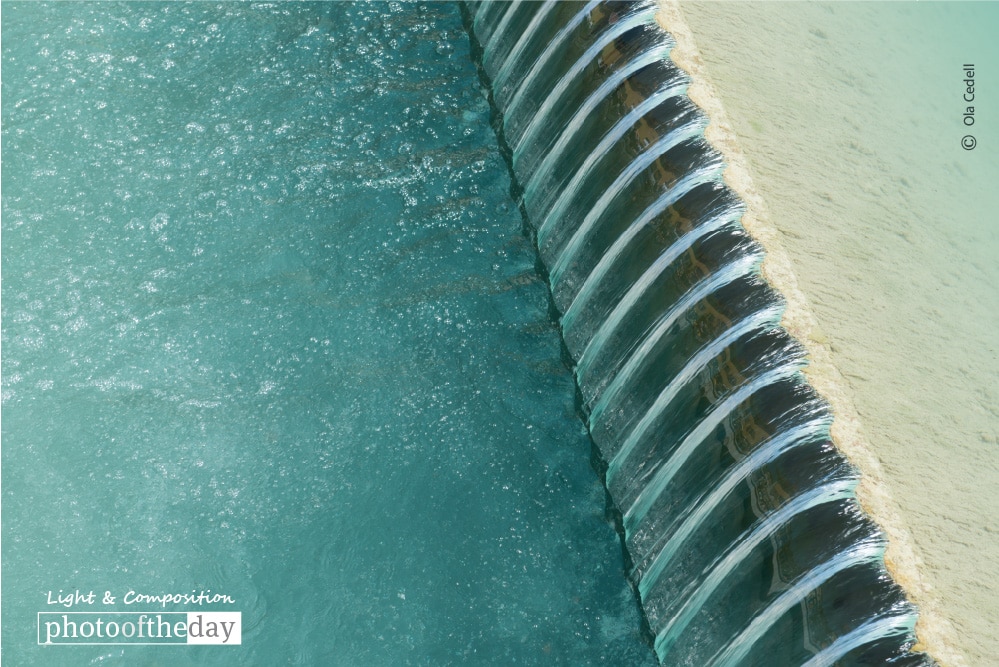
Exposure 1/200sec @ f/9 | ISO 200 | Focal Length 70mm
Ola Cedell
Born in southern Sweden in 1969, Ola Cedell has cultivated a diverse international perspective through his time living in Australia and Germany before returning to his home country. Balancing a professional career in engineering with a long-standing passion for photography, he specializes in landscape and food imagery. His work is deeply influenced by the natural beauty of the French Alps and the landscapes of southern Sweden, reflecting a keen eye for detail and a commitment to capturing the essence of his surroundings.
Resonance Score Breakdown
Transparency Note: The resonance score (12.7/20) is calculated based on social engagement metrics collected before the award announcement.
Expert Photography Reviews · 6
The Weight of Water
I keep a small, rusted iron key in a velvet pouch, though I have long since forgotten which door it once opened. It is heavy for its size, cold to the touch, and carries the faint, metallic scent of a time when locks were forged by hand.
Read the reflection →The Weight of Flowing
Water does not argue with the stone. It moves around it, or it moves over it, but it never stops to explain its path. We spend our lives building gates, trying to hold back the current, believing that if we can just control the flow, we might finally be still.
Read the reflection →Reviews & Comments
Share your thoughts about this award-winning photograph. Your reviews contribute to the community engagement score.
The Thiou’s rush against the masonry recalls the crisp, clinical precision of Atget’s architectural studies, yet it lacks his haunting, spectral stillness. While the D800’s sensor renders the stone with a sharpness that would have baffled Talbot, the composition feels tethered to a conventional postcard aesthetic. I’ve seen this floodgate rendered a thousand times, but the way the light catches the turbulence here—it’s genuinely refreshing. It’s a competent dialogue with tradition, even if it doesn’t quite break new ground.
The water pulls against the stone. It’s a rhythmic friction. I find myself holding my breath, waiting for the current to break the silence of the floodgate. The frame doesn’t crowd the eye. It leaves room for the river to breathe. Nothing here is accidental. The empty corner is not empty. It’s the weight of the pause. I’ve stood by the Thiou, but I’ve never felt its stillness quite like this. It’s enough.
The Thiou’s floodgate is rendered with a clinical, almost violent clarity that leaves no room for the soul to hide. It’s too bright, too eager to explain itself. Where is the hesitation? Where is the dark, churning uncertainty of the water? I’m left cold by such relentless illumination. It’s a technical triumph, sure, but it’s terrified of the abyss. I’d trade all that crisp architectural detail for just one honest, suffocating shadow.
The water hits the stone and time just stops. It’s a clean, sharp edit. Cedell caught the river’s pulse at 1/200th, freezing the rush without killing the momentum. I love how the light bites into the masonry; it’s the kind of frame an editor keeps because the rhythm is perfect. It doesn’t need a pan or a zoom. The shot holds its own weight. I’d give anything to stand there and hear that water hit the gate.
At f/9, the D800’s sensor resolves the Thiou’s turbulent surface with clinical precision, avoiding the diffraction limit while maintaining a razor-thin focal plane across the masonry. It’s a rare pleasure to see such controlled micro-contrast in moving water. The way the light refracts through those ripples, captured at 1/200sec, feels almost tactile. I’ve spent hours staring at the floodgate’s texture; it’s genuinely moving how the glass renders the fluid dynamics of that river so perfectly.
The floodgate’s masonry creates a rigid datum against the Thiou’s kinetic energy. It’s a classic architectural tension—solid against void, static against fluid. While the 1/200th shutter speed freezes the water, I’m struck by how the light rakes across the stone, revealing the texture of centuries of erosion. It doesn’t capture the sound of the rush, but it’s honest about the structure’s weight. I find myself wanting to walk across that threshold, feeling the spray.