Men with Suit by Fidan Nazim Qizi
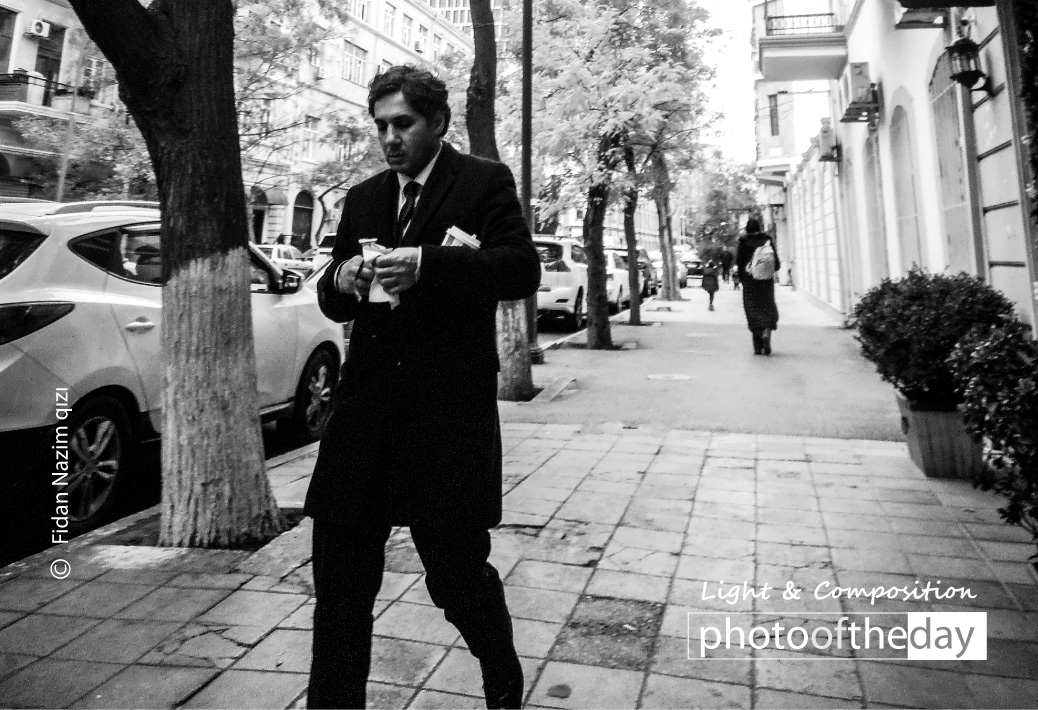
Captured on a bustling street, this photograph freezes a fleeting moment of a man in a suit moving with purposeful speed. The image evokes a nostalgic 1960s aesthetic, drawing a visual parallel to the evolution of men’s tailoring from the 1920s through the mid-century. By focusing on the sharp lines and classic silhouette of the subject, the photographer highlights the timeless nature of the suit. This piece is award-worthy for its ability to transform a mundane urban commute into a cinematic study of movement and style, effectively bridging the gap between contemporary street life and vintage sartorial elegance.
Fidan Nazim Qizi
Born in Baku, Azerbaijan, Fidan Nazim Qizi maintains her base in her home city while frequently traveling to capture the world around her. Her deep appreciation for nature and hiking often informs her creative perspective, though she is perhaps best known for her dedication to the black and white medium. Heavily influenced by the work of Vivian Maier, Fidan seeks to distill raw energy and human emotion into her frames. She views photography as a vital source of inspiration, using her lens to translate the feelings of life into enduring visual narratives.
Resonance Score Breakdown
Transparency Note: The resonance score (8.4/20) is calculated based on social engagement metrics collected before the award announcement.
Expert Photography Reviews · 8
The Rhythm of Passing
There is a quiet dignity in the way we move through the world, often unaware that our own stride creates a melody. We walk with purpose, our shoulders carrying the weight of the day, our feet tracing paths that have been worn smooth by those who came before us.
Read the reflection →The Weight of the Stride
I have always been suspicious of the man in the suit. There is a performance in the tailoring, a rigid architecture meant to signal that the wearer is going somewhere important, that he has a destination that justifies the starch and the seam.
Read the reflection →Reviews & Comments
Share your thoughts about this award-winning photograph. Your reviews contribute to the community engagement score.
The city’s light here isn’t just illumination; it’s a weight, pressing against the sharp geometry of his suit. He’s moving through the bustle, yet he seems anchored by the stillness of the stone behind him. I’ve spent enough hours waiting for the sun to hit a ridge to recognize that quiet focus. It’s a lonely, beautiful rhythm. I feel a strange, sudden ache for the way he carries the past into this modern, hurried Baku afternoon.
Baku’s urban grain is lost here, flattened into a mere backdrop for a silhouette. The architecture’s rhythm—its fenestration and the crucial datum lines of the street—is sacrificed for the subject’s movement. I’m frustrated; the frame omits the threshold where this man actually exists. It’s a missed opportunity to explore how light hits the stone surfaces of the city. Still, I’ve got to admit, the way the light catches his lapel makes me ache for the city’s texture.
It’s a sharp, clean frame, but I find myself craving the messy unpredictability of the wild. Street photography feels like a shortcut compared to the weeks I’ve spent shivering in a blind, waiting for a wolf to trust my scent. This man in his suit didn’t need to be earned; he was just caught. It’s technically precise, sure, but it lacks the profound, quiet intimacy that comes when you finally disappear into the landscape.
The vertical axis of the subject’s lapel creates a perfect perpendicular tension against the horizontal blur of the Baku street. It’s a 1:3 ratio of sharp silhouette to chaotic motion that anchors the frame. I’m genuinely thrilled by how the suit’s geometry cuts through the negative space, solving the chaos of the commute with pure, rigid lines. It’s a beautifully calculated equation of stillness amidst the urban drift. The math here is simply elegant.
The shutter speed is perfect. It’s a blur of Baku pavement, but the suit holds its line. I’ve seen this rhythm before; it’s the walk of a man who knows exactly where the scene ends. The motion isn’t just captured, it’s directed. I love the way the fabric cuts through the city’s noise. It’s a frame the editor keeps because the cut would’ve been a mistake. He’s moving, yet he’s perfectly still. Pure cinema.
You caught him in that blur of motion, and it’s the urgency that gets me. I’ve spent enough time on city streets to know that look—the weight of a day already pressing down on his shoulders. It isn’t just about the suit or the vintage aesthetic. It’s the way he’s leaning into the wind. You waited for the right heartbeat to press that shutter. And I felt that rush of life right there.
Baku’s streetlights blur, mimicking the photon trails I usually chase across the Milky Way. While I’m used to sensors struggling against thermal noise, Fidan captures this man’s movement with a shutter speed that feels like a heartbeat. It’s a fleeting, terrestrial exposure. I find myself holding my breath, watching him stride through the city’s glow. It’s strange, really—how a simple suit can anchor us to the present when the stars above are already ghosts.
We see a man cutting through Baku’s bustle, his suit a sharp, mid-century armor against the modern blur. Fidan Nazim Qizi hasn’t just captured a silhouette; she’s caught the rhythm of a life lived in motion. I find myself wondering where he’s rushing to, and who he was before he stepped into that frame. It’s a quiet, cinematic ache. I’d love to know the conversation he had with the city before he walked past.