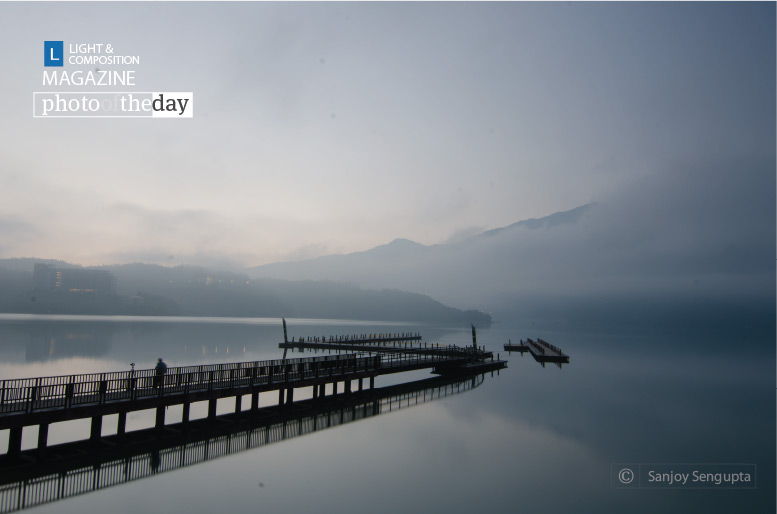
Misty Morning by Sanjoy Sengupta
Captured at the serene Sun Moon Lake in Taiwan, this photograph depicts the ethereal beauty of a mountain-top reservoir at dawn. The photographer navigated a long, early-morning trek to the pier, meticulously timing the shot to catch the interplay of light and mist across the water. By utilizing a long exposure of ten seconds, the photographer transformed the shifting atmosphere into a smooth, dreamlike landscape. This image is award-worthy for its masterful command of light and composition, successfully translating the quiet, majestic stillness of the Nantou district into a compelling visual narrative that invites the viewer into the heart of the morning.
Sanjoy Sengupta
Based in Muscat, Oman, Sanjoy Sengupta has cultivated a lifelong passion for photography that evolved from early experiments with point-and-shoot and film cameras to a dedicated mastery of Nikon DSLR systems. His artistic journey is defined by a persistent desire to capture the fleeting, cherished moments of life through a refined technical lens. Through years of hands-on learning and a commitment to documenting the world's beauty, Sengupta has developed a keen eye for atmospheric landscapes, consistently seeking to elevate his craft with every frame he captures.
Resonance Score Breakdown
Transparency Note: The resonance score (11.4/20) is calculated based on social engagement metrics collected before the award announcement.
Expert Photography Reviews · 4
The Breath of the Earth
There is a moment just before the sun fully claims the sky when the world holds its breath. The earth exhales, and a thin, silver veil rises from the water to meet the cooling air. It is a quiet surrender, a blurring of the lines between what is solid and what is merely a dream.
Read the reflection →The Weight of Breath
There is a moment before the world wakes when the air holds its breath. It is a heavy, grey suspension. We spend our lives trying to name things, to pin them down with language, but some things exist only in the blur.
Read the reflection →Reviews & Comments
Share your thoughts about this award-winning photograph. Your reviews contribute to the community engagement score.
When I see this photo I remember old times . I thinks this is because for the fog mountains.
I love the composition and the lighting of the photo. I also like the symmetry as well.
The horizon line anchors the frame, providing a necessary fulcrum against the ethereal blur of the water. It’s a disciplined use of the 15mm focal length. The negative space doesn’t collapse; it breathes. I’ve grown weary of such atmospheric subjects, yet the structural integrity here holds. The long exposure creates a tonal gradient that refuses to dissolve into sentimentality. It’s a rare instance where the stillness doesn’t feel like a crutch. The architecture is sound.
Before the eye identifies the pier, something in the chest softens. The ten-second exposure turns the water into a vast, unblinking eye, pulling my own pulse down to match its stillness. It’s a quiet I’ve felt in dreams, that heavy, damp silence of a morning before the world wakes. When I return to this, I don’t see Taiwan; I feel the cold mist clinging to my skin, a lingering, beautiful ache of solitude.
Sun Moon Lake is a tourist trap, yet here the water looks genuinely silent. That ten-second exposure suggests Sengupta didn’t just stumble onto the pier for a quick snap; he likely shivered through the damp dawn while the tourists were still in bed. It’s a quiet, disciplined bit of work. I’ve spent enough mornings freezing in similar mist to appreciate the patience required to let the water settle this perfectly. He earned this stillness.
The palette here evokes the muted, chalky stillness of a Morandi study, where the grey of wet slate dissolves into the pale, bruised violet of dawn. It’s a haunting, liquid silence that makes my own breath hitch, as if the mist itself were pressing against my skin. One finds the tonal transitions so impossibly soft, like Turner’s vaporous horizons, that the water doesn’t merely reflect the sky; it consumes it in a slow, melancholic embrace.