Spring is Here by Bawar Mohammad
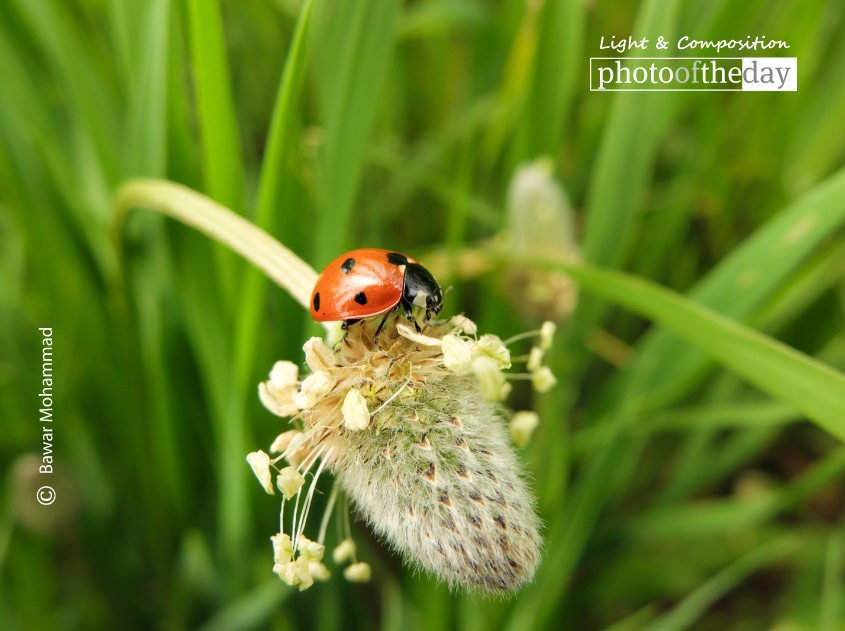
Captured at the onset of the spring season in Duhok, this image highlights the delicate presence of ladybugs within the local landscape. The photographer utilized a macro-focused approach to isolate the subject against the vibrant backdrop of nature, emphasizing the intricate patterns and vivid coloration of the insect. By documenting this fleeting moment of seasonal transition, the photograph serves as a testament to the beauty found in small, often overlooked details of the natural world. Its technical clarity and thoughtful composition earned it recognition as a standout piece of nature photography.
Bawar Mohammad
Born in 1985 in Duhok, Kurdistan, Bawar Mohammad is a computer science graduate from the University of Duhok who has dedicated his career to the intersection of culture, journalism, and the visual arts. Currently serving within the directorate-general of culture and arts, he balances his professional responsibilities with a passionate pursuit of freelance photography. His work focuses on documenting the essence of life, nature, and human experience, with a dedicated ambition to share the rich artistic heritage of his nation with a global audience.
Resonance Score Breakdown
Transparency Note: The resonance score (13.3/20) is calculated based on social engagement metrics collected before the award announcement.
Expert Photography Reviews · 6
The Weight of Small Things
In the quiet corners of a garden, there is a rhythm that ignores the frantic pace of our human clocks. We measure our days in meetings and deadlines, while the earth measures hers in the slow unfurling of a leaf or the deliberate crawl of a creature no larger than a fingernail.
Read the reflection →The Unseen Inhabitants
We often mistake the city for a collection of concrete, steel, and glass, forgetting that the urban fabric is merely a stage for a much larger, non-human drama.
Read the reflection →Reviews & Comments
Share your thoughts about this award-winning photograph. Your reviews contribute to the community engagement score.
The ladybug’s placement creates a precarious fulcrum against the blurred foliage. It’s a study in spatial tension. The macro depth of field isolates the subject, yet the background’s chaotic tonality threatens to collapse the frame. It doesn’t quite achieve total equilibrium. I’ve grown tired of such fragile subjects, but the way the insect’s rigid geometry anchors the composition is undeniable. It’s a disciplined exercise in containment. The frame holds, though only just.
1/125sec at f/4, 7.1mm on a small sensor. It’s a compromise. The Fuji X30’s 2/3-inch sensor struggles here; the depth of field is too deep to truly isolate the ladybug, yet too shallow to render the background anything but a distracting, noisy blur. I’ve spent years staring at these sensor limitations, and it’s frustrating. The technical execution doesn’t support the macro intent. It’s a snapshot that missed the mark on optical separation.
A single ladybug. It clings to the curve of a leaf. The rest of the frame dissolves into a soft, green blur. I’ve spent minutes just watching the way the light catches its shell. It’s quiet here. The vast, out-of-focus space isn’t just background. It’s the breath between heartbeats. Nothing here is accidental. The empty corner is not empty. It’s a stillness I haven’t felt in a long time. It’s enough.
At f/4, the FujiFilm X30’s sensor captures the ladybug’s elytra with startling precision. The focal plane is razor-thin, yet it resolves the chitinous texture that our eyes usually blur into mere color. I’m genuinely moved by how the diffraction of light across that curved, polished surface reveals the insect’s microscopic topography. It’s a rare moment where the lens’s optical limits align perfectly with the subject’s scale. It doesn’t just show spring; it maps its smallest, most vibrant architecture.
In Duhok, spring arrives not with a shout, but with the quiet arrival of a ladybug. We look at this tiny traveler and we’re reminded that every life has a story, even those we usually step over. Bawar Mohammad didn’t just look; he listened to the silence of the grass. It’s a tender portrait of a creature finding its way. I find myself holding my breath, hoping it stays a while longer. It’s truly beautiful.
The scarlet of the ladybug’s carapace, a shade reminiscent of Vermeer’s most saturated vermilion, vibrates against the verdant, mossy blur of the Duhok spring with such startling intensity that it’s impossible not to feel a sudden, sharp intake of breath. One finds the chromatic tension here exquisite; it’s a dialogue between the insect’s polished, lacquered heat and the cool, liquid emeralds of the background, creating a harmony that feels, quite frankly, like a quiet, living miracle.