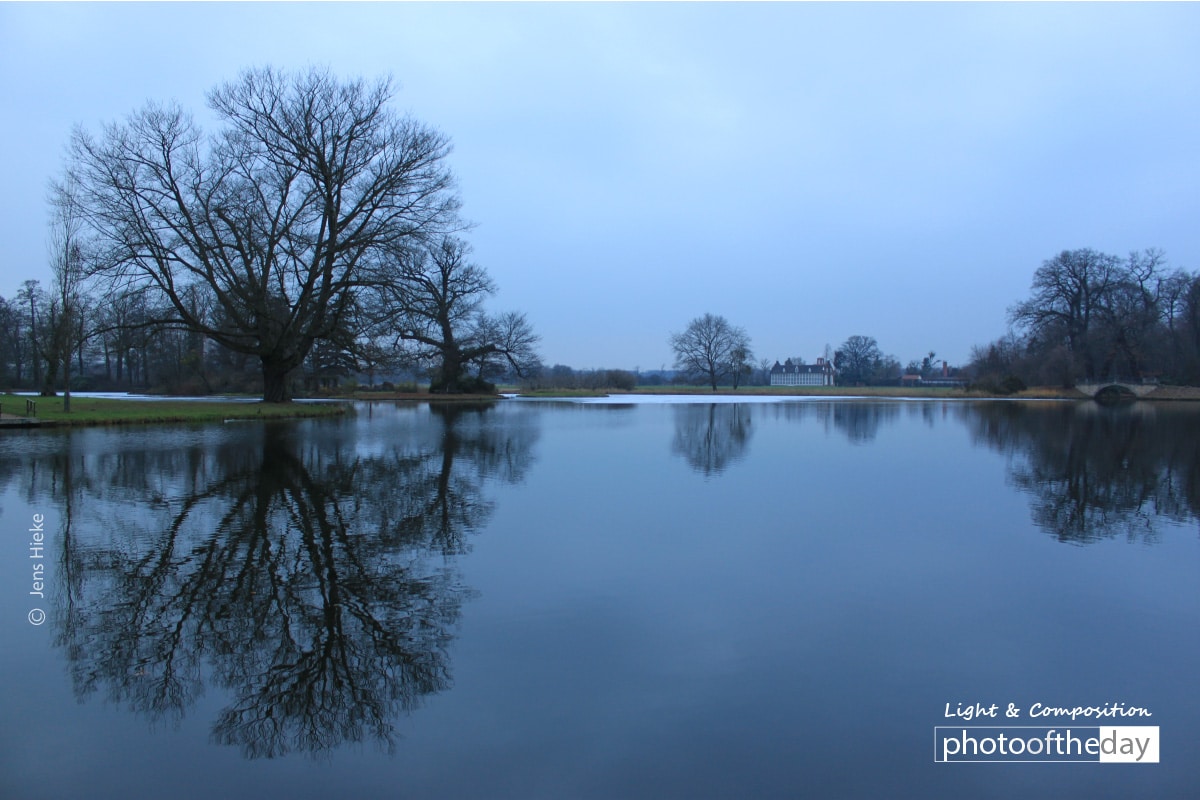
Blue Hour by Jens Hieke
Captured during the serene blue hour at Wörlitzer Park in Dessau, Germany, this image portrays the historic landscape in a moment of profound stillness. By choosing a wide-angle perspective, the photographer emphasizes the mirror-like reflections of 18th-century trees upon the undisturbed water, highlighting the park's Enlightenment-era design. The composition is award-worthy for its masterful use of natural light and the deliberate exclusion of human presence, which allows the viewer to experience the park’s architectural and natural harmony in complete silence. The technical precision of the exposure perfectly balances the cool, ambient tones of the twilight sky.
Jens Hieke
Born in 1967, Jens Hieke is a German photographer based in Leipzig, Saxony. A former librarian and broadcaster, he transitioned from a career in literature to photography, finding it the ideal medium to document the transient beauty of the world. His work reflects a deep fascination with the diversity of nature and human life, which he captures with a keen eye for atmospheric detail and narrative depth.
Resonance Score Breakdown
Transparency Note: The resonance score (10.8/20) is calculated based on social engagement metrics collected before the award announcement.
Expert Photography Reviews · 5
The Weight of Still Water
There is a silence that arrives before the night fully settles. It is not the absence of sound, but the presence of a pause. In the north, we know this weight.
Read the reflection →The Silence of Mirrors
Why do we feel a sudden, sharp ache when we encounter a world that does not need us? We spend our lives trying to leave a mark, to carve our names into the bark of time, yet there are places that exist in a state of perfect, indifferent grace.
Read the reflection →Reviews & Comments
Share your thoughts about this award-winning photograph. Your reviews contribute to the community engagement score.
Wörlitzer Park is a sanctuary, yet I find myself searching the edges of this frame for the life that should be there. It’s technically precise, sure, but it feels hollow. Where are the ripples from a feeding mallard or the wake of a beaver? By prioritizing the architectural stillness of the Enlightenment, Hieke has extracted a landscape devoid of its pulse. I’d trade that perfect mirror reflection for a single, honest sign of wild movement.
The blue hour isn’t a transition; it’s a suspension of the world’s breath. In Hieke’s Wörlitzer Park, the shadows don’t merely cling to the trees—they anchor the reflection, forcing the water to hold a weight it shouldn’t possess. I’ve stared at these dark, submerged silhouettes until my own pulse slowed to match the stillness. It’s a haunting, cold clarity. When light retreats this far, it doesn’t leave us; it forces us to finally confront the void.
Most landscape photography today is just noise, but Hieke’s work holds a rare, quiet gravity. Of the thousands I’ve reviewed, few capture the Enlightenment’s stillness this effectively. The mirror-like reflection isn’t just technical precision; it’s a deliberate invitation to pause. I felt a genuine shiver looking at that water—it’s so perfectly undisturbed, it feels like time stopped. It’s not just a pretty park; it’s a memory of silence that will still matter in thirty years.
You’ve captured a stillness that’s almost heavy. I’ve walked through places like this, and there’s a specific kind of loneliness that settles in when the light dies. It’s quiet, sure, but it’s the silence of someone holding their breath. Because you kept the frame empty, I found myself looking for a ghost in those reflections. You waited for the world to stop moving, and I felt that pause in my own chest. It’s honest work.
The frame breathes. It’s a long, static take where the light refuses to fade, holding the stillness of Wörlitzer Park in a perfect, icy grip. I’ve spent hours watching rushes, but this—this is the frame the editor keeps. The 18mm lens stretches the silence until it’s almost deafening. It’s haunting. I feel like I’m waiting for a character to step into the reflection, but the cut never comes. It doesn’t need to. It’s already complete.