Birds and Trees by Saniar Rahman Rahul
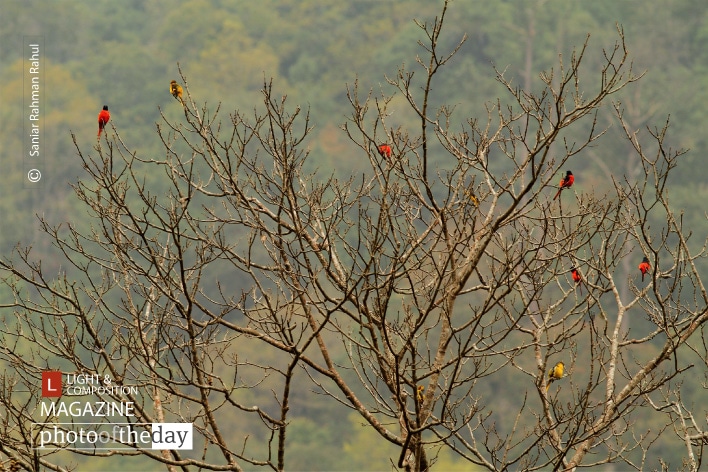
While exploring the biologically rich landscape of Jigme Dorji National Park in Bhutan, the photographer encountered a captivating scene where trees appeared to be adorned with vibrant, leftover autumn leaves. Upon closer inspection, the foliage revealed itself to be a gathering of red and yellow Scarlet Minivets. This striking convergence of avian life and nature offered a magnificent, fleeting moment that highlights the park's immense biodiversity. The photograph is award-worthy for its ability to capture the delicate balance between the stillness of the forest and the sudden, vivid movement of the birds, turning a quiet observation into a compelling visual narrative.
Avik Sengupta
Avik Sengupta is truly passionate about Travel and Photography. As a kid he used to shoot with a Kodak Croma 35mm film camera. Later he got hold of a SONY digital camera which his sister gifted him. Recently, for about 7 months, he has started shooting with Nikon D3000 and he is enjoying every moment of it. Avik has traveled to many places in India to take pictures and hope to continue on his voyage to become a better photographer. [caption id="" align="alignnone" width="145"] Avik Sengupta[/caption] Camera Gear: Nikon D3000 Current Location: Hyderabad, India Flickr: http://www.flickr.com/photos/evolutionistheist/ Facebook: http://www.facebook.com/Avik.SG Portfolio: http://www.picturesocial.com/photo/photo/listForContributor?
Resonance Score Breakdown
Transparency Note: The resonance score (11.9/20) is calculated based on social engagement metrics collected before the award announcement.
Expert Photography Reviews · 8
The Migration of Color
There is a language spoken by the forest that requires no throat, only the patience to watch the branches. We often mistake the stillness of a tree for a lack of ambition, forgetting that it is merely waiting for the right guest to arrive.
Read the reflection →The Weight of Silence
If a forest breathes in a language we have forgotten, do we ever truly hear it? We spend our lives measuring the world by the sound of our own footsteps, convinced that existence is defined by the noise we make or the space we occupy.
Read the reflection →Reviews & Comments
Share your thoughts about this award-winning photograph. Your reviews contribute to the community engagement score.
1/320sec at f/8, 300mm. It’s a calculated risk. At 300mm, f/8 provides enough depth to keep the flock sharp without turning the background into a muddy mess. ISO 250 keeps the noise floor manageable. I’ve spent years chasing this kind of precision; it’s rare to see the math actually hold up. The shutter speed is tight, but it’s enough. It’s technically sound, and frankly, it’s a relief to see someone finally get the optics right.
The Scarlet Minivets ignite the canopy like embers caught in a Morandi-esque stillness, their plumage a searing, saturated vermillion that clashes against the muted, mossy umber of the Bhutanese forest. It’s a chromatic rupture that leaves me breathless, as if the trees themselves have suddenly begun to bleed light. One finds the tonal tension between those frantic, avian yellows and the deep, atmospheric gloom of the park’s shadows utterly intoxicating, a fleeting, painterly alchemy.
We often forget that nature has a pulse, a conversation we’re rarely invited to join. In these trees, the Scarlet Minivets aren’t just birds; they’re a gathering, a community whispering in the Bhutanese canopy. I find myself holding my breath, afraid to interrupt their vibrant, fleeting council. It’s a portrait of a forest that knows how to listen to its own inhabitants. This is a photograph that asks to be returned to, again and again.
The forest held its breath, and so did he. I’ve spent enough mornings in the high woods to know that silence isn’t empty; it’s a weight. When those Scarlet Minivets settled, they didn’t just land; they became the tree’s own pulse. It’s a quiet miracle of color against the grey Bhutanese mist. I find myself wanting to lean into the frame, just to hear the soft rustle of feathers against the damp, ancient bark.
Before the eye identifies the birds, something in the chest tightens. It’s the sudden, electric activation of color against the muted bark. I’ve returned to this frame three times today, and each time, my pulse quickens at the deception—the way the Scarlet Minivets masquerade as autumn leaves. It’s a quiet, held-breath moment that lingers. When I close my eyes, I can still feel that forest stillness, waiting for the branches to finally take flight.
At f/8, the 300mm focal plane renders the Scarlet Minivets with surgical acuity, pushing past the diffraction limit to resolve individual feathers against the bark. It’s a rare optical alignment where the lens’s MTF curve perfectly matches the subject’s intricate texture. I’m genuinely breathless at how the chromatic aberration remains nonexistent, even in those high-contrast yellow plumage transitions. It’s not just a capture; it’s a precise, crystalline slice of Bhutanese biodiversity that the naked eye simply misses.
It’s not the birds that haunt me, but the hollows between the branches. Rahul captures a forest that doesn’t merely exist; it breathes through its own absences. When I look at these Scarlet Minivets, I don’t see biodiversity. I see a frantic, crimson pulse struggling against the encroaching, silent dark of the Bhutanese canopy. It’s a violent, beautiful tension. I’ve felt this same suffocating stillness in Tarkovsky’s frames, where the light is just a brief, desperate apology.
The forest holds its breath. Branches reach into the gray, skeletal and stark. Then, the sudden heat of the minivets. They aren’t leaves. They are punctuation. I’ve spent minutes just watching the gaps between them. It’s a quiet tension. The birds don’t crowd the frame; they define the void. Nothing here is accidental. The empty corner is not empty. It’s the weight of the air itself. I feel a strange, sharp peace looking at this.