In Search of Happiness by Sammam Junaid
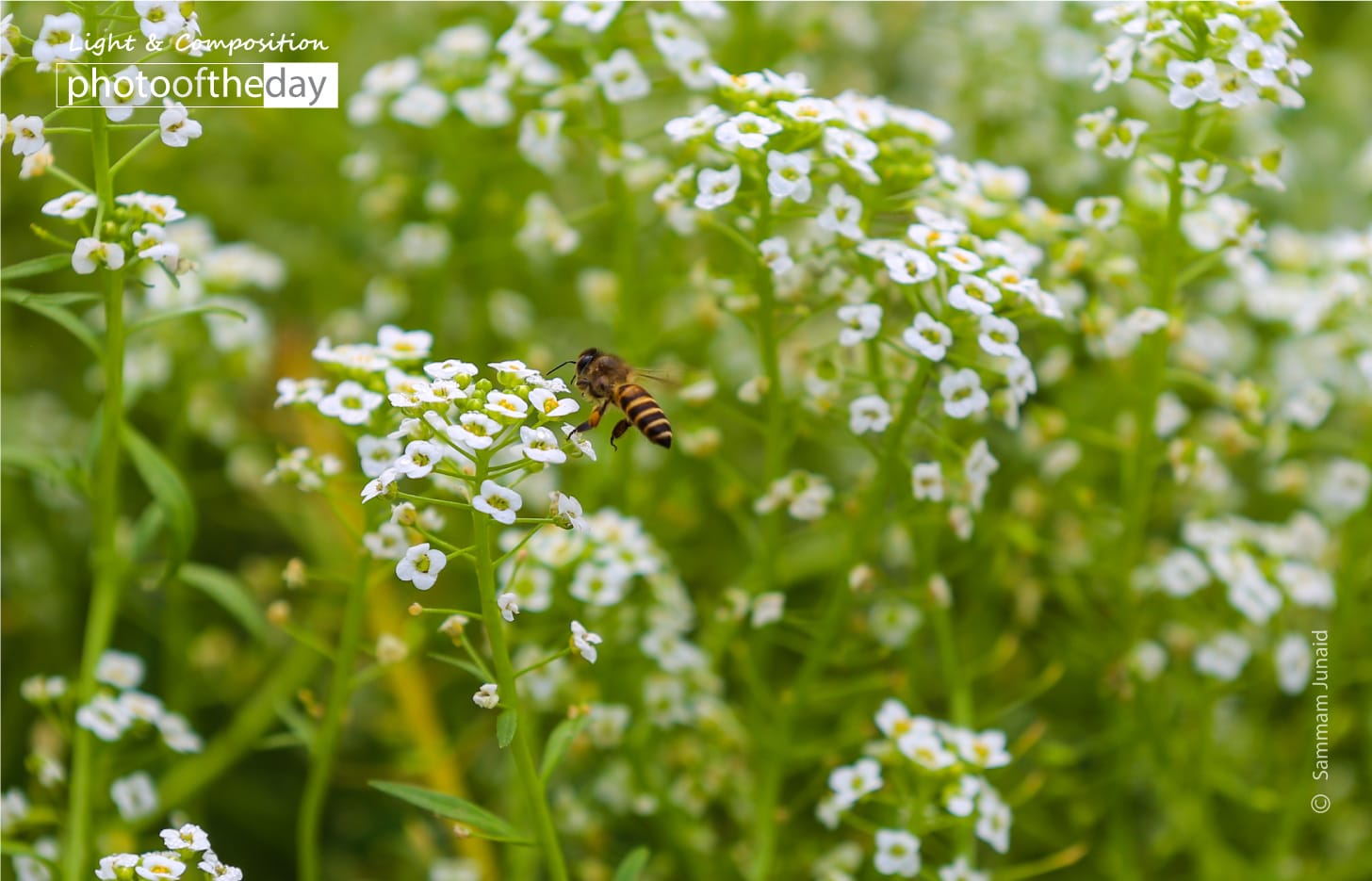
In the lush surroundings of The Palace in Bahubal, Sylhet, the photographer observed a poignant parallel between the natural world and human ambition. By capturing a bee diligently collecting nectar, the image serves as a visual metaphor for the universal pursuit of happiness and the sacrifices made to achieve one's dreams. The composition highlights the delicate interplay between flora and fauna, rendered with a keen eye for detail. This award-winning shot is distinguished by its ability to transform a simple, fleeting moment in nature into a profound philosophical reflection on the essence of life and purpose.
Sammam Junaid
Born in Bangladesh in 2003, Sammam Junaid is a self-taught photographer currently based in Dhaka. A student at Notre Dame College, he possesses a deep-seated curiosity for the natural world, which drives his creative process and his dedication to capturing the beauty of his homeland. Though he lacks formal academic training in photography, his active involvement in various photography groups has helped him refine his unique perspective on nature and life, earning him recognition for his evocative and thoughtful imagery.
Resonance Score Breakdown
Transparency Note: The resonance score (5.9/20) is calculated based on social engagement metrics collected before the award announcement.
Expert Photography Reviews · 3
The Labor of Contentment
Epictetus famously reminded his students that we are not disturbed by things themselves, but by the views we take of them.
Read the reflection →The Weight of the Nectar
My grandmother’s garden was a map of things that had stopped moving.
Read the reflection →Reviews & Comments
Share your thoughts about this award-winning photograph. Your reviews contribute to the community engagement score.
A bee on a petal is a tired trope, yet here it’s framed as a grand philosophical inquiry. Does the insect truly labor for happiness, or are we just projecting our own restless ambition onto a creature that doesn’t know we’re watching? I find the curator’s heavy-handed metaphor exhausting. Why must we colonize nature’s simple survival with our human anxieties? It’s technically sharp, sure, but it feels like a hollow exercise in aestheticizing the mundane.
The bee’s trajectory creates a sharp diagonal, slicing the frame into a precise golden ratio. Its body anchors the lower-left quadrant, balancing the heavy, blurred floral mass above. I’m genuinely captivated by how the radial symmetry of the petals pulls the eye toward the central vector. It’s a perfect spatial equation where the insect’s velocity resolves the static tension of the bloom. It’s not just nature; it’s a beautifully calculated collision of form and movement.
Macro photography often risks falling into the clinical trap of Blossfeldt’s botanical studies, yet here the bee’s frantic industry against the petal’s soft geometry feels refreshingly urgent. It’s a delicate dance, echoing the precision of early micro-cinematography, though it avoids that sterile detachment. I’m genuinely moved by the way the light catches the wing’s translucency; it’s a fleeting, golden vulnerability that reminds me why I’ve spent decades staring at these tiny, perfect fragments of existence.