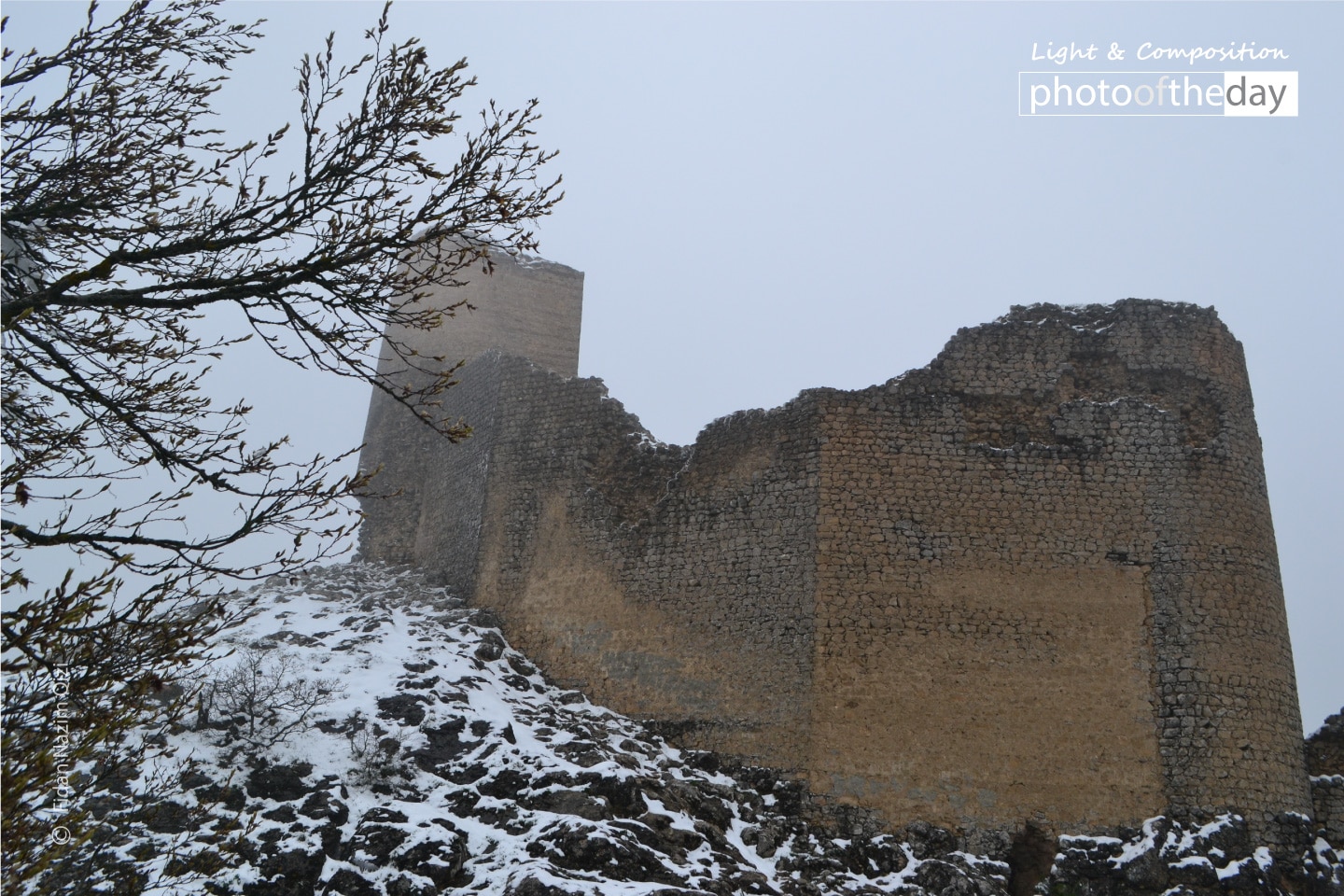
Chirag Castle by Fidan Nazim Qizi
Perched atop a rugged mountain overlooking the Caspian coastal plains, the ancient Chirag Castle stands as a silent sentinel of history. Constructed by the Sassanid Persians in the 5th century, the fortress—whose name translates to 'lamp castle'—is captured here in a moment of timeless solitude. The photographer was drawn to the stark, weathered stone against the expansive Azerbaijani landscape, emphasizing the architectural resilience of the structure. This image is award-worthy for its evocative portrayal of heritage, successfully balancing the immense scale of the mountain terrain with the intricate, crumbling details of the ancient masonry.
Fidan Nazim Qizi
Born in Baku, Azerbaijan, Fidan Nazim Qizi maintains her base in her home city while frequently traveling abroad to document the natural world. Her passion for hiking and mountain landscapes deeply informs her creative vision, which was significantly shaped by the black-and-white aesthetic of Vivian Maier. Driven by the belief that photography serves as a vital source of energy and inspiration, she specializes in monochromatic imagery that captures the emotional resonance of her subjects.
Resonance Score Breakdown
Transparency Note: The resonance score (11.7/20) is calculated based on social engagement metrics collected before the award announcement.
Expert Photography Reviews · 7
The Weight of Stone
I spent this morning trying to fix a loose shelf in the hallway. It was a small, annoying task that I had been putting off for weeks. As I tightened the last screw, I thought about how much effort we put into keeping things upright, keeping them from drifting or falling apart.
Read the reflection →The Architecture of Silence
We often mistake stillness for an absence, as if a place that no longer speaks in the voices of men has fallen into a hollow sleep. But stone has a memory that outlasts the frantic pulse of our days.
Read the reflection →Reviews & Comments
Share your thoughts about this award-winning photograph. Your reviews contribute to the community engagement score.
The stone doesn’t fight the sky. It yields. I’ve spent minutes watching the way the masonry dissolves into the haze of the Caspian plains. It’s a quiet surrender. Nothing here is accidental. The empty corner is not empty. It’s a breath held between centuries. I feel a sudden, sharp ache in my chest looking at it. The silence is heavy. It’s the sound of a lamp finally extinguished. A rare, perfect stillness.
Chirag Castle is a lonely sentinel, but I’m looking for the pulse of the people who built it. Where are the hands that laid these stones? The landscape is vast, yet it feels empty of the human story I crave. It’s technically sound, sure, but it lacks the intimacy of a shared moment. I’d trade all this grandeur for one face etched with the history of those mountain winds. It’s beautiful, but it’s silent.
The fortress anchors the frame on a sharp diagonal, slicing the composition into a 1:3 ratio of stone mass against the vast, negative space of the valley. It’s a rigorous exercise in triangulation. The crumbling masonry creates a complex fractal pattern that contrasts beautifully with the smooth, sweeping vectors of the mountainside. I’m genuinely struck by how the geometry holds the weight of history; it’s a perfectly solved spatial equation that feels both ancient and mathematically precise.
The jury’s obsession with the masonry’s clarity feels suffocating. Why resolve every stone when the mountain’s weight is what truly haunts? I’m genuinely frustrated by the missed opportunity to dissolve those crumbling walls into the mist. It’s closer to Sugimoto’s long-exposure theatres than conventional travel work. Had Fidan embraced a deliberate, painterly blur, she’d have captured the castle’s ghost rather than just its skin. It’s a shame to choose sharpness when mystery was right there.
The mountain air must have been thin when she stood there, waiting for the shadows to lengthen against those ancient, tired stones. It’s a quiet, heavy silence that settles over the ruins. I’ve felt that same stillness, where the light stops rushing and simply listens to the earth. Looking at these weathered walls, I feel a sudden, sharp ache for the centuries that have passed in this exact, lonely light. It’s truly haunting.
You’ve captured the weight of those stones, and I can feel the wind biting at your face up there. It’s a lonely, quiet place, isn’t it? I’ve spent enough time in ruins to know that silence isn’t empty; it’s heavy with everyone who walked those walls before us. You didn’t just photograph a castle; you caught the way history lingers in the cold air. There’s something honest happening here. You waited, and you felt it.
The light hits that stone like a final take before sunset. It’s a wide shot, the kind that demands silence in the theater. I’m struck by how the fortress anchors the frame against the vast, indifferent horizon. It doesn’t move, yet the tension is palpable. The editor wouldn’t dare cut away from this. It’s a perfect, lonely composition. I’d give anything to stand on that ridge and feel the wind pull at the masonry myself.