To Victory by Shahnaz Parvin
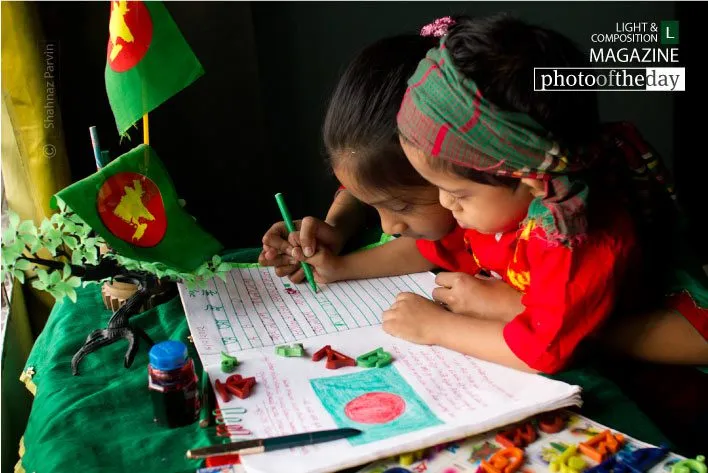
Captured during rehearsals for a school Victory Day program, this candid portrait features the photographer’s niece and nephew embodying the spirit of Bangladesh. The image serves as a poignant reflection on the nation's history, with the red and green hues symbolizing the sacrifices of 1971 and the enduring hope for a prosperous future. By focusing on the innocence and ambition of the next generation, the photographer creates a powerful narrative of resilience. The image is award-worthy for its ability to transform a personal family moment into a profound cultural statement, balancing technical precision with deep emotional resonance.
Shahnaz Parvin
Based in Dhaka, Bangladesh, Shahnaz Parvin balances a professional career as a system administrator with a profound dedication to the art of photography. Her work is deeply rooted in documentary storytelling, driven by a desire to capture and share the authentic spirit of her homeland with an international audience. Her evocative imagery has earned recognition in various renowned global publications, establishing her as a sensitive observer of the human condition and the vibrant culture of Bangladesh.
Resonance Score Breakdown
Transparency Note: The resonance score (11.8/20) is calculated based on social engagement metrics collected before the award announcement.
Expert Photography Reviews · 8
The Weight of Small Hands
In the quiet corners of a house, history often hides in plain sight. We tend to think of the past as something etched in stone or bound in heavy, dusty volumes, but it is far more fluid than that.
Read the reflection →The Weight of Tomorrow
I spent this morning watching my neighbor’s kids play in the alleyway. They were wearing oversized cardboard crowns, marching back and forth with such serious, heavy-footed determination that I couldn't help but smile.
Read the reflection →Reviews & Comments
Share your thoughts about this award-winning photograph. Your reviews contribute to the community engagement score.
At f/3.5, the Canon’s sensor struggles with the ISO 1600 noise, yet the focal plane captures a startling intimacy. The bokeh, a function of that wide aperture, renders the background into a soft, chromatic wash that isolates the children’s expressions. It’s the diffraction of light across their eyes that truly moves me; it’s a fragile, optical miracle. I’ve rarely seen such raw, human ambition resolved with this level of delicate, scientific precision. It’s simply beautiful.
Shadows here don’t merely frame the children; they anchor their fragile ambition against the encroaching dark of history. It’s a heavy, suffocating weight that makes their bright, patriotic colors ache with a desperate, almost violent, hope. I’ve stared at the way the darkness swallows the edges of their faces, and it honestly frightens me. Parvin understands that to capture a nation’s future, one must first acknowledge the ghosts that refuse to leave the room.
The frame’s geometry is tight, almost claustrophobic. It’s a calculated arrangement of mass. The subjects’ alignment creates a vertical axis that anchors the chaos of the background. I’m struck by the harsh, clinical light; it doesn’t soften the subjects, it defines them. The negative space is sparse, forcing the eye back to the central fulcrum. It’s a rigid, disciplined structure. It doesn’t rely on sentiment. It holds because the architecture is sound.
It’s easy to snap a niece and nephew in costume, but catching that specific, fleeting glint of defiance in their eyes requires more than a quick shutter press. One wonders how many rehearsals Shahnaz endured before the light finally hit just right. I’ve spent enough hours in damp fields to recognize when someone has actually waited for the moment to arrive. It’s a quiet, earned triumph. I find myself genuinely moved by their small, steady gaze.
Most candid shots of children are fleeting, but this one sticks. Of the thousands I’ve reviewed, few capture such quiet, unforced gravity. The way the light catches their eyes while they rehearse isn’t just a family memory; it’s a historical echo. I find myself genuinely moved by the weight they carry in those small, solemn faces. It’s the rare shot that’ll still matter in thirty years because it captures the exact moment innocence meets national identity.
The light here isn’t just illumination; it’s a soft, indoor glow that feels like a held breath. I’ve spent enough time in Dhaka to know that specific, humid haze. She stood there, waiting for the children to settle into their roles, listening to the quiet weight of history in their eyes. It’s a tender, fragile stillness. Looking at their faces, I feel a sudden, sharp ache for the future they’re carrying. It’s truly beautiful.
Two children. A sliver of green fabric. The rest is shadow. I’ve spent minutes watching the way the light catches their faces, then drifts into the dark. It’s quiet here. The frame doesn’t crowd them. It lets them breathe. I feel a sudden, sharp ache for the simplicity of their focus. Nothing here is accidental. The empty corner is not empty. It holds the weight of everything they haven’t yet had to carry.
The verdant green of the fabric, reminiscent of a Morandi still life’s muted, dusty depth, collides with that piercing, arterial red, creating a chromatic tension that’s frankly breathtaking. It’s a visceral, rhythmic pulse of national identity, where the light doesn’t merely illuminate but breathes through the subjects, casting a warmth that feels like a soft, humid embrace. I’ve found myself utterly captivated by how these pigments vibrate, humming with a quiet, persistent, and deeply moving hope.
Great capture