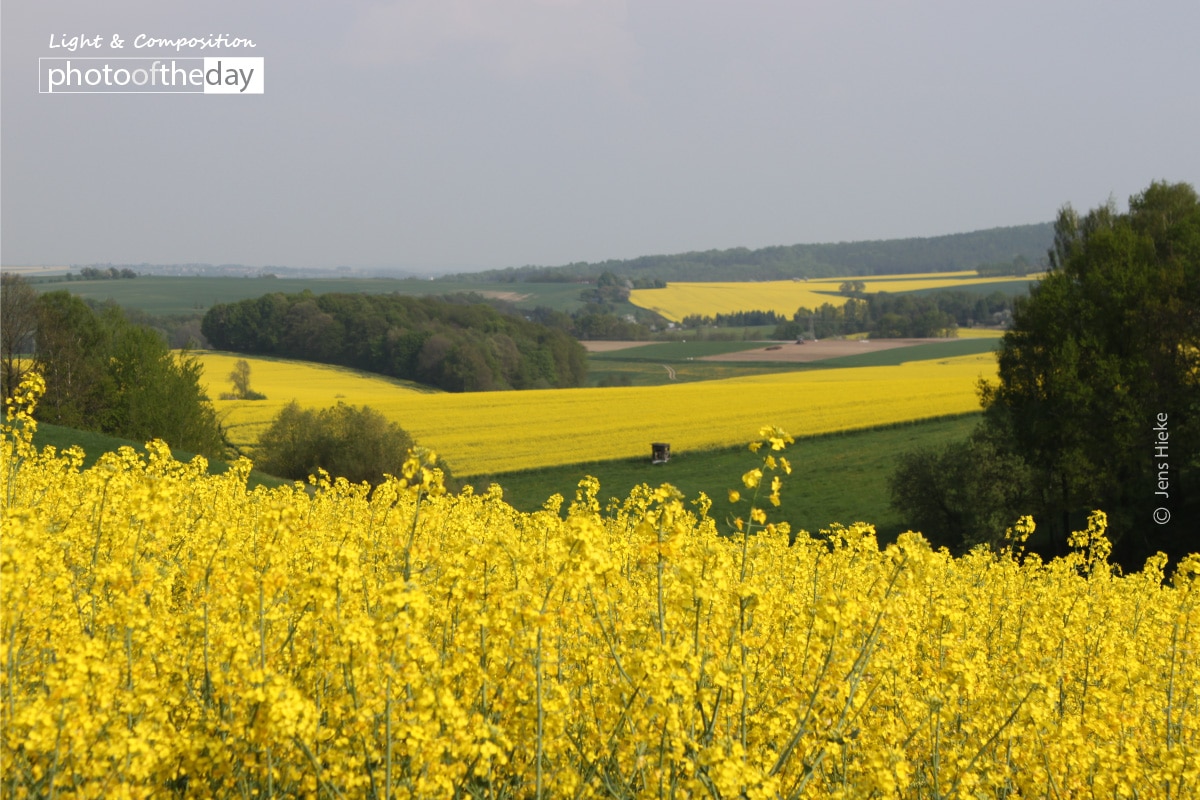
World in Yellow and Green by Jens Hieke
Captured in the rolling hills of Saxony, this image documents the striking seasonal transformation of the landscape into vibrant stripes of yellow and green. The photographer utilized an 18mm wide-angle lens to emphasize the vast, rhythmic patterns created by rapeseed cultivation. Beyond its aesthetic appeal, the photograph serves as a poignant commentary on the controversial shift toward biofuel production, highlighting the tension between energy crop expansion and traditional food agriculture. The composition is award-worthy for its ability to marry a visually arresting color palette with a timely, thought-provoking narrative about land use and environmental change.
Jens Hieke
Born in 1967, Jens Hieke is a Leipzig-based photographer and former librarian who transitioned from a career in broadcasting to the visual arts. His work is deeply influenced by his background in literature, blending a storyteller's eye with a fascination for the transient beauty of the natural world. Currently capturing his surroundings with a Canon EOS 500D, Hieke focuses on the constantly changing details of human and environmental landscapes, seeking to document the diversity of the world through a thoughtful and poetic lens.
Resonance Score Breakdown
Transparency Note: The resonance score (11.0/20) is calculated based on social engagement metrics collected before the award announcement.
Expert Photography Reviews · 7
Stitched by the Seasons
I spent this morning trying to organize my bookshelf, pulling out volumes I haven't touched in years. It’s funny how we try to categorize our lives into neat, separate sections, as if we can keep the past from bleeding into the present.
Read the reflection →The Earth’s Quiet Ledger
We often mistake the land for a static stage, a backdrop that waits patiently for our footsteps. But the soil is a restless ledger, keeping account of every season’s ambition.
Read the reflection →Reviews & Comments
Share your thoughts about this award-winning photograph. Your reviews contribute to the community engagement score.
The light here doesn’t demand attention; it hums with the quiet urgency of the season. Jens stood in the cooling air of Saxony, waiting for the rapeseed to find its rhythm against the earth. It’s a strange, vibrant geometry that makes me ache for the soil beneath my own boots. He didn’t just capture a crop; he listened to the land’s transformation. I’ve felt that same stillness, that moment when the world finally stops moving for you.
Rapeseed stripes slice through Saxony, but at what cost to the soil? Hieke’s wide-angle gaze turns industrial monoculture into a decorative pattern, sanitizing the environmental toll of biofuel. It’s visually seductive, yet I feel a cold detachment looking at these sterile, neon rows. Does this aestheticization mask the displacement of food crops? By framing the landscape as a graphic design, are we ignoring the reality of the land? It’s pretty, but it’s hauntingly hollow.
Yellow stripes cut the earth. Green follows. It’s a rhythmic pulse, a geometry of industry. I’ve stood before these fields in Saxony, and the silence there is heavy. It’s not just crops. It’s a quiet tension between soil and fuel. I find myself holding my breath. Nothing here is accidental. The empty corner isn’t empty. It’s a pause. A deliberate absence that forces me to look at what we’ve taken from the land.
It’s a shame the shutter speed didn’t push further into abstraction. At 1/30sec, the rapeseed fields hover in a sterile, sharp limbo that feels far too safe. I’d have loved to see the yellow and green bleed into one another, turning the landscape into a painterly smear. Why resolve the horizon so clearly? It’s a missed opportunity to dissolve the tension between industry and nature. I’m left craving a blur that actually feels something.
It’s a striking pattern, but I’m looking for the person in these fields. You’ve captured the geometry of the rapeseed, yet the land feels strangely empty. I’ve spent enough time in Saxony to know the weight of that soil, but here, the human cost of biofuel feels distant. Because you focused on the rhythm, you missed the struggle. I wanted to feel the farmer’s hand in this, not just the machinery of the crop.
Rapeseed stripes in Saxony are a common enough sight, yet one wonders how many mornings Hieke spent shivering in that damp air to catch the light just so. It’s a clean, rhythmic frame. I’ve spent enough hours waiting for the wind to drop to appreciate the stillness here. It doesn’t feel like a lucky snap; it feels like a man who returned until the landscape finally relented. It’s a decent bit of work, honestly.
Of the thousands of landscape submissions I’ve reviewed, most rely on sunset theatrics to distract from a lack of substance. Hieke’s work avoids that trap. The rhythmic, aggressive geometry of these rapeseed stripes forces a conversation about land use that’s rarely this visually arresting. I’ll admit, the sheer saturation makes me slightly uneasy, but that’s exactly why it’ll endure. It doesn’t just document a field; it captures the precise moment our landscape became an industrial factory.