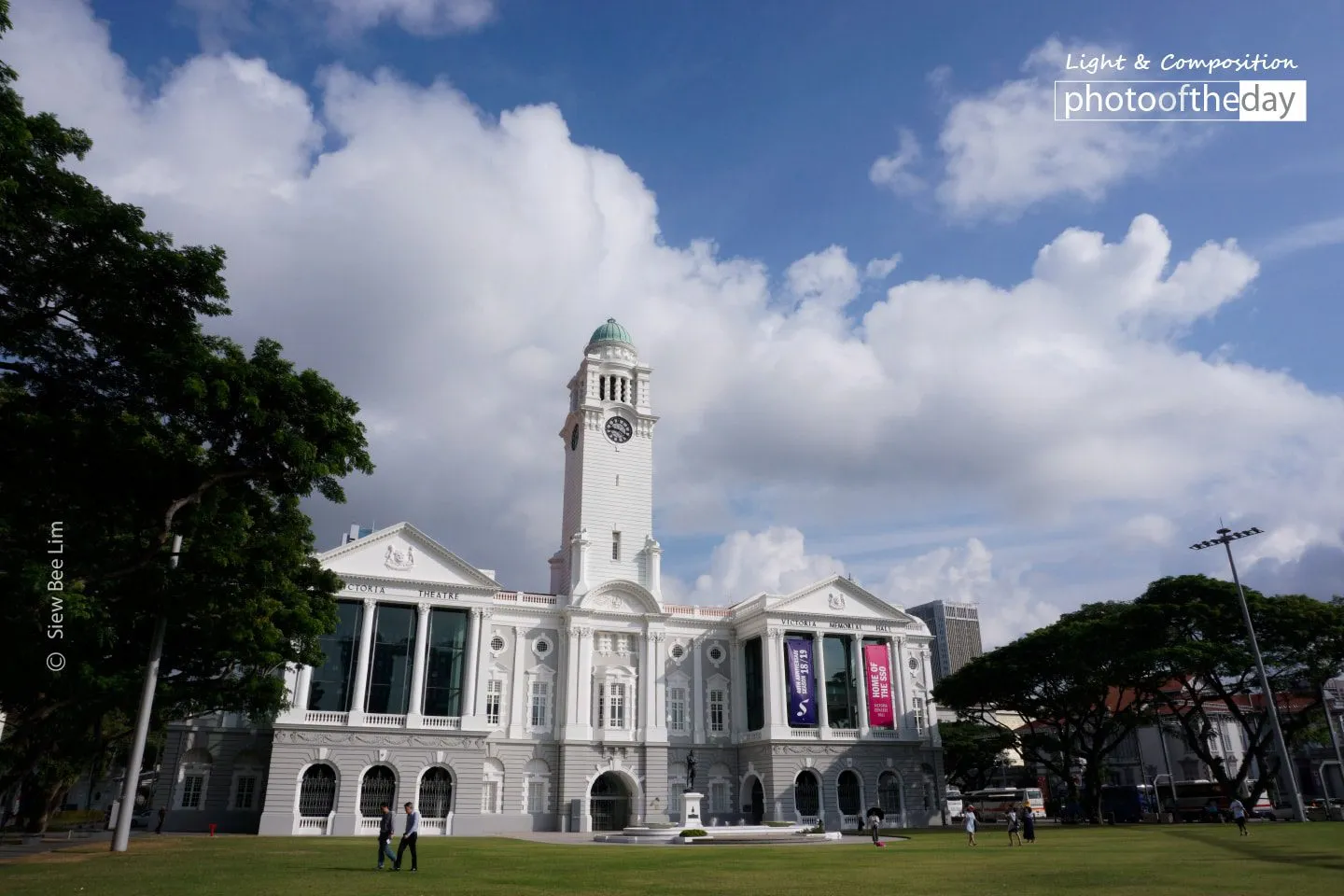
The Victoria Theatre and Concert Hall by Siew Bee Lim
The Victoria Theatre and Concert Hall in Singapore is captured here as a testament to colonial architectural grandeur. The photographer focuses on the harmonious integration of the historic Town Hall and the memorial hall, linked by their iconic clock tower. By highlighting the intricate details of the Swan & McLaren design, the image emphasizes the building's enduring presence in the city's central district. This photograph is award-worthy for its precise composition and its ability to transform a functional performing arts center into a timeless study of light, shadow, and historical narrative.
Siew Bee Lim
Born in Singapore in 1965, Siew Bee Lim is a dedicated photographer who balances her professional background as a programmer with a deep-seated passion for visual storytelling. Though she initially explored photography as a young adult, her journey has evolved into a formal pursuit of artistic mastery through the Light & Composition platform. Drawing inspiration from her lifelong appreciation for literature and traditional Chinese painting, she now focuses on refining her technical skills to capture the architectural beauty and cultural heritage of her home country.
Resonance Score Breakdown
Transparency Note: The resonance score (11.7/20) is calculated based on social engagement metrics collected before the award announcement.
Expert Photography Reviews · 7
The Echo of the Clock
I remember sitting in a café in Singapore, watching the humidity cling to the glass while the afternoon rain turned the streets into mirrors. An elderly man sat at the table next to me, meticulously winding a pocket watch that had long since stopped ticking.
Read the reflection →Echoes in the Stone
I walked past the old library downtown this morning, the one with the heavy brass doors that always stick.
Read the reflection →Reviews & Comments
Share your thoughts about this award-winning photograph. Your reviews contribute to the community engagement score.
The clock tower’s rigid geometry evokes the precise, structural clarity of Berenice Abbott’s New York studies, yet it’s the interplay of light on the Palladian facade that truly arrests me. It’s a rare, crisp dialogue between colonial heritage and tropical luminosity. I’ve spent decades cataloging such structures, but the way Lim captures the shadow’s weight against the white stone feels genuinely fresh. It’s a sophisticated nod to the past, rendered with a startling, modern stillness.
f/8 at 24mm, ISO 100. A standard architectural baseline. It’s safe, but it works. The diffraction limit hasn’t softened the clock tower’s stonework, and the depth of field holds the facade’s geometry in tight alignment. I’ve spent years looking at these colonial structures, and honestly, the crispness of the shadows here actually made me stop and stare. It’s a clean execution. The technical choices don’t distract from the architecture. That’s the highest compliment I can offer.
Before the eye identifies the clock tower, a strange stillness settles in the chest. It’s the weight of colonial stone pressing against the humid Singapore sky. I find my breath hitching at the shadows stretching across the facade; they feel like long-forgotten memories of a city that never sleeps. When I return to this frame, the silence remains, heavy and absolute. It’s a haunting, rhythmic pulse that follows me home, echoing in the quiet of my own room.
The clock tower stands frozen, but the street is dead. Where’s the life? Architecture needs the pulse of the city to breathe. I’m looking for a ghost, a shadow, a human element to break that rigid symmetry. It’s technically sharp, sure, but it’s too polite. I’d trade that perfect geometry for one blurred passerby. Without the chaos of the street, it’s just a postcard. It doesn’t make my heart race. It’s missing the decisive moment.
Most architectural shots of the Victoria Theatre fall into the trap of postcard symmetry. What separates this from the thousands I’ve reviewed is the way the light clings to the clock tower’s pediment, grounding the structure in a specific, heavy history. It’s not just a building; it’s a memory of colonial permanence. I’ll admit, the shadows almost felt too clinical, but they’re exactly what will make this relevant in thirty years. It’s honest work.
Colonial grandeur feels heavy here, doesn’t it? Siew Bee Lim frames the clock tower with such clinical precision that the building’s violent history vanishes into clean, white stone. Why does the composition sanitize the power dynamics inherent in this architecture? I feel a cold detachment looking at these symmetrical lines. Whose heritage are we actually celebrating when we strip away the context of the people who built it? It’s technically sharp, but ethically, it’s remarkably hollow.
We look at the Victoria Theatre and realize it’s not just stone; it’s a face. Siew Bee Lim has listened to the clock tower, capturing the way it watches over Singapore like an elder guarding a secret. The shadows don’t just fall; they linger, holding the weight of every performance held within. I feel a sudden, quiet ache for the ghosts of the music that once filled these halls. It’s a portrait of a city’s memory.