Pulling in Symmetry by Nirupam Roy
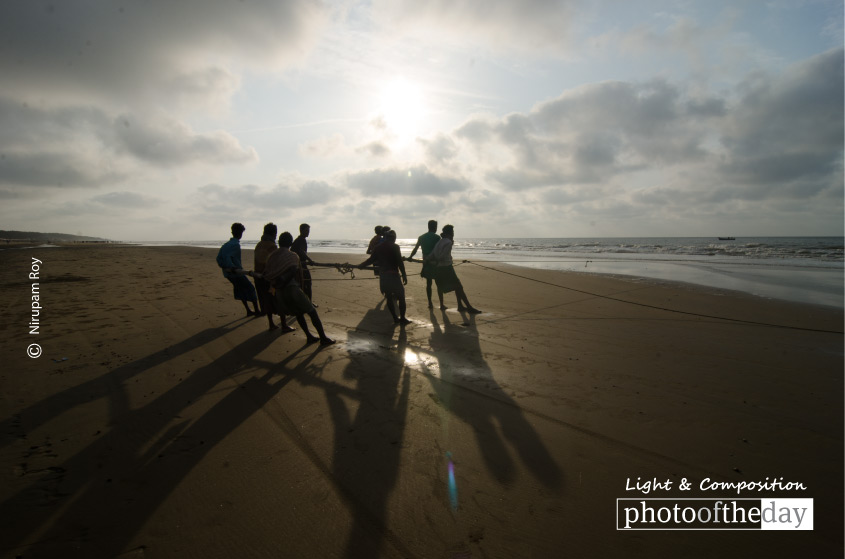
Captured at 8:00 AM on the final day of a coastal trip, this image documents the disciplined, rhythmic labor of fishermen at Udaypur Sea Beach. The photographer was drawn to the impressive, synchronized effort required to pull in the 'Sareen' fishing nets, a process that demands perfect coordination to ensure a productive catch. The resulting composition highlights the geometric harmony of the workers against the vast shoreline. This photograph is award-worthy for its ability to transform a routine, strenuous labor process into a visually striking study of human cooperation and symmetry, framed with technical precision during the soft morning light.
Nirupam Roy
Hailing from the small town of Tufanganj in the CoochBehar District of West Bengal, India, Nirupam Roy balances a career as a school teacher with a profound dedication to photography. His transition into the medium began during a family trip, where he discovered a desire to document the scenic beauty of the coast and his family life. Since then, photography has become his primary passion, shifting his perspective on nature and humanity. Roy continuously seeks to produce innovative concepts, finding in his craft a sense of peace and creative fulfillment that complements his daily life.
Resonance Score Breakdown
Transparency Note: The resonance score (11.7/20) is calculated based on social engagement metrics collected before the award announcement.
Expert Photography Reviews · 7
The Weight of the Collective
Why do we assume that the burden of existence is meant to be carried alone? We spend our lives building private fortresses of identity, convinced that our struggles are singular and our paths entirely our own.
Read the reflection →The Weight of the Tide
I once watched a team of men in a small village in Cornwall haul a heavy wooden boat onto the shingle. They didn't speak; they didn't need to.
Read the reflection →Reviews & Comments
Share your thoughts about this award-winning photograph. Your reviews contribute to the community engagement score.
Eight in the morning on the final day. Most would’ve been packing their bags, but Roy was out there in the salt spray. It’s a rare thing to see such geometric discipline in the chaos of a haul. I’ve spent enough mornings shivering on beaches to know that rhythm doesn’t just happen; it’s earned through persistence. The symmetry here isn’t luck. It’s the result of standing in the sand until the light and the labor finally aligned.
At eight in the morning, the light doesn’t shout; it hums against the wet sand. Nirupam stood there as the tide retreated, watching the men pull in unison. It’s the rhythm of their labor that catches my breath—a quiet, geometric prayer against the vastness of the coast. I’ve spent enough hours waiting for the tide to know that he didn’t just capture a scene; he waited for the land to reveal its own hidden, synchronized soul.
The tide recedes. It leaves a wet, gray mirror. The fishermen pull the net in a line. Their bodies are small against the sand. I feel the cold morning air on my skin. It’s quiet. The symmetry isn’t just in the men. It’s in the space they leave behind. Nothing here is accidental. The empty corner is not empty. It’s a breath held before the catch. I’ve never seen labor look so much like stillness.
The rhythm hits you first. It’s a wide shot, a locked-off frame where the tension of the rope dictates the pace. The fishermen aren’t just working; they’re a synchronized ensemble cast. I love the way the 12mm lens stretches that geometry, turning labor into a ballet of lines. It’s a sequence frozen at the exact moment of peak exertion. The cut would’ve been a mistake. This is the frame the editor keeps to anchor the entire film.
Most entries in this category rely on the chaos of the catch, but Roy found the geometry within the strain. By pinning the fishermen to the horizon line, he turns manual labor into a rhythmic, repeating pulse. It’s the stillness of the composition that makes it endure; I’ve looked at this for years, and I still feel the grit of that sand under my own feet. It’s a rare, quiet dignity that’ll still matter in thirty years.
The rhythmic alignment of the fishermen creates a rigid geometric spine against the horizon. It’s a calculated distribution of mass. The wide-angle perspective forces a convergence toward the center, anchoring the chaotic labor into a singular, balanced fulcrum. I’m genuinely struck by how the negative space doesn’t collapse under the weight of the figures. The frame holds. It’s a rare instance where the architecture of the scene isn’t sacrificed for the sake of the narrative.
The morning light here isn’t merely illumination; it’s a pale, bruised ochre that clings to the wet sand like a Morandi still life, turning the fishermen’s exertion into a rhythmic, chromatic pulse. I’m utterly captivated by how the cool, slate-grey shadows of the nets quarrel with that warm, humid atmosphere. It’s a delicate, aching harmony that feels like the very breath of the tide, and frankly, it’s enough to make one weep for the sheer, quiet grace of it all.