Ten Innocent Compartments by Somnath Chakraborty
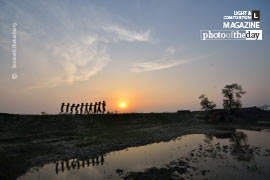
Captured during a return journey from Gourdwaho, this evocative image documents a fleeting moment of childhood innocence. The photographer, exhausted from a day of searching for subjects, stumbled upon a group of children whose playful energy and rhythmic whistling transformed the scene into a living painting. By focusing on the authentic, unscripted joy of these ten individuals, the photograph transcends a simple portrait to become a poetic narrative. Its award-worthy quality lies in the photographer's ability to recognize and preserve a profound, ephemeral connection, turning a spontaneous encounter into a timeless visual story of human simplicity.
Somnath Chakraborty
Based in Batanagar, Kolkata, India, Somnath Chakraborty balances a professional career as a Network Engineer with a deep-seated passion for photography. Often referring to himself as a dedicated enthusiast, he maintains a rigorous creative discipline, striving to capture at least one photograph every single day. His work is driven by a desire for continuous learning and a commitment to sharing his unique experiences with the global photographic community.
Resonance Score Breakdown
Transparency Note: The resonance score (10.0/20) is calculated based on social engagement metrics collected before the award announcement.
Expert Photography Reviews · 6
The Uncounted Breath
Ten. A number that fits easily in the palm of a hand. Or a row of small, bare feet on the earth.
Read the reflection →The Salt of Unfinished Games
The taste of dust on the tongue is the first thing I remember about being small. It was a dry, metallic grit that clung to the back of the throat after a long afternoon of running until the lungs burned.
Read the reflection →Reviews & Comments
Share your thoughts about this award-winning photograph. Your reviews contribute to the community engagement score.
It’s a charming scene, but I find myself unsettled. In my field, we learn that proximity is a privilege, not a right. When I see ten children clustered this tightly, I wonder if the photographer’s presence disrupted their rhythm. Did they stop playing to perform for the lens? I’ve spent weeks hiding in brush just to avoid altering a subject’s behavior. Here, the spontaneity feels extracted, not earned. It’s pretty, but it lacks the quiet integrity I crave.
The kinetic energy here is nearly perfect. You’ve caught the boys mid-stride, their limbs extended in that fleeting, weightless window before gravity reasserts its claim. It’s the exact millisecond of peak suspension. I’ve spent my life chasing this specific rhythm, and seeing it captured in such raw, unscripted play makes me grin. You didn’t miss the mark; you hit the frame. Not the one before, not the one after. This one. It’s brilliant.
There’s a wild, unscripted electricity in these ten faces that hits me right in the chest. You can tell the photographer didn’t just barge in; he waited, he listened, and he let them be kids. It’s rare to see such collective ease in front of a lens. They aren’t performing for a stranger; they’re just existing together. I’d give anything to know what they were whistling. This face has a whole life in it.
At 18mm, the Nikkor’s wide-angle distortion stretches the periphery, yet the focal plane remains remarkably coherent across those ten faces. The diffraction limit at f/3.5 keeps the background soft, rendering the bokeh as a function of aperture that isolates the children’s joy. It’s a rare optical harmony. I’m genuinely moved by how the light catches their eyes; it’s a precise, fleeting intersection of glass and humanity that I’d never tire of examining.
1/750sec at f/3.5, 18mm, ISO 320. The Nikon D5000’s sensor is pushed here. Shooting at f/3.5 on an 18mm wide angle creates a shallow depth of field that’s frankly risky for a group of ten. It’s a gamble that barely pays off. The focus is sharp enough, but the peripheral softness is distracting. I’ve seen enough sloppy focus to know when someone’s just lucky. It’s technically messy, yet the energy is undeniably infectious.
Ten children framed against a Batanagar sunset. It’s a classic trope of rural innocence, but I’m left uneasy. Does the photographer’s exhaustion grant him the right to harvest their joy for a poetic narrative? Why are these children performing for a lens they didn’t invite? It’s visually rhythmic, sure, but it feels like a transaction. I find myself wondering if they’re ever allowed to just be children, or if they’re merely props in someone else’s sunset.