Alone in the Lane by Sourav Das
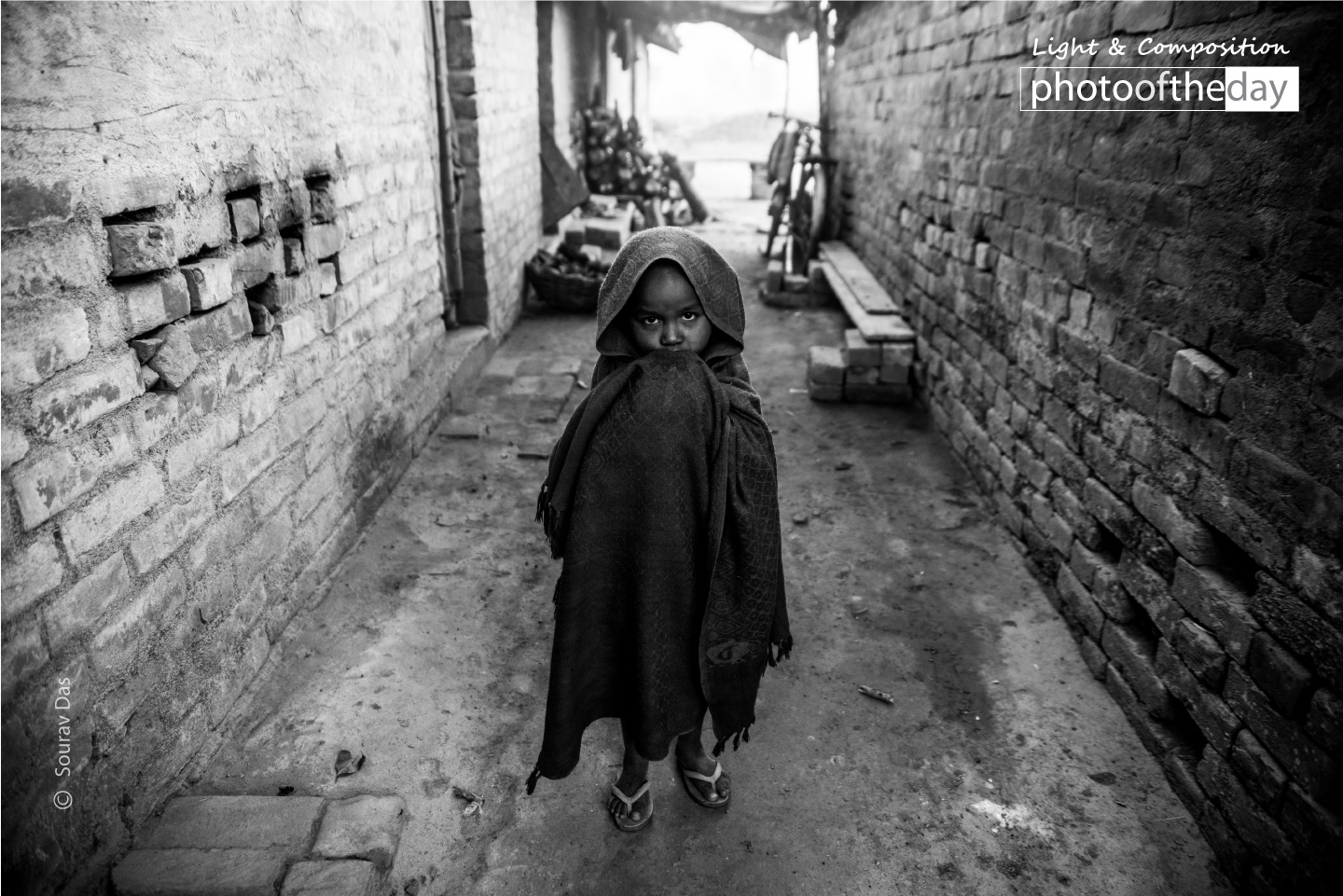
Captured in the quiet morning light of a brick field in Kolaghat, this portrait captures a young boy traversing a narrow lane. The photographer was drawn to the child’s expressive eyes and his worn shoes, elements that anchor the image in a poignant, lived-in reality. By focusing on the interplay of soft morning light and the boy’s solitary presence, the photographer creates a narrative of innocence amidst a rugged landscape. The image is award-worthy for its evocative composition and its ability to transform a fleeting, everyday encounter into a timeless study of childhood and human connection.
Sourav Das
Based in Kolaghat, West Bengal, Sourav Das is a dedicated photographer who utilizes street and humanist photography to document the complexities of social change. He views the camera as a narrative tool, comparable to literature or music, capable of sketching the nuances of human customs and societal structures. Through his work, Das seeks to reveal the uneven realities of modern life, aiming to bridge the gap between visual storytelling and the broader human experience.
Resonance Score Breakdown
Transparency Note: The resonance score (11.6/20) is calculated based on social engagement metrics collected before the award announcement.
Expert Photography Reviews · 8
The Weight of Morning
There is a specific quality to the light just after dawn, before the sun has fully asserted itself, when the air holds a thin, milky haze that softens the edges of everything it touches.
Read the reflection →The Weight of Small Steps
I keep a small, rusted iron key in a velvet pouch, though I have long forgotten which door it once opened. It is heavy for its size, cold to the touch, and carries the faint, metallic scent of a house that no longer exists.
Read the reflection →Reviews & Comments
Share your thoughts about this award-winning photograph. Your reviews contribute to the community engagement score.
At f/2.8 on a 24mm wide-angle, the focal plane is razor-thin, forcing the background into a soft, creamy bokeh that isolates the boy’s gaze. I’m genuinely moved by how the lens resolves the dust motes dancing in that morning light; it’s a beautiful diffraction of photons across his worn shoes. It’s rare to see such technical restraint. The optics don’t just capture a child; they reveal the quiet, physical weight of his solitary morning.
The brick field’s narrow lane acts as a forced perspective, a datum line pulling the eye toward the boy. It’s a brutal, repetitive structure, yet the soft light grazing those rough textures softens the solid-void relationship. I’m struck by how the boy’s scale renders the architecture immense, almost crushing. It’s a rare, honest capture of a threshold—the moment a child’s fragility meets the unyielding, industrial geometry of his world. It’s hauntingly spatial.
The frame holds. A boy caught in the amber of a Tamluk morning, his worn shoes anchoring a narrative that refuses to cut away. It’s a wide 24mm gaze, yet it feels intimate, like a close-up that breathes. I’ve seen a thousand street portraits, but this one hits me—the light doesn’t just fall, it lingers. It’s the shot the editor keeps because the silence in those eyes is louder than any movement could ever be.
It’s refreshing to see a portrait where the light isn’t fighting the water’s refractive index. Here, the air doesn’t steal the reds or scatter the photons like a dirty strobe angle would. I’m struck by the boy’s clarity; there’s no backscatter to blur his gaze. It’s a stark contrast to my world, where every warm tone is a hard-won victory against the deep. I’d love to see this boy’s curiosity translated into a reef encounter.
The dust-choked geometry of the brick field creates a harsh, tactile stage, where the low morning light catches the grit of the path, turning the ground into a textured tapestry. It’s here that the boy’s worn shoes become vital, grounding his small frame against the vast, industrial scale of his world. I’m genuinely moved by how the landscape swallows him. He isn’t just walking; he’s navigating a reality that defines his very existence.
The boy’s worn shoes anchor him in this brick field, but why does the frame isolate him so cleanly? I feel a sharp pang of discomfort looking at his gaze. Is he a subject or a prop for our aesthetic consumption? The soft morning light feels too curated, almost masking the labor inherent in this landscape. Does the photographer’s lens bridge a gap, or does it merely widen the distance between the observer and the observed?
1/125sec at f/2.8, 24mm. ISO 320. Wide-angle portraits are a gamble; at 24mm, the distortion risks turning a face into a caricature. Das kept his distance, avoiding the nose-stretch. It’s a clean execution. The f/2.8 aperture isolates the boy from the brick field without losing the context of the lane. I’ve seen too many botched wide-angle shots, but this one actually works. The technical restraint here is refreshing. It’s a precise, calculated choice.
One wonders how many mornings were spent in that brick field before the dust settled just so. It’s easy to snap a child walking; it’s quite another to capture the weight of those worn shoes against the grit. I’ve spent enough damp dawns waiting for light to know when someone’s actually put in the hours. Das didn’t just find this; he earned it. It’s a quiet, honest bit of work. I’m genuinely moved.