Pa-Oh by Shirren Lim
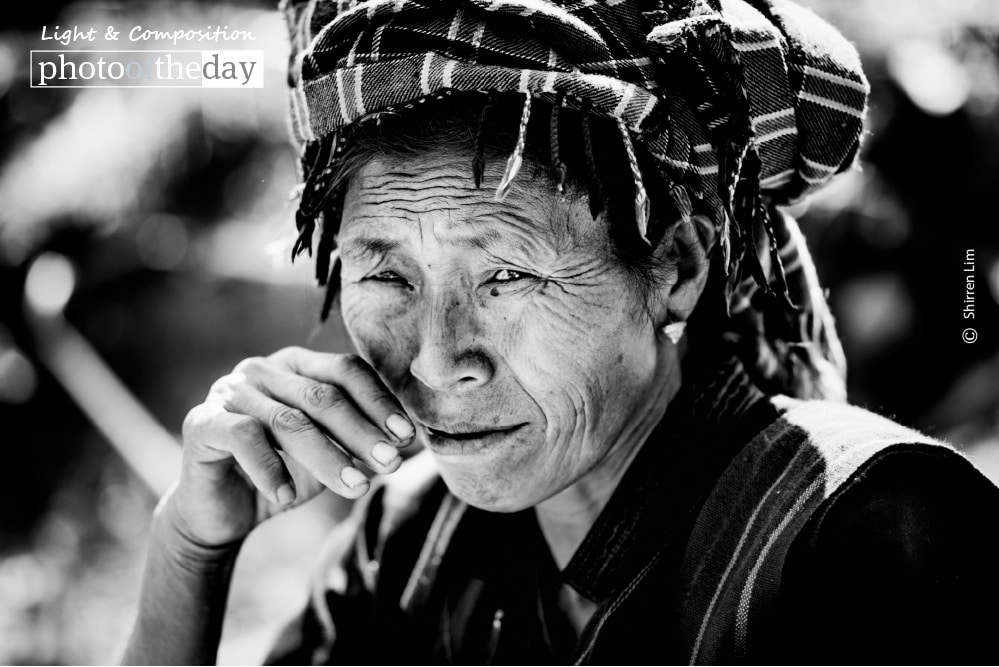
Captured in the scenic village of In-Dein, Myanmar, this portrait highlights a member of the Pa-Oh tribe, the second-largest ethnic group in the Shan state. The photographer encountered the subject while she was visiting the local hills to trade her crops. By seeking permission to document her presence, the photographer secured a moment of genuine connection, resulting in an intimate portrait that reflects the subject's quiet dignity. The image is award-worthy for its authentic portrayal of indigenous life, demonstrating a respectful approach to cultural storytelling and a keen eye for the raw, uncovered sincerity found within human expression.
Shirren Lim
Born in 1970 on Penang Island, Malaysia, Shirren Lim is a Jakarta-based photographer who discovered her true passion for the craft in 2009. Specializing in portraiture, she is deeply moved by the sincerity of human expression and strives to capture the essence of humanity through an intense, earthy aesthetic. Heavily inspired by the iconic work of Steve McCurry, Lim seeks to create images that resonate with the same emotional depth and global impact as the legendary photographs that defined her early aspirations.
Resonance Score Breakdown
Transparency Note: The resonance score (12.2/20) is calculated based on social engagement metrics collected before the award announcement.
Expert Photography Reviews · 8
The Geography of Belonging
We often mistake the periphery for the margins, assuming that distance from the urban core equates to a lack of complexity. Yet, every settlement, no matter how remote, is a dense archive of human history and economic survival.
Read the reflection →The Weight of Woven Time
The smell of damp earth after a long drought is a heavy, velvet thing that clings to the back of the throat. It is the scent of roots waking up, of history pushing through the soil.
Read the reflection →Reviews & Comments
Share your thoughts about this award-winning photograph. Your reviews contribute to the community engagement score.
The Pa-Oh woman’s gaze is heavy, yet I’m troubled by the curator’s insistence on “genuine connection.” Does a transaction in a marketplace ever truly strip away the power imbalance between a tourist and a subject? She’s framed against the village, but whose narrative are we consuming here? I feel a sharp, uncomfortable ache looking at her weathered hands. Is this dignity, or is it just the aestheticization of someone else’s survival for our own visual consumption?
Shadows here don’t merely define the Pa-Oh woman’s face; they anchor her existence against the encroaching void of the Shan hills. It’s a heavy, deliberate silence. When I look at those deep, recessed eyes, I’m struck by a sudden, cold shiver—the realization that she isn’t being observed, but rather, she is waiting for us to vanish. Lim hasn’t just captured a portrait; she’s allowed the darkness to articulate a dignity that refuses our gaze.
The jury’s obsession with clarity here feels stifling. Why demand the Pa-Oh subject’s skin texture be rendered with forensic indifference? I’m far more intrigued by the soft, atmospheric haze surrounding her. It’s closer to the ethereal dissolution of a Sugimoto long-exposure than a standard travel portrait. I’d have pushed the motion further, letting the background bleed into her silhouette. What did Lim choose not to resolve? That’s where the real, haunting humanity actually lives.
You didn’t just take a picture of a Pa-Oh woman; you sat with her. I can feel the weight of those baskets and the long walk she took to get there. It’s the eyes that get me—there’s a quiet, tired wisdom in them that makes me want to put my camera down and just listen. Because you asked permission, you earned this gaze. You waited, and she let you in. That’s rare. I respect that.
Most portraits of indigenous subjects feel like tourism, but this one avoids that trap. The subject’s gaze isn’t performing for the lens; it’s anchored in a weary, lived-in reality. I’ve seen thousands of portraits where the photographer’s presence disrupts the scene, yet here, the stillness is absolute. It’s the texture of her skin against the muted background that keeps me looking. I’d bet in thirty years, we’ll still be trying to decipher what she’s thinking.
The ochre of the Pa-Oh woman’s headwrap, a shade reminiscent of Morandi’s dustiest pigments, anchors this frame in a stillness that’s profoundly moving. It’s the way the light catches the fabric, shifting from burnt sienna to the pale, bruised violet of a fading Shan sunset, that makes my heart ache. One finds here a chromatic dialogue so intimate, so devoid of artifice, that it’s as if the very air has been stained by her quiet, enduring grace.
Before the eye identifies the Pa-Oh woman’s weathered skin, something in my own chest tightens. It’s the weight of her gaze, an activation of ancestral recognition. When I return to this portrait, the stillness doesn’t fade; it settles into my pulse. I’ve spent years looking at faces, but hers feels like a secret I’m finally allowed to keep. It’s a quiet, heavy grace that follows me into sleep, long after the gallery lights dim.
The focal plane here is razor-thin, isolating the subject’s eyes with clinical precision. You can see the diffraction of light across the fine, weathered texture of her skin—it’s a resolution that exceeds what the naked eye registers in passing. I’m genuinely moved by how the bokeh, a function of a wide aperture, renders the background into soft, painterly light. It’s not just a portrait; it’s a triumph of optics capturing the quiet, human truth.