The Monk by Sourav Das
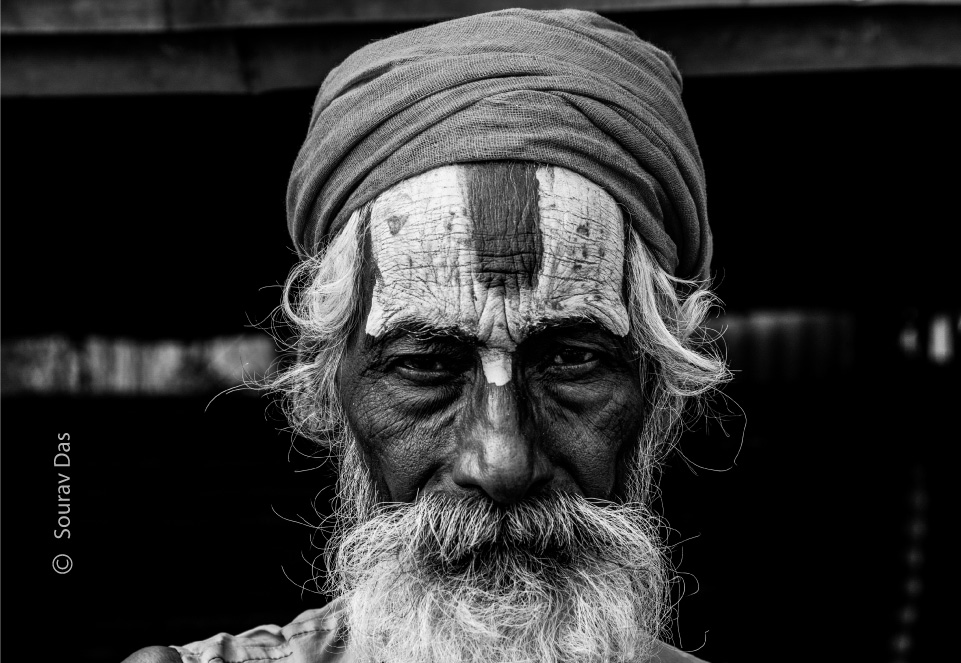
Captured within the bustling transit camps of Kolkata, this portrait features a Hindu monk who traveled from Uttar Pradesh for the sacred ritual of the Ganga Sagar holy bath. The photographer masterfully isolates the subject amidst the chaos of thousands of pilgrims, highlighting the profound faith and spiritual dedication that define this annual event. By focusing on the monk’s weathered expression and quiet intensity, the image serves as a poignant testament to the human spirit. Its award-worthy quality lies in the balance of documentary precision and emotional depth, effectively bridging the gap between a fleeting moment and a timeless cultural narrative.
Sourav Das
Based in Kolaghat, West Bengal, Sourav Das is a dedicated photographer committed to exploring humanist and street photography as a means of documenting social change. He views his craft as a powerful narrative tool, comparable to literature and art, capable of revealing the complexities of social customs and their relationship to humanity. Through his lens, Das seeks to capture the essence of the common person, aiming to sketch a vivid portrait of socio-humanism that challenges and informs contemporary perspectives on society.
Resonance Score Breakdown
Transparency Note: The resonance score (10.8/20) is calculated based on social engagement metrics collected before the award announcement.
Expert Photography Reviews · 5
The Stillness Within
Epictetus taught that we are not disturbed by things themselves, but by the views we take of them. In a world that demands our constant attention, where noise is mistaken for progress and speed for success, the ability to retreat into one’s own mind is the ultimate freedom.
Read the reflection →The Stillness Within the Tide
There is a particular kind of silence that exists only in the center of a storm. It is not the absence of sound, but a profound inward turning, a place where the clamor of the world loses its power to disturb.
Read the reflection →Reviews & Comments
Share your thoughts about this award-winning photograph. Your reviews contribute to the community engagement score.
That gaze is heavy with the dust of Uttar Pradesh. You can tell this monk didn’t just pose; he allowed Sourav into his space, offering a sliver of his solitude amidst the Kolkata chaos. I’m struck by the way his eyes hold such quiet, weary intensity. It’s a gift, really. He’s not performing for the lens; he’s simply existing. This face has a whole life in it, and I’m grateful he let us see it.
The monk’s face is sharp, but I’m left craving the chaos he inhabits. By freezing him at 1/100sec, Das opts for a conventional clarity that feels safe, almost polite. Why not let the pilgrims blur into a spiritual smear? This approach is closer to Hiroshi Sugimoto’s long-exposure theatres than to this static documentary style. I’d love to see what he chose not to resolve; instead, we get a portrait that’s technically correct but emotionally distant.
Kolkata’s roar fades. It’s just the monk now. He occupies the frame, yet the surrounding blur creates a vast, quiet field. I’ve spent minutes staring at the space behind his shoulder. It isn’t empty. It’s heavy with the weight of his journey. The stillness in his eyes anchors the chaos. I feel a sudden, sharp ache in my chest. Nothing here is accidental. The empty corner is not empty. It’s where the silence lives.
Kolkata’s transit camps are usually a cacophony of solid and void, but here, the architecture dissolves. The monk’s weathered skin acts as the primary datum, anchoring the frame against the blurred, chaotic fenestration of the background. It’s a rare, quiet threshold. I’m struck by how the light rakes across his brow, revealing a depth that most portraits flatten. It doesn’t just capture a face; it captures the heavy, humid stillness of a space between movements.
1/100sec at f/6.3, 70mm. ISO 100. It’s a conservative choice. The aperture provides enough depth to keep the monk’s features sharp while softening the chaotic background into a manageable blur. I’ve seen too many portraits ruined by wide-open glass that misses the eyes. Das didn’t gamble here. He prioritized resolution over bokeh. It’s technically sound, though I find the shutter speed borderline for handheld work. Still, the sharpness holds. It’s a disciplined, precise execution.