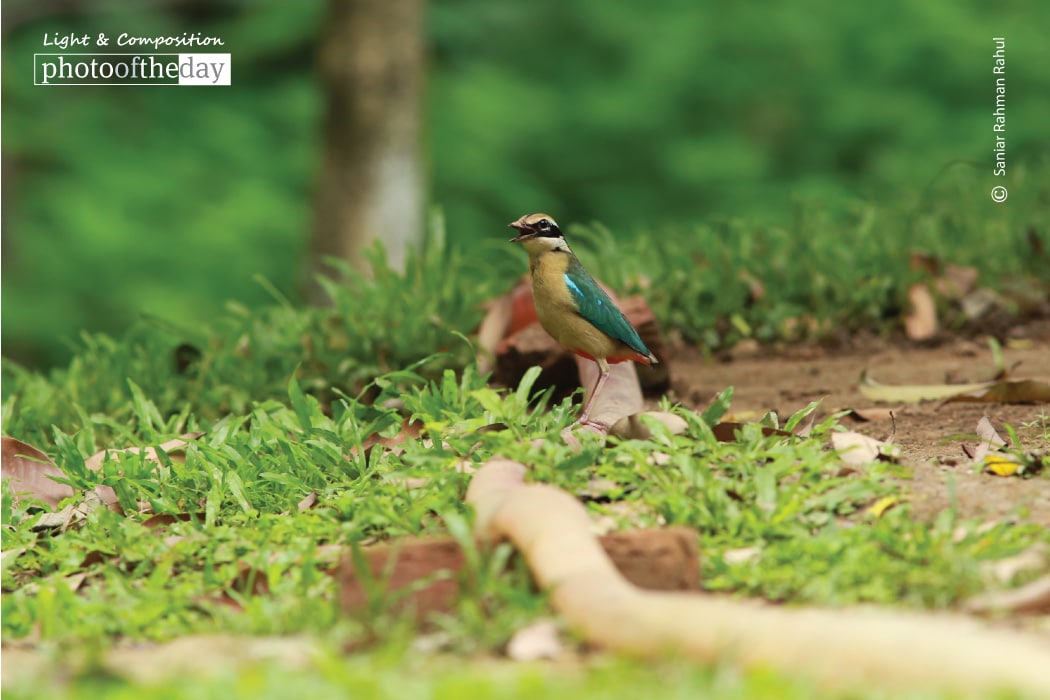
Indian Pitta by Saniar Rahman Rahul
Captured in the lush landscapes of Gazipur, Bangladesh, this portrait of an Indian Pitta showcases the vibrant passerine during its summer breeding season. The photographer meticulously composed the shot to highlight the bird's striking plumage against its natural habitat, demonstrating a keen eye for wildlife behavior. By balancing technical precision with the fleeting nature of the subject, the image captures a moment of quiet intensity. This photograph is award-worthy for its masterful use of light and composition, which elevates a common seasonal visitor into a compelling study of avian beauty and environmental connection.
Saniar Rahman Rahul
Based in Dhaka, Bangladesh, Saniar Rahman Rahul is an accomplished Art Director and photographer whose creative journey began in childhood while observing his father’s work. After establishing a successful career in graphic design and advertising with global agencies like Grey Worldwide, he rediscovered his passion for photography in 1997. His work is defined by a deep appreciation for visual storytelling and technical precision, earning him early recognition as a pioneer in the Bangladeshi photography community, including being named a Photo of the Month winner in 2010.
Resonance Score Breakdown
Transparency Note: The resonance score (12.2/20) is calculated based on social engagement metrics collected before the award announcement.
Expert Photography Reviews · 6
The Weight of a Wing
I keep a small, dried feather inside the pages of a book of poetry I haven't opened in years. It is a fragile, iridescent thing, a fragment of a flight I never saw, yet it feels heavy with the gravity of a season that has long since passed.
Read the reflection →The Hum of Hidden Things
The smell of damp earth after a sudden monsoon rain is a heavy, velvet thing. It clings to the back of the throat, tasting of minerals and ancient, rotting leaves.
Read the reflection →Reviews & Comments
Share your thoughts about this award-winning photograph. Your reviews contribute to the community engagement score.
Most wildlife shots are just trophies, but this Indian Pitta lingers. I’ve seen thousands of bird portraits, yet the 17mm focal length here is a gamble that paid off. By pulling back, Rahul forces us to see the bird as a guest in its own home rather than a specimen. It’s rare to feel such quiet respect for a subject. I’d bet in thirty years, this frame will still feel like a genuine encounter.
The Indian Pitta doesn’t just sit there; it waits for the forest to breathe. Rahul must have stood in the humid stillness of Gazipur for hours, letting the dappled light settle into the plumage. I’ve felt that same ache in my knees, waiting for the wild to trust me. It’s a quiet, holy communion. When the shutter finally clicked at 1/60th, he wasn’t taking a picture—he was listening to the bird’s secret rhythm.
The Indian Pitta doesn’t merely exist here; it emerges from the suffocating density of the Gazipur undergrowth. I’m struck by how the shadows swallow the bird’s periphery, forcing us to confront its vibrant plumage as a desperate, singular defiance against the dark. It’s a fragile, violent clarity. When I look at those deep, encroaching blacks, I feel a sudden, cold loneliness. It’s not just wildlife; it’s a creature holding its breath against the inevitable, encroaching void.
At 17mm, Rahul hasn’t just captured a bird; he’s wrestled with the geometry of the Gazipur undergrowth. Most wildlife shooters obsess over telephoto isolation, but this wide-angle choice forces the Indian Pitta into a chaotic, verdant context. It’s messy, and I love that. Why resolve the background when the blur tells a better story of the forest’s density? It’s closer to Sugimoto’s blurred theatres than conventional nature photography. It’s refreshingly, beautifully unrefined.
The bird sits. It doesn’t claim the frame. It occupies a sliver of the forest floor. The rest is shadow and soft, blurred earth. I’ve spent minutes looking at the dark space behind the Pitta. It’s heavy. It’s quiet. I feel a sudden, sharp ache for that stillness. Nothing here is accidental. The empty corner is not empty. It’s a breath held in the humid Gazipur air. Rahul knows when to stop. That’s rare.
The shutter speed is a gamble, but it pays off. At 1/60th, the movement isn’t frozen; it’s held in a soft, breathless suspension. I’m struck by the stillness here—it’s the frame an editor keeps because the cut would’ve been a mistake. The Pitta doesn’t just sit; it anchors the frame. It’s a quiet, cinematic beat in the Gazipur heat. I’d kill to have captured that light. It’s a film that refused to move.