Child’s Direct Look, Weathered Doorway

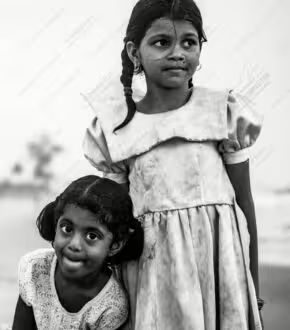
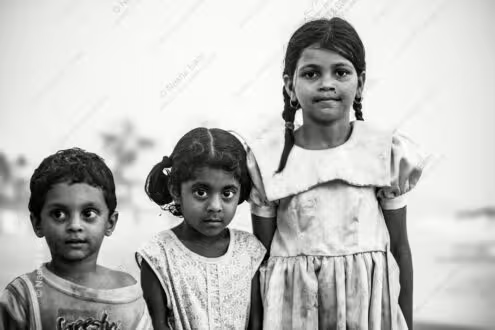
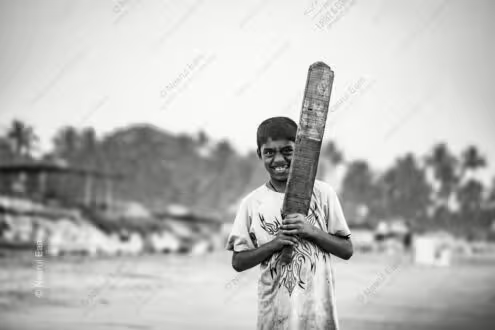
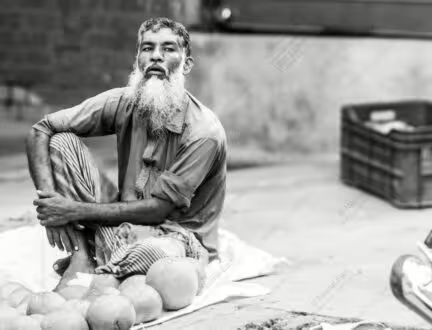
This striking black and white photograph centers on a young child, positioned centrally within the frame, confronting the viewer with an unblinking gaze. The child’s face, smudged with dirt, conveys a complex emotional state—a blend of vulnerability and a nascent stoicism. The composition is anchored by the strong vertical lines of a weathered wooden doorway behind the subject, which is slightly ajar, hinting at a domestic interior. To the left, a rough-hewn stone wall provides a textural contrast to the smoother, worn fabric of the child’s clothing. The framing is tight, emphasizing the child’s presence and the immediate environment, with a partial view of a plastic chair to the right adding a contemporary, perhaps incongruous, element to the scene. The overall spatial geometry creates a sense of confinement yet also intimacy, drawing the viewer into the child’s world.
The lighting in the image is nuanced, suggesting a diffused ambient light source that avoids harsh shadows, allowing for a rich tonal range. The highlights on the child’s face and the texture of the sweater are rendered with delicate detail, while the shadows within the doorway and on the stone wall possess a deep, velvety quality. This mastery of tonality, from luminous skin tones to profound blacks, aligns with the collection’s emphasis on expressive power and human presence. The photographic technique employed suggests a keen understanding of capturing subtle atmospheric conditions and rendering surface textures with tactile realism, creating a sense of optical depth that invites close examination.
Captured by the discerning eye of Nasrul Eam in May 2009, this portrait emerges from a journey through the mountainous terrain suggested by the location hint ’13.Mang 2 Yak Kharka’. This setting, likely a remote village or settlement, provides a backdrop of stark beauty and perhaps challenging living conditions. The photograph serves as a poignant visual record, offering a glimpse into the lives of children in such environments, transcending mere documentation to become a profound statement on childhood and human experience in diverse geographic and cultural contexts.
Nasrul Eam’s artistic vision, as evidenced in this work, consistently delves into the intricacies of human emotion and the power of visual storytelling. The photographer’s ability to capture the raw, unvarnished essence of his subjects, particularly children, resonates deeply, aligning with his known projects that explore the spirit of youth. This image transcends its documentary origins to become a powerful exploration of innocence confronting the realities of its surroundings, evoking a profound emotional response from the viewer and speaking to universal themes of childhood resilience and the human condition.
This photograph represents a significant acquisition for collectors seeking works of enduring artistic merit and emotional impact. Its museum-grade quality, evident in the masterful composition and tonal rendering, ensures its archival longevity and its capacity to captivate viewers for generations. As a limited-edition archival print, it offers a tangible connection to Nasrul Eam’s celebrated oeuvre, solidifying its value as a cornerstone piece for any discerning fine art collection that appreciates authenticity and profound humanistic storytelling.
About the Photographer
Nasrul Eam is a visionary art and documentary photographer whose work has deeply influenced the photography world since 2008. With over 60 publications to his name, including notable works like “The Quintessence of Photography: Understanding Composition” and “Masterclass in Portrait Photography: Echoes of Emotion”, he explores the intricacies of human emotion and visual storytelling. As the chief judge for Light & Composition University’s prestigious photography award for the past 14 years, Nasrul’s discerning eye and expertise have shaped the future of countless photographers. His role as Dean of the Department of Art and Photography further reflects his dedication to nurturing new talent. Nasrul’s photography, particularly through projects like “The Happy Children of the Third World,” captures the essence of his subjects with profound depth, inspiring collectors and photographers alike. His evocative images transcend time, culture, and genre, and have become highly sought after in the art world for their emotional depth and unique storytelling, making them a valuable addition to any high-end collection. His work continues to inspire and elevate the art of photography globally, solidifying his reputation as one of the foremost photographers of his generation.