Boy in Knit Cap Behind Stacked Stones
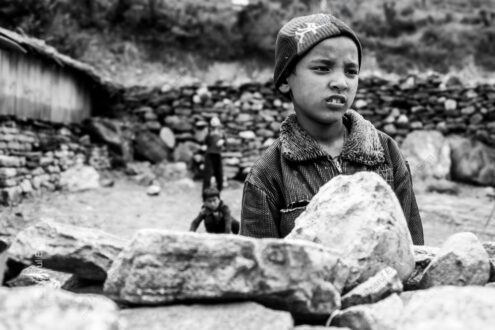
The photograph establishes a compelling spatial hierarchy through layered depth and tight framing. Occupying the upper right quadrant, a young boy stands in three-quarter profile, his intense, off-camera gaze introducing a narrative tension that pulls the viewer beyond the edges of the frame. The immediate foreground is anchored by a rough horizontal arrangement of weathered stones, creating a physical barrier that separates the subject from the lens. Behind him, dry-stone masonry and terrain rise in textured tiers, with a secondary child figure crouching in the middle ground, adding environmental scale and visual counterweight to the primary subject.
Rendered in a nuanced black-and-white tonal spectrum, the lighting provides a soft, atmospheric diffusion that highlights intricate tactile details without harsh spectral glare. The selective depth of field subtly softens the foreground rocks and background wall, isolating the boy whose woven beanie, fleece-lined collar, and facial features are rendered with crisp clarity. Midtone gradations transition smoothly between deep, shadowy crevices within the stone architecture and the muted brilliance of ambient skylight, exemplifying a masterful control over exposure and textural presence.
Captured by photographer Nasrul Eam in May 2009, this image emerged during a visual journey along the high-altitude mountain paths between Muktinath and Jomsom. Rather than offering a detached geographic document, the frame captures an intimate, unscripted moment embedded within the rugged topography of the region. The interplay between human expression and the enduring stonework reflects the photographer’s immersive approach to capturing life across remote Himalayan corridors.
Aligning with Eam’s overarching investigation into the human condition, the portrait transcends simple documentary recording to probe themes of childhood, environment, and quiet observation. The subject’s candid posture and slightly parted lips suggest a fleeting pause in daily routine, inviting an empathetic connection without resorting to sentimental exaggeration. By situating the child within an environment shaped entirely by raw earth and hand-piled stone, the composition explores how personal identity is quietly framed by the enduring textures of place.
As a compelling entry within high-end documentary portraiture collections, this artwork holds significant value for discerning collectors. Its powerful emotional clarity, rich tonal architecture, and timeless humanness ensure its status as a vital acquisition. Produced as an archival print, it stands as a testament to the evocative possibilities of monochrome human study.
About the Photographer
Nasrul Eam is a visionary art and documentary photographer whose work has deeply influenced the photography world since 2008. With over 60 publications to his name, including notable works like “The Quintessence of Photography: Understanding Composition” and “Masterclass in Portrait Photography: Echoes of Emotion”, he explores the intricacies of human emotion and visual storytelling. As the chief judge for Light & Composition University’s prestigious photography award for the past 14 years, Nasrul’s discerning eye and expertise have shaped the future of countless photographers. His role as Dean of the Department of Art and Photography further reflects his dedication to nurturing new talent. Nasrul’s photography, particularly through projects like “The Happy Children of the Third World,” captures the essence of his subjects with profound depth, inspiring collectors and photographers alike. His evocative images transcend time, culture, and genre, and have become highly sought after in the art world for their emotional depth and unique storytelling, making them a valuable addition to any high-end collection. His work continues to inspire and elevate the art of photography globally, solidifying his reputation as one of the foremost photographers of his generation.