Expedition Overview
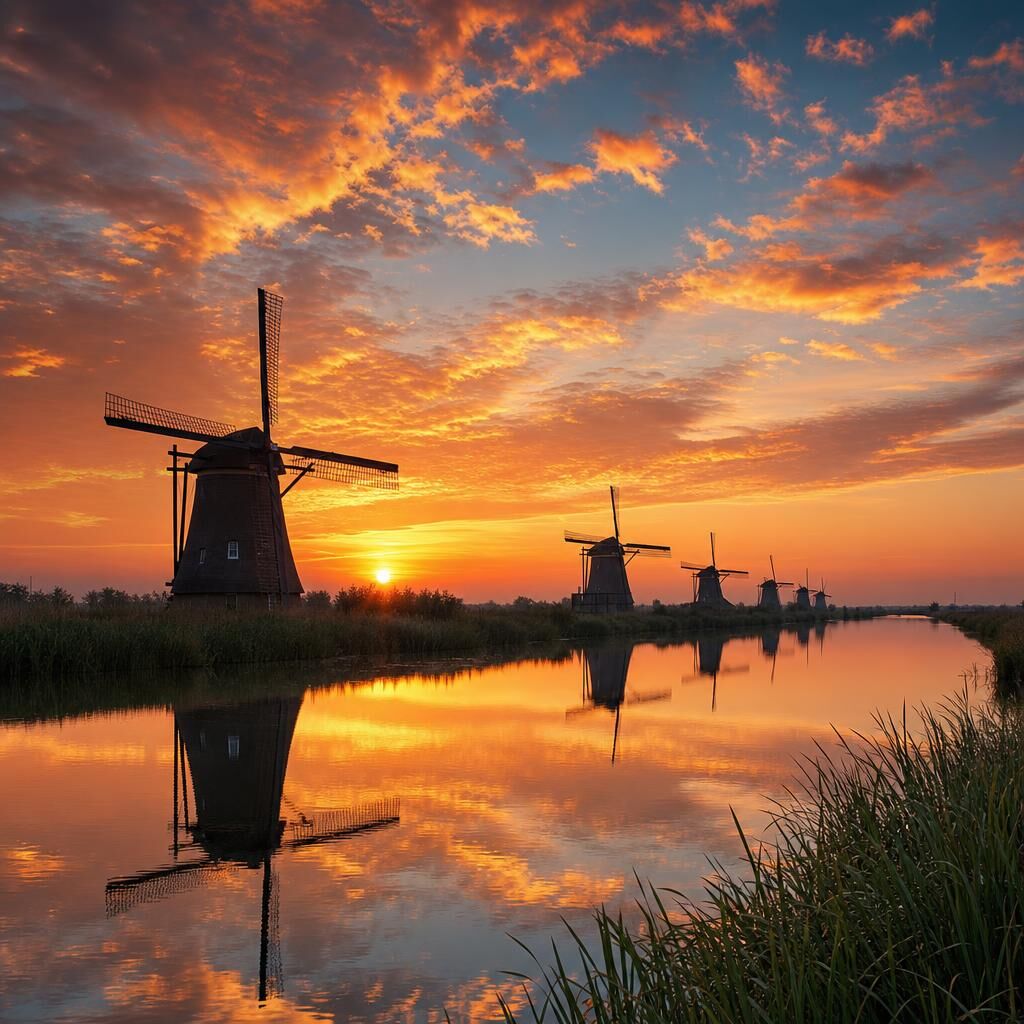
Kinderdijk's 19 windmills were built between 1722 and 1761 to drain the Alblasserwaard polder — a flat basin sitting 4 metres below sea level — and they still operate, their sails turning when the wind allows. The polder's drainage channels between the two mill rows produce mirror-flat reflections on still mornings, and at dawn from the south end of the Nederwaard row, the photographer has two identical rows of working mills extending to the horizon: one above and one below, in a symmetry that exists nowhere else in the photographable world. On a calm morning with no wind, both the mill silhouettes and their reflections are sharp; when the sails are turning and a light breeze ripples the surface, the reflected image moves while the mills above it remain still.
{leader_name} approaches Kinderdijk without the instinct to photograph the mills as individual objects — the close-up of a single sail, the standard image of any Dutch windmill that could have been made at any of the country's mill sites. This expedition reads Kinderdijk as a landscape system: the row perspective, the water channel reflections, and the specific positions within the complex where the mills and their reflections create the deepest layers of visual information.
Expedition Itinerary
Day 1: Nederwaard Row — Mirror Conditions at Sunrise
The Nederwaard row faces east and the sunrise condition arrives directly — the mills are silhouetted against the sky at first light and begin to catch warm light on their brick bases by 7am. Pre-dawn positioning at the south end of the row places the photographer at the optimal perspective: all 8 mills receding to the north, reflected in the drainage channel running alongside. When the wind is below 3 knots the surface is glass; above 3 knots it ripples and the reflection breaks into texture that moves in the opposite direction from the turning sails. Both conditions reward long exposure work at different shutter speeds.
The Goal of the Day: Industrial windmill row photography at sunrise; mirror-reflection conditions and the perspective of diminishing scale along the mill row.
Day 2: Overwaard Row — Backlit Sails in Late Light
The Overwaard row faces west, meaning its light conditions are the mirror-opposite of the Nederwaard: dawn is frontlit and afternoon produces dramatic backlight that makes the canvas sails translucent against direct sun, revealing the wooden frame structure within. We photograph the Overwaard row in the late afternoon when the sails glow from within and the brick tower bases are in shade below — a contrast condition available for approximately 90 minutes before sunset. Between the two mill rows, the polder's drainage infrastructure — sluice gates, pumping stations, and the flat agricultural land the mills made habitable — provides documentary material throughout the day.
The Goal of the Day: Backlit translucent windmill sail photography; the polder drainage system as working industrial documentary.
Book Your Expedition
Note: Final price may vary based on specific expedition details and customizations.
Expedition Leaders
Kirsten Bruning is a distinguished L&C Faculty Expedition Leader and Art Marketing Specialist based in the vibrant city of Cologne, Germany. Since joining Light & Composition University in 2019, Kirsten has dedicated her expertise to guiding aspiring photographers and promoting the art of visual storytelling. Her photographic work is characterized by a profound appreciation for the subtle beauty found in nature and a unique ability to capture the emotional narratives embedded within everyday moments. Her approach encourages participants to look beyond the obvious, fostering a deeper connection with their surroundings and their craft.
Kirsten's journey into photography began at an early age, sparked by her father's introduction to the timeless art of analogue photography. This foundational experience instilled in her a meticulous eye and a deep respect for the photographic process, influences that are evident in her diverse range of specialties. She masterfully navigates various genres, including Street, Architecture, Portrait, Landscape, Nature, Long Exposure, Travel, and Documentary photography. Whether she's exploring urban environments or serene natural landscapes, Kirsten consistently seeks to uncover and highlight the often-overlooked details that tell a compelling story.
As an experienced Expedition Leader, Kirsten leads immersive photographic journeys across a rich tapestry of European locations, including Germany, Belgium, the Netherlands, Luxembourg, and France. Her expeditions are more than just photo walks; they are carefully curated experiences designed to inspire creativity, enhance technical skills, and provide participants with unforgettable cultural and visual encounters. Through her warm guidance and extensive knowledge, Kirsten empowers photographers of all levels to refine their vision and capture the world with authenticity and artistic flair, embodying the spirit of discovery and artistic expression.
Travel Information
Local Logistics
Rent a bicycle at Kinderdijk for convenient exploration of the windmills and surrounding polder. Public transport, like the waterbus from Rotterdam or Dordrecht, offers direct access to the Kinderdijk site. Consider staying in nearby towns such as Dordrecht or Papendrecht for accommodation, as options within Kinderdijk itself are limited. Plan your photography around sunrise and sunset for optimal lighting conditions, especially for reflections on the water.
Health and Safety
Carry layers of clothing and waterproof gear, as weather in the Netherlands can change rapidly. Be prepared for mosquitoes, especially during warmer months near the many waterways, and bring insect repellent. The area is generally very safe, but always keep an eye on your photography equipment and personal belongings. Watch for cyclists when walking near paths, as bicycle traffic is constant.
Cultural Guidelines for Photographers
Always respect private property boundaries; many windmills are inhabited and not all areas are publicly accessible. Ask for permission before taking close-up photographs of people to ensure their comfort and privacy. Avoid disturbing local residents, especially during early morning or late evening shoots, by keeping noise levels low. Do not climb on the windmills or cross fences into restricted areas.
What to Bring
Kinderdijk Windmills Photography Expedition: 2-Day Packing ListGeneral Considerations: Kinderdijk is beautiful but can be exposed to wind and rain even in summer. Layers are key, and comfortable, waterproof footwear is a must for walking along the paths and dikes. Early mornings and late evenings for optimal light can be chilly.
- Photography Equipment- Camera Body: Your primary DSLR or Mirrorless camera body.
- Lenses:
- Wide-angle lens (e.g., 16-35mm, 14-24mm): Essential for capturing the vast landscapes, windmills, and polder in their entirety.- Standard zoom lens (e.g., 24-70mm, 24-105mm): Versatile for general travel shots, environmental portraits, and isolating specific windmills.- Telephoto zoom lens (e.g., 70-200mm, 100-400mm): For compressing scenes, isolating distant windmills, details, and potentially wildlife.- Tripod: Sturdy, yet travel-friendly tripod – absolutely essential for long exposure photography and sharp landscape shots in low light.- Filters (Crucial for Landscape &
Long Exposure):
- ND (Neutral Density) filters: Various strengths (e.g., 3-stop, 6-stop, 10-stop) for different long exposure effects during the day.- Graduated ND filters: Soft and/or hard edge, to balance bright skies with darker foregrounds.
Where Will Your Lens Take You Next?
Every horizon holds a new masterclass. Explore 68 worldwide fieldwork routes, interactive satellite maps, confirmed small-group departure dates, and regional optical dossiers.
Expeditions Overview & Master Map
Explore 68 worldwide expedition stops, interactive satellite coordinates, faculty leaders, and complete academic fieldwork curriculum.
Destinations & Lighting Specs
Examine comprehensive regional field dossiers detailing optical lighting conditions, microclimates, cultural protocols, and camera gear.
2026–2027 Departure Matrix
Search confirmed departure windows by season, country, and faculty leader. Small groups guaranteed with 4–8 photographers maximum.