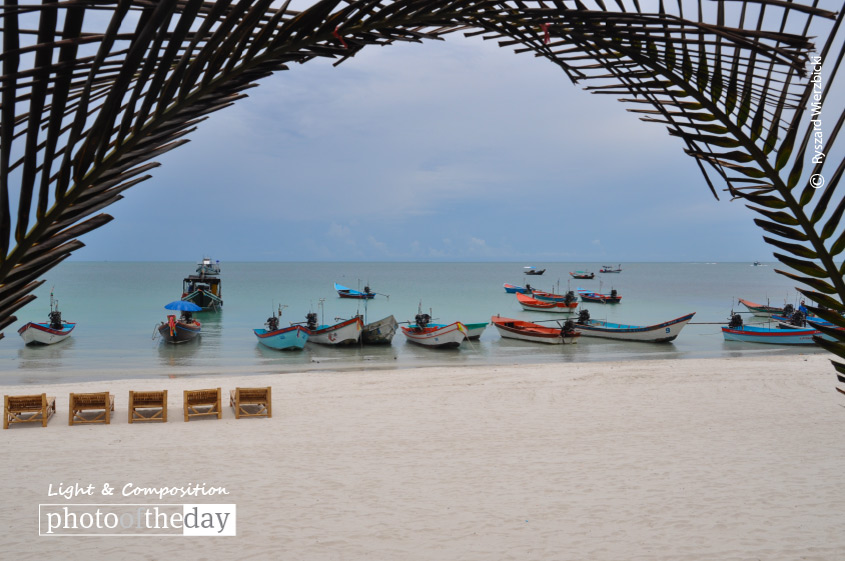
The Full Moon Party Beach – Gate by Ryszard Wierzbicki
Captured on the shores of Haad Rin Nok Beach, this photograph reveals the serene beauty of Koh Phangan in the quiet aftermath of the infamous Full Moon Party. By venturing to the island's southern reaches just days after the festivities, the photographer successfully bypassed the chaotic crowds to document a tranquil, hidden landscape. The image is award-worthy for its ability to transform a site synonymous with revelry into a peaceful, contemplative vista, showcasing the island's natural allure through a balanced composition and precise technical execution.
Ryszard Wierzbicki
Born in 1963 and a graduate of the University of Gdańsk, Ryszard Wierzbicki transitioned from a diverse career in education and marketing to become a dedicated traveler and photographer after emigrating to the United Kingdom in 2006. A PADI scuba instructor with a deep passion for South-East Asia, he frequently volunteers with orphanages and manages platforms dedicated to global exploration. Now based in Swindon, he balances his professional life as a marketing advisor and tour organizer with his enduring commitment to capturing the world through his lens.
Resonance Score Breakdown
Transparency Note: The resonance score (12.1/20) is calculated based on social engagement metrics collected before the award announcement.
Expert Photography Reviews · 8
The Morning After the Noise
There is a specific silence that follows a riot of sound. It is not the silence of a library or a sleeping house; it is the hollowed-out quiet of a space that has been emptied of its purpose.
Read the reflection →The Architecture of Aftermath
We often mistake the city for its peak moments—the festival, the protest, the rush hour. We define a space by its capacity to hold a crowd, measuring its success by the density of bodies it can sustain. But there is a profound honesty in the quiet that follows the departure.
Read the reflection →Reviews & Comments
Share your thoughts about this award-winning photograph. Your reviews contribute to the community engagement score.
At f/14, the Nikon D90 hits the diffraction limit, yet Wierzbicki’s 27mm glass manages to resolve the sand’s granular texture with surprising clarity. The focal plane is deep, anchoring the gate against the horizon’s soft atmospheric haze. I’m genuinely moved by how the light renders the wood’s weathered grain; it’s a tactile, almost microscopic intimacy I rarely find in travel work. It’s not just a beach; it’s a precise calibration of light meeting raw, quiet matter.
The frame breathes. It’s the silence after the music dies, that heavy, humid stillness where the lens finally catches its breath. Wierzbicki nails the exposure; at f/14, the depth holds every grain of sand like a film set waiting for the actors to return. I’ve stood on beaches like this, and honestly, the ache of the emptiness hits me hard. It’s a perfect wide shot. The cut would’ve been a mistake. This is the frame the editor keeps.
Most travel photography is just noise, but Wierzbicki’s frame finds the silence left behind. By shooting at f/14, he’s rendered the sand and tide with a clinical precision that makes the aftermath of the party feel almost holy. It’s the contrast between the chaotic reputation of Haad Rin and this stillness that hits me; I actually felt my pulse slow down looking at it. It’ll endure because it captures a place, not just a moment.
Cleaning up after a bacchanal is a thankless task, yet Wierzbicki managed to find the silence beneath the debris. It’s a tidy composition, though one wonders if he simply arrived when the tide did the heavy lifting. I’ve spent enough mornings shivering on desolate beaches to know the difference between luck and labor. It’s a decent frame, but I’m left questioning if he actually waited for the light, or just happened to be there.
The sand here feels scrubbed clean, as if the ocean finally exhaled after the noise. He stood in the cooling hour, waiting for the light to soften against that weathered gate. It’s a quiet ache, seeing such stillness where chaos once lived. I find myself breathing deeper just looking at it. He didn’t rush the frame; he let the island’s own rhythm dictate the shutter. It’s a rare, honest peace he’s pulled from the tide.
We look at this gate and we don’t see a party; we see the silence left behind. It’s a portrait of a place catching its breath. Ryszard listened to the sand before he looked, finding the stillness hidden beneath the revelry. I feel a strange, hollow ache looking at these empty wooden slats. It’s as if the beach is waiting for a secret to be told. This is a photograph that asks to be returned to.
You’ve found the silence that usually gets drowned out here. Most people only see the neon chaos of Haad Rin, but you waited for the hangover to pass. I’m looking at that gate, and it’s lonely—it feels like a stage after the actors have gone home. There’s something honest happening here. You didn’t just take a travel shot; you felt the quiet exhaustion of a place that’s been used up. I respect that.
The frame’s architecture relies on the gate’s verticality to anchor the horizon. It’s a rigid fulcrum against the chaotic sprawl of the sand. The negative space doesn’t collapse; it breathes. I’ve grown tired of travel photography that leans on sentiment, but the geometric discipline here is undeniable. The tension between the man-made structure and the receding shoreline holds the eye captive. It’s a rare instance where the composition doesn’t just work—it commands.