Take a Break by Jana Luo
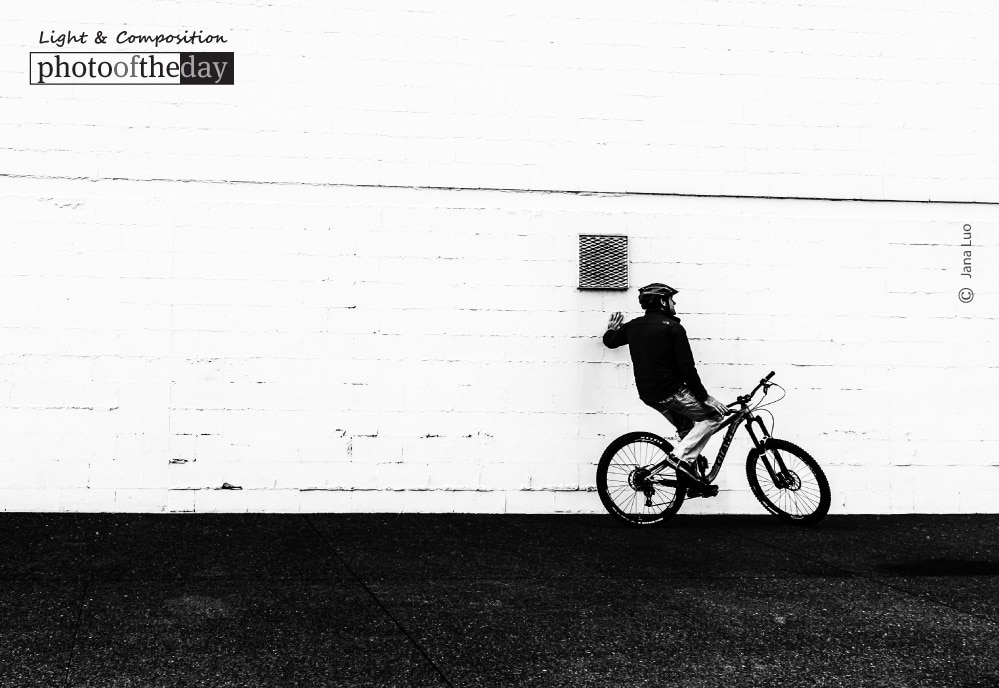
While wandering through the Viaduct in Auckland, the photographer captured a candid moment of urban life. Spotting a cyclist ahead, she followed him until he paused to lean against a wall, waiting for his son. This quiet, fleeting interaction highlights the beauty of everyday pauses in a bustling city. The image is award-worthy for its masterful composition and the authentic, human narrative it preserves. By focusing on the stillness of the subject against the backdrop of the environment, the photographer transforms a simple routine into a compelling, timeless black and white study of patience and connection.
Jana Luo
Born in China, Jana Luo relocated to New Zealand in 2005, where she developed a profound appreciation for the country's landscape. After acquiring her first professional camera in 2013, she quickly discovered photography as a vital medium for expressing her internal moods and unique perspective on the world. Known for her sensitivity and artistic intuition, Luo uses her gear to translate personal feelings into evocative visual narratives that resonate with viewers internationally.
Resonance Score Breakdown
Transparency Note: The resonance score (10.8/20) is calculated based on social engagement metrics collected before the award announcement.
Expert Photography Reviews · 6
The Architecture of Waiting
In the nineteenth century, the invention of the railway forced a new kind of rhythm upon the human body. We became creatures of the schedule, tethered to the departure board and the ticking clock. We learned to measure our lives in transit, in the spaces between here and there.
Read the reflection →The Weight of the Pause
I keep a small, rusted iron key in my desk drawer that no longer fits any lock in my house. It is heavy for its size, cold to the touch, and carries the phantom weight of a door I can no longer name.
Read the reflection →Reviews & Comments
Share your thoughts about this award-winning photograph. Your reviews contribute to the community engagement score.
The Viaduct’s geometry usually demands clinical sharpness, but I’m drawn to how Luo lets the urban noise dissolve. It’s not about the cyclist; it’s about the deliberate refusal to resolve the background into mere data. I find myself wanting to lean into that blur, to feel the city’s pulse rather than count its bricks. Why resolve the environment when the atmosphere tells a truer story? It’s a quiet rebellion against the tyranny of the lens.
Stripped of chromatic distraction, one finds the silver-grey of the Auckland concrete possesses the melancholic, chalky density of a Morandi still life. It’s a study in monochromatic patience, where the cyclist’s shadow bleeds into the pavement like ink in water. I’ve felt such a sudden, sharp ache for this stillness; it’s the quietude of a Vermeer interior, where the light doesn’t just fall, it breathes, turning a fleeting urban pause into something eternal.
The city’s rush fades here. He stood against that wall, waiting for his son, and in that stillness, the concrete softened. It’s a quiet grace I’ve chased in my own work, that moment when the world stops demanding our movement. I feel a sudden, sharp ache for that silence. She didn’t force the frame; she listened to the rhythm of his pause. It’s a rare, honest breath caught in the middle of a busy harbor.
f/2 at 1/125s, ISO 400, 23mm. The X100s lens wide open creates a shallow plane that isolates the subject from the Viaduct’s visual noise. It’s a calculated risk. The focus on the cyclist’s posture is sharp, but the background blur is messy. I’ve seen better bokeh, yet the technical restraint here works. It’s honest. I actually felt a rare, quiet relief seeing the subject’s stillness amidst that urban clutter. The numbers justify the intent.
The cyclist leans, the city breathes, and the frame locks. It’s a quiet cut in a frantic sequence of urban motion. I love how the wall anchors him; it’s the stillness that makes the shot hold. You can feel the father’s patience in the grain. It’s not just a pause; it’s the exact moment the editor keeps before the scene shifts. Luo caught the rhythm of a heartbeat in a bustling port. It’s perfect.
The vertical axis of the wall bisects the frame, creating a perfect tension against the cyclist’s horizontal posture. It’s a study in intersecting vectors. The negative space in the upper quadrant balances the dense, dark mass of the bicycle, establishing a precise 1:2 ratio of void to form. I’m genuinely struck by how the geometry anchors the stillness here. It’s not just a pause; it’s a solved equation of urban equilibrium. The math is simply beautiful.