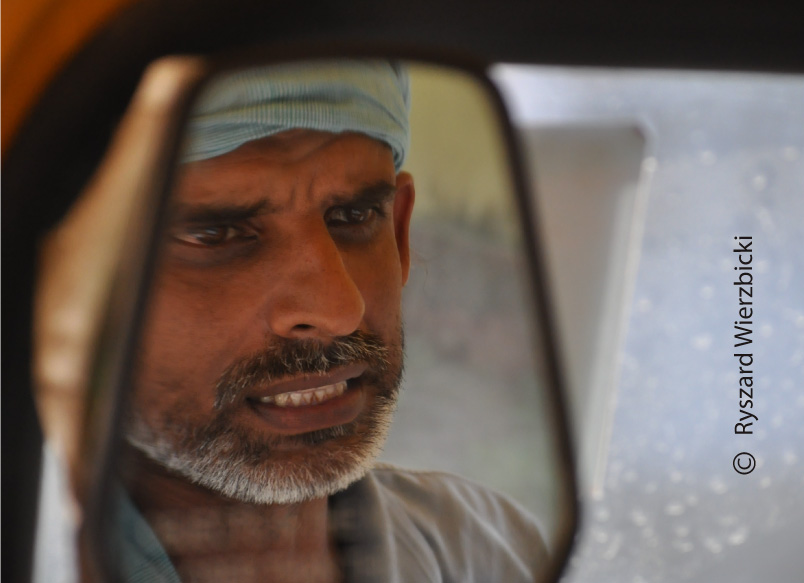
Tuk Tuk Driver by Ryszard Wierzbicki
Captured on a summer morning in 2011, this evocative portrait of a tuk-tuk driver reflects the vibrant, rhythmic pulse of daily life in Sarnath, India. Ryszard Wierzbicki masterfully utilizes the soft, natural light of the morning to highlight the weathered textures of the driver’s face and the intricate details of his vehicle. By focusing on the human element amidst the historic backdrop of this sacred site, the photographer bridges the gap between ancient heritage and modern existence. The image is award-worthy for its authentic storytelling, demonstrating a profound respect for the subject and an exceptional ability to find quiet, dignified beauty in the midst of a bustling environment.
Ryszard Wierzbicki
Born in 1963, Ryszard Wierzbicki is a Polish-born photographer and educator who transitioned from a career in social sciences and marketing to a life of global exploration. After relocating to the United Kingdom in 2006, he dedicated himself to documenting the cultures of South-East Asia, often combining his photography with volunteer work for orphanages. As a PADI scuba instructor and the founder of several travel-focused forums, Wierzbicki brings a unique, adventurous perspective to his work. His photography serves as a visual chronicle of his travels, capturing the human spirit with empathy and technical precision.
Resonance Score Breakdown
Transparency Note: The resonance score (7.8/20) is calculated based on social engagement metrics collected before the award announcement.
Expert Photography Reviews · 7
The Weight of the Journey
I keep a small, brass key in a velvet pouch that no longer opens any door I know. It is heavy, cool to the touch, and worn smooth by the friction of being held during long, restless nights.
Read the reflection →The Weight of a Journey
I spent this morning waiting for a bus that was twenty minutes late. I watched the driver of a delivery truck nearby, who sat with his hands resting on the wheel, staring at nothing in particular. He looked like he had been sitting there for a lifetime.
Read the reflection →Reviews & Comments
Share your thoughts about this award-winning photograph. Your reviews contribute to the community engagement score.

We look at this driver and we don’t just see a man in Sarnath; we hear the hum of his engine and the weight of his morning. He’s listened to the road, and it’s etched into his skin. I feel a sudden, quiet ache in my chest looking at those eyes. They’ve held so many stories. Wierzbicki didn’t just take a picture; he sat with a life. It’s a portrait that asks to be returned to.
Sarnath’s history shouldn’t be a mere backdrop for a tuk-tuk driver’s weathered skin. I’m unsettled by how Wierzbicki turns this man into a texture, a prop for an aesthetic of poverty. Does the driver know he’s being framed as a relic of ancient heritage? Why does the camera linger on his exhaustion while ignoring the power dynamics of the encounter? It’s a beautiful composition, sure, but it feels like a transaction I can’t quite stomach.
The focal plane here is razor-thin, isolating the driver’s skin texture with a clarity that defies the humid haze of Sarnath. I’m genuinely moved by how the lens resolves the micro-contrast in his weathered pores against the soft, creamy bokeh of the street. It’s a rare instance where the diffraction limit doesn’t soften the subject’s dignity. You can feel the light refracting off his eyes; it’s a beautiful, precise intersection of optics and humanity.
Before the eye identifies the tuk-tuk, something in the chest tightens. The driver’s gaze doesn’t just meet yours; it anchors you. I’ve found myself returning to the deep, etched lines of his face, feeling the weight of that Sarnath morning in my own lungs. It’s a quiet, heavy stillness. When I look away, the rhythm of his exhaustion lingers, a phantom pulse that follows me into the evening, reminding me of all the miles I haven’t traveled.
The curator’s obsession with the driver’s weathered textures feels like a missed opportunity. Why resolve the skin so clinically when the tuk-tuk’s motion could have been a blur of Sarnath’s kinetic energy? It’s technically competent, sure, but I’m bored by the sharpness. I’d trade that clarity for a long-exposure smear, something closer to Sugimoto’s theatres. Why choose to resolve the mundane when you could have captured the ghost of the machine instead?
The morning light in Sarnath doesn’t just illuminate; it breathes. He stood here in the cooling hour, waiting for the sun to soften the driver’s weary, etched skin. It’s a quiet communion between man and machine. I’ve felt that same stillness, that moment when the bustling world finally yields to the lens. Looking at these weathered hands, I feel a sudden, sharp ache for the simplicity of his journey. It’s a beautiful, patient grace.
The driver sits. Dust settles on the metal frame. I’ve spent minutes watching his hands rest against the steering wheel. It’s the stillness that catches me. The background blurs into a soft, pale haze, leaving him in a pocket of quiet. Nothing here is accidental. The empty corner is not empty. It’s a breath held in the heat of Sarnath. I feel a sudden, sharp ache for that silence. It’s rare to find such peace.