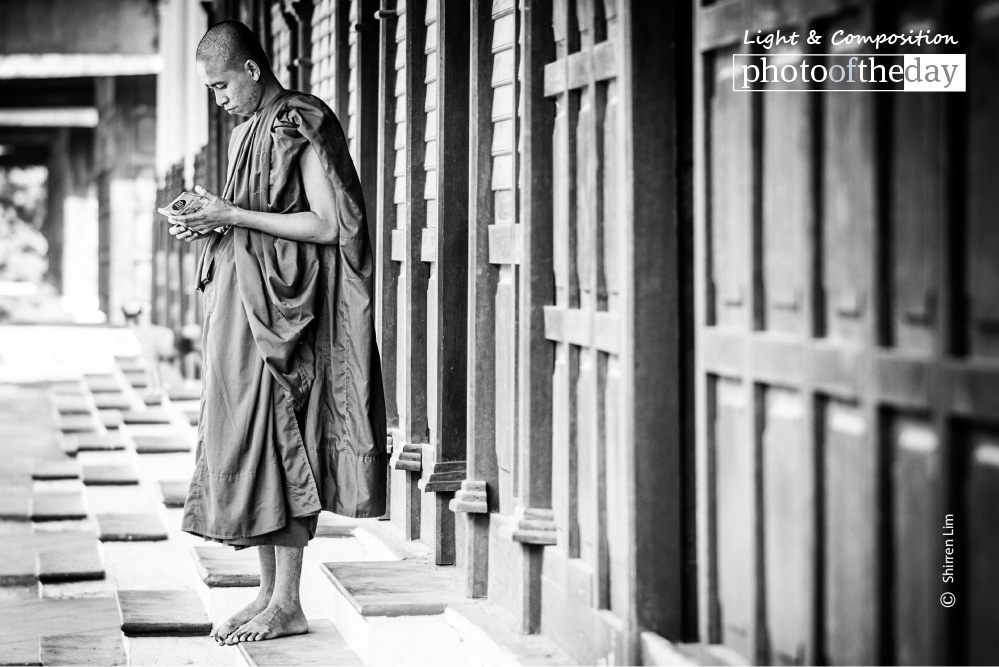
Tourist Monk by Shirren Lim
While exploring the historic grounds of the Royal Palace in Mandalay, the photographer encountered a monk engaged in a quiet moment on his mobile phone. Recognizing the juxtaposition of ancient tradition and modern technology, she carefully positioned herself to utilize the palace architecture as a leading line, creating a sense of depth and perspective. This candid capture is award-worthy for its masterful composition and the subtle, humanizing narrative it weaves, effectively bridging the gap between the monumental history of the last Burmese monarch and the everyday reality of contemporary life.
Shirren Lim
Born in Penang Island, Malaysia, in 1970, Shirren Lim is a Jakarta-based photographer who discovered her true passion for the craft in 2009. Specializing in portraiture, she seeks to capture the raw sincerity and humanity of her subjects, often producing work described as intense and earthy. Inspired by the iconic imagery of Steve McCurry, Lim strives to create powerful, world-changing photographs that cut to the heart of the subject matter, and her work has been featured in numerous international print and web publications.
Resonance Score Breakdown
Transparency Note: The resonance score (12.2/20) is calculated based on social engagement metrics collected before the award announcement.
Expert Photography Reviews · 8
The Weight of a Whisper
I keep a small, rusted key in a velvet pouch, though I have long since forgotten which door it once opened. It is heavy for its size, a cold piece of iron that feels like a secret held too tightly in the palm.
Read the reflection →The Weight of the Present
In the quiet corners of old libraries, one often finds a curious tension between the parchment of the past and the hum of the modern world.
Read the reflection →Reviews & Comments
Share your thoughts about this award-winning photograph. Your reviews contribute to the community engagement score.
The saffron robes bleed into the sun-bleached ochre of the palace walls, a monochromatic embrace that feels like a Vermeer interior caught in the humid, dusty heat of Mandalay. It’s a chromatic sigh, really; I’m breathless at how the monk’s vibrant, saturated orange anchors the composition against those muted, crumbling stone tones. One doesn’t merely see the phone; one feels the jarring, electric dissonance of modernity bleeding into a palette that’s ancient, eternal, and utterly divine.
You caught a quiet, jarring truth here. It’s easy to mock the monk with the phone, but you didn’t. You just watched. I’ve spent enough time in places like Mandalay to know that sacred spaces don’t stop the world from turning. And you waited for that exact second where the ancient walls framed his modern distraction. It’s a lonely, human moment. I felt a strange pang of recognition looking at him. You got it right.
The palace wall recedes. It’s a cold, stone throat. The monk sits small. He’s tethered to a screen, yet the silence holds him. I’ve felt that ache before—the pull of the world against the stillness of the robe. Nothing here is accidental. The empty corner isn’t empty. It’s the weight of centuries pressing against a thumb. It doesn’t need more. It’s enough. I find myself holding my breath, waiting for the phone to go dark.
It’s a clever juxtaposition, certainly. One wonders how long she stood in that heat, waiting for the monk to find his signal against the palace walls. It’s easy to snap a tourist’s curiosity, but catching the stillness of a man tethered to two worlds requires a rare, quiet persistence. I’ve spent enough afternoons baking in similar sun to appreciate the discipline here. She didn’t just find this moment; she clearly earned it.
The palace’s receding colonnade establishes a rigid orthogonal grid, forcing the eye toward the monk’s singular, dark mass. It’s a perfect exercise in spatial tension. By placing the subject at the intersection of the primary vertical axis and the golden ratio, Lim balances the heavy, ancient architecture against the fleeting, modern geometry of the phone. I’m genuinely thrilled by how the light creates a negative quadrant that isolates his focus. It’s a beautifully solved equation.
The juxtaposition feels tired. We’ve seen this “monk with a phone” trope a thousand times, yet Lim insists on framing it against the Royal Palace’s grandeur. Why must we exoticize his digital intimacy to make it palatable? It’s a staged candid that feels voyeuristic rather than humanizing. I’m honestly exhausted by this reductive gaze. Does the monk’s humanity only matter when it’s contrasted against ancient stone? Whose history are we actually consuming here?
We look at this monk, bathed in the shadow of Mandalay’s history, and we see a man caught between two worlds. He’s holding that phone like a prayer bead, tethered to the present while surrounded by the weight of the Royal Palace. It’s a quiet, jarring intimacy that I find deeply moving. Did Shirren listen to the silence before she clicked? I think she did. It’s a photograph that asks to be returned to, again and again.
The rhythmic fenestration of the Mandalay Palace creates a powerful datum, pulling the eye toward the monk. It’s a classic use of perspective, yet the architecture feels strangely hollow here. By flattening the threshold between the ornate timber and the monk’s digital distraction, Lim ignores the tactile weight of the space. I’m struck by how the light hits the floor, though—it’s a beautiful, sharp sliver of reality that almost makes me forget the building’s missing soul.