The Young Fisherman by Tanmoy Saha
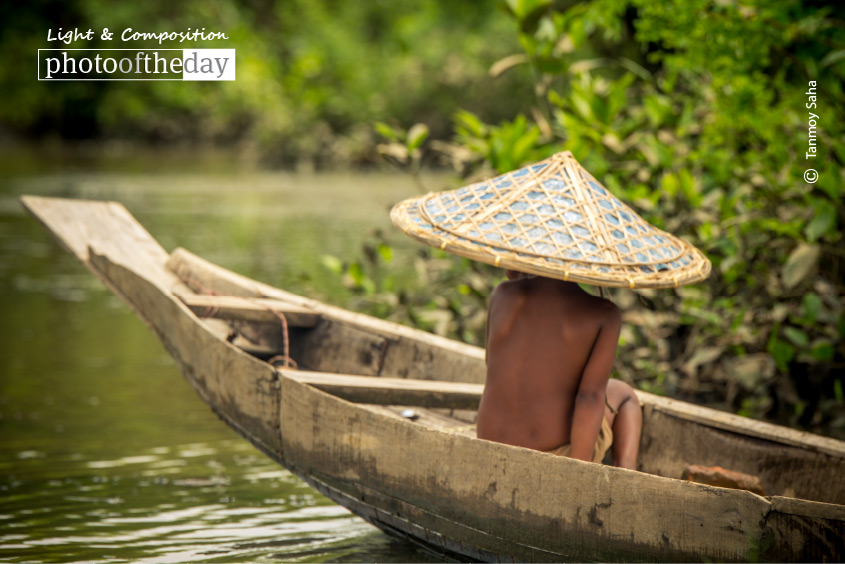
Captured during a return journey from the Ratargul Swamp Forest in Sylhet, this photograph documents a poignant moment on a bright, sunny afternoon. The image depicts a young fisherman diligently searching for his catch alongside his father, highlighting the quiet rhythm of local life. The photographer’s ability to frame the scene with such clarity and emotional resonance, while balancing the harsh natural light of the afternoon, elevates this simple daily activity into a compelling artistic narrative. It is a testament to the beauty found in everyday human connection and traditional livelihood.
Tanmoy Saha
Based in Dhaka, Bangladesh, Tanmoy Saha Turja is a dedicated photographer who began his creative journey in 2007. An Electronics and Telecommunication Engineering graduate, he balances his professional work in the audio-visual sector with a deep passion for portrait, landscape, and wildlife photography. His technical foundation, built through studies at the Dhaka University Photography Society and Pathshala, has led to his work being featured in prestigious exhibitions at the National Art Gallery of Bangladesh.
Resonance Score Breakdown
Transparency Note: The resonance score (12.4/20) is calculated based on social engagement metrics collected before the award announcement.
Expert Photography Reviews · 8
The Weight of Small Hands
There is a specific silence that belongs to a child who has already learned the language of labor. It is not the silence of play, which is full of potential and noise, but the quiet of a small body learning to mimic the heavy, rhythmic movements of a man.
Read the reflection →The Inheritance of the Water
We often speak of the city as a landscape of concrete and glass, forgetting that for many, the geography of survival is written in water and silt.
Read the reflection →Reviews & Comments
Share your thoughts about this award-winning photograph. Your reviews contribute to the community engagement score.

The sun hangs heavy, bleaching the surface of the Ratargul waters. It’s a harsh, unforgiving light, yet Tanmoy found the grace within it. I’ve spent enough hours in the swamp to know how the humidity clings to your skin, but here, the stillness feels sacred. Watching the boy mirror his father’s posture, I feel a sudden, sharp ache for the simplicity of their rhythm. He didn’t rush the shutter; he waited for the water to listen.
The high-noon sun in Sylhet creates a brutal challenge for the sensor, yet the lens handles the harsh contrast with remarkable control. I’m struck by the micro-contrast on the boy’s skin; it’s rendered with such clinical sharpness that you can almost trace the refraction of light through the water droplets. It’s a rare moment where the focal plane perfectly isolates the human element against the swamp’s chaotic textures. Honestly, the clarity here makes my heart ache.
The light hits the water like a hard cut. It’s a high-contrast sequence, the kind where the motion is suspended in the ripple. I’m struck by the boy’s focus; he’s holding his breath, waiting for the edit. The composition doesn’t need a pan or a zoom. It’s a perfect, static close-up of a life lived in the reeds. I’d have killed to film this. It’s the frame the editor keeps when everything else is discarded.
Sunlight in the Ratargul swamp doesn’t just illuminate; it interrogates. Saha’s frame forces the fisherman into a brutal, high-contrast struggle against the encroaching dark of the forest floor. It’s a heavy, suffocating beauty. I’ve stared at the boy’s silhouette for an hour, and I’m unsettled by how much of his humanity is surrendered to the black water. He isn’t just fishing; he’s negotiating with the void. It’s a haunting, silent weight I can’t quite shake.
The water stretches. A vast, dark mirror. The boy and his father are small, tethered to the bottom edge. They don’t crowd the frame. They let the swamp breathe. I’ve spent minutes watching that stillness. It’s a quiet I rarely find. The light hits the surface, but the shadows hold the weight. Nothing here is accidental. The empty corner is not empty. It’s a pause. A breath. I feel the humidity just looking at it.
Most entries from the Sylhet region lean on the exotic, but this avoids that trap. It’s the restraint in the boy’s posture that caught me; he isn’t posing, he’s working. I’ve seen thousands of portraits of labor, yet this one lingers because the light doesn’t just illuminate the water—it defines the weight of the net. It’s a quiet, honest document of a vanishing rhythm. I’d bet my career this will still matter in thirty years.
The emerald murk of the Ratargul swamp, that dense, vegetal green reminiscent of a Turner study in humidity, swallows the light until it’s merely a bruised, golden shimmer upon the water’s skin. I’m breathless at how the boy’s skin tone, a warm, sun-baked ochre, vibrates against the cool, suffocating depths. It’s a Morandi-esque stillness, where the palette doesn’t just describe the heat; it’s the very weight of the afternoon pressing against one’s own tired eyes.
The vertical axis of the boat bisects the frame, creating a perfect 1:1 equilibrium between the subject and his reflection. I’m struck by how the diagonal of the oar disrupts the stillness, slicing the negative space into precise, calculated triangles. It’s a rigorous spatial solution. The light doesn’t just illuminate; it defines the geometry of the water’s surface. It’s rare to see such chaotic natural elements forced into such a clean, satisfying mathematical order. I love it.