The Purest Water by Manon Mathieu
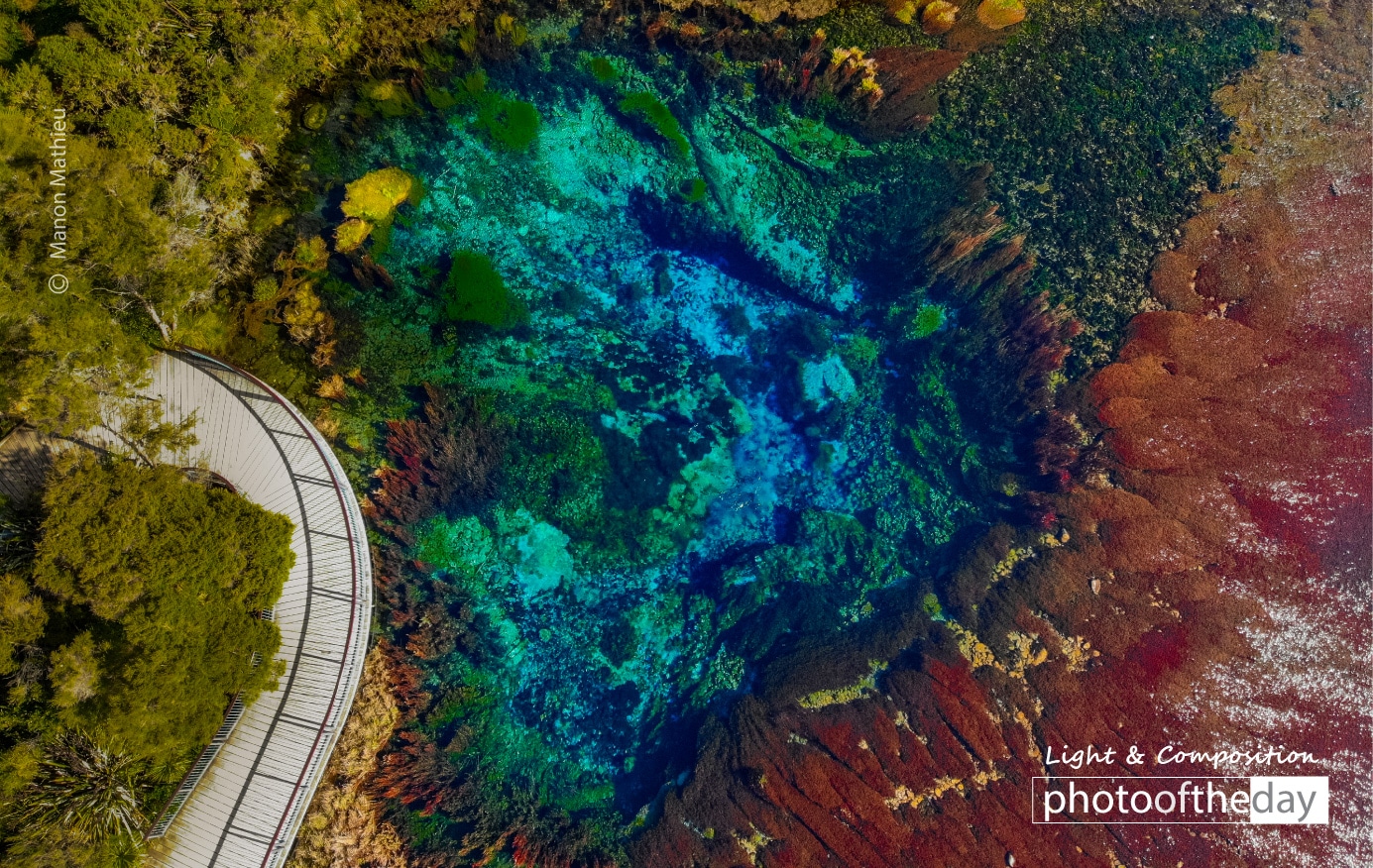
Captured from the sky, this aerial perspective of Te Waikoropupu Springs reveals the breathtaking transparency of one of the world's purest water sources. Manon Mathieu utilized the DJI Mavic Air to document the intricate underwater environment, which is typically obscured from ground level. The photograph highlights the vibrant, crystalline clarity of the springs, a site deeply protected by the Maori people. This image is award-worthy for its technical precision in aerial composition and its ability to transform a renowned natural landmark into a meditative study of light, depth, and pristine ecological beauty.
Manon Mathieu
Born in the south of France, Manon Mathieu is a journalist who has resided in Paris, Marseille, and Provence. She currently documents her extensive travels through New Zealand while living in a campervan, a lifestyle that allows her to immerse herself in the natural landscape. Her photography is driven by a desire to capture the moving, evocative beauty of the places she encounters, reflecting a deep appreciation for the environment and the diverse terrains she explores.
Resonance Score Breakdown
Transparency Note: The resonance score (11.7/20) is calculated based on social engagement metrics collected before the award announcement.
Expert Photography Reviews · 4
The Memory of Transparency
I often think of the city as a series of layers, like the sediment of a riverbed or the peeling paint on a door in the Alfama district. We walk through these streets believing we see the surface, but we are really just skimming the top of a deep, hidden history.
Read the reflection →The Memory of Stone
Water that emerges from deep aquifers has spent decades, sometimes centuries, filtering through layers of limestone and gravel before it finally breaks the surface.
Read the reflection →Reviews & Comments
Share your thoughts about this award-winning photograph. Your reviews contribute to the community engagement score.
The frame’s geometry relies on the submerged fissures to anchor the chaos of the water’s surface. It’s a precarious balance. The negative space doesn’t collapse, though the lack of a horizon line threatens to dissolve the picture plane entirely. I’m unsettled by how the light fractures against the silt. It’s a cold, clinical architecture that demands total submission from the viewer. The composition holds, but only just. It’s a rare, precise victory of form.
There’s a profound stillness in the way the light penetrates these springs. Manon didn’t just capture water; she listened to the silence of the earth beneath the surface. I’ve spent hours waiting for such clarity, and seeing this, I feel a sudden, sharp ache for that pristine quiet. She hovered there, patient and detached, letting the sky reveal what the land usually hides. It’s a rare, sacred transparency that makes me want to hold my breath.
1/180sec at f/2.8, ISO 100, 24mm. The Mavic Air’s sensor is small, but Mathieu didn’t overreach. Keeping ISO at base was the only way to retain texture in those springs. I’ve spent hours staring at the refraction patterns here; they’re sharp enough to satisfy. It’s a cold, calculated choice that pays off. Most pilots would’ve pushed the shutter too far and lost the clarity. She didn’t. It’s technically sound, and frankly, I’m impressed.
Te Waikoropupu’s clarity is legendary, but capturing it from above is a clever workaround for the physics that usually plague us. Down here, water’s refractive index and light absorption make every shot a battle against haze. Mathieu’s aerial perspective bypasses the backscatter that ruins so many of my own dives. It’s hauntingly beautiful; seeing the spring’s vent from the sky makes my heart race. She’s captured the raw, sacred transparency of a world I usually fight to reveal.