Let’s Play! by Stefan Thallner
In this evocative still life, Stefan Thallner captures a wooden solitaire game, a classic pastime increasingly overshadowed by the digital ubiquity of mobile phones and video games. By focusing on the tactile, tangible nature of the board, the photographer invites the viewer to pause and reflect on the simple joys of analog play. The shallow depth of field, achieved through a macro lens, isolates the game pieces, emphasizing their texture and the nostalgia they evoke. This image is award-worthy for its ability to transform a humble, forgotten object into a poignant commentary on the evolution of leisure and the enduring charm of traditional games.
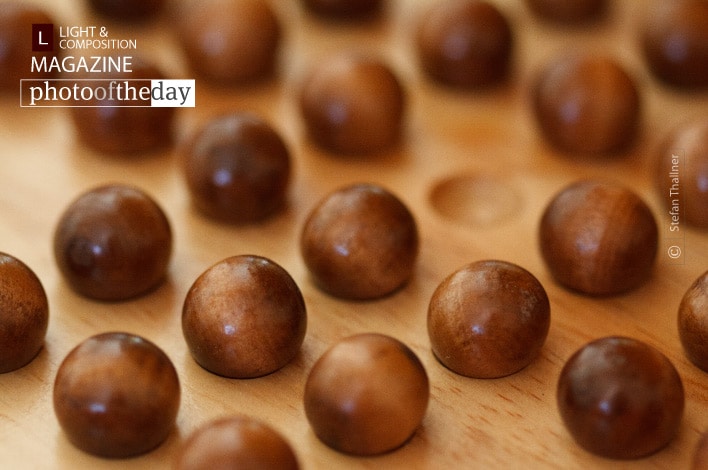
Exposure 1/100sec @ f/2.8 | ISO 1600 | Focal Length 100mm
Stefan Thallner
Born in 1987, Stefan Thallner is a photographer and web developer based in Allhartsberg, Austria. His creative journey began in childhood, but his passion for the craft was truly ignited in 2007 when he received his grandfather's Canon EOS D30. Balancing his professional career in IT with his artistic pursuits, Thallner has developed a keen eye for technical precision and exploration, notably winning Scott Kelby's Worldwide Photo Walk in Linz in 2009. For Thallner, photography serves as a vital creative outlet, offering a sense of freedom and personal expression away from the pressures of his technical work.
Resonance Score Breakdown
Transparency Note: The resonance score (11.7/20) is calculated based on social engagement metrics collected before the award announcement.
Expert Photography Reviews · 6
The Weight of Silence
Why do we feel the need to fill every silence with the frantic hum of progress? We treat time as a resource to be mined, a currency to be spent on efficiency, forgetting that the most profound human connections often happen in the gaps between our tasks.
Read the reflection →The Grain of Quiet
The smell of cedar always brings me back to the attic of my childhood, where the wood was dry and thirsty, drinking in the heat of the summer afternoons.
Read the reflection →Reviews & Comments
Share your thoughts about this award-winning photograph. Your reviews contribute to the community engagement score.
The shallow depth of field creates an aggressive isolation. It’s a narrow slice of focus that forces the eye into the center, ignoring the periphery entirely. The wooden spheres provide a rhythmic, tactile weight, yet the frame doesn’t quite resolve the spatial tension at the edges. It’s technically precise, but I’m left craving a wider aperture to anchor the board. It’s a rigid structure, though it lacks the necessary geometric finality to truly hold the plane.
100mm at f/2.8, 1/100sec, ISO 1600. That aperture is a gamble on a macro plane. It’s razor-thin, isolating the wood grain but leaving the board’s geometry to dissolve into noise. ISO 1600 on a 50D sensor? It’s grainy, frankly. I’d have preferred a tripod and base ISO for this stillness. It’s technically reckless, yet the texture holds. I find myself wanting to touch the wood despite the sensor’s obvious struggle. It’s a flawed, honest choice.
Nostalgia feels like a trap here. Thallner isolates these wooden spheres, but why strip away the context of the room? It’s a clean, clinical aesthetic that ignores the messy reality of how we actually play. I find the shallow focus frustrating; it turns a tactile game into a sterile abstraction. Does this really honor analog joy, or does it just fetishize the object? I’m left wondering who owns this board and why it’s being presented as a relic.
At f/2.8, the 100mm macro lens renders the focal plane razor-thin, isolating the wood grain’s tactile topography. The diffraction limit is barely touched, yet the bokeh—a function of that wide aperture—dissolves the background into a soft, nostalgic blur. I’m genuinely moved by how the light catches the spherical pieces; it’s a precise, luminous collision of physics and memory. It’s rare to see optics used to make the tangible feel this fragile, almost ethereal.
Most entries in this category rely on sterile sharpness, but Thallner’s choice to shoot at f/2.8 is what saves this. By letting the wooden grain blur into soft, amber bokeh, he forces us to feel the tactile weight of the pieces. I’ve seen thousands of still lifes, yet this one makes me miss the quiet frustration of a real game. It’s a rare, honest anchor in our digital noise. It’ll still matter in thirty years.
Architecture is about the threshold between the hand and the void. Here, the solitaire board acts as a micro-site, its circular voids defining a rigid datum for the wooden spheres. Thallner’s shallow depth of field flattens the spatial sequence, yet I’m struck by how the light rakes across the grain, revealing the mass of the timber. It’s a quiet, tactile structure. I find myself wanting to reach out and disrupt the order of its fenestration.