Junction by Keith Goldstein
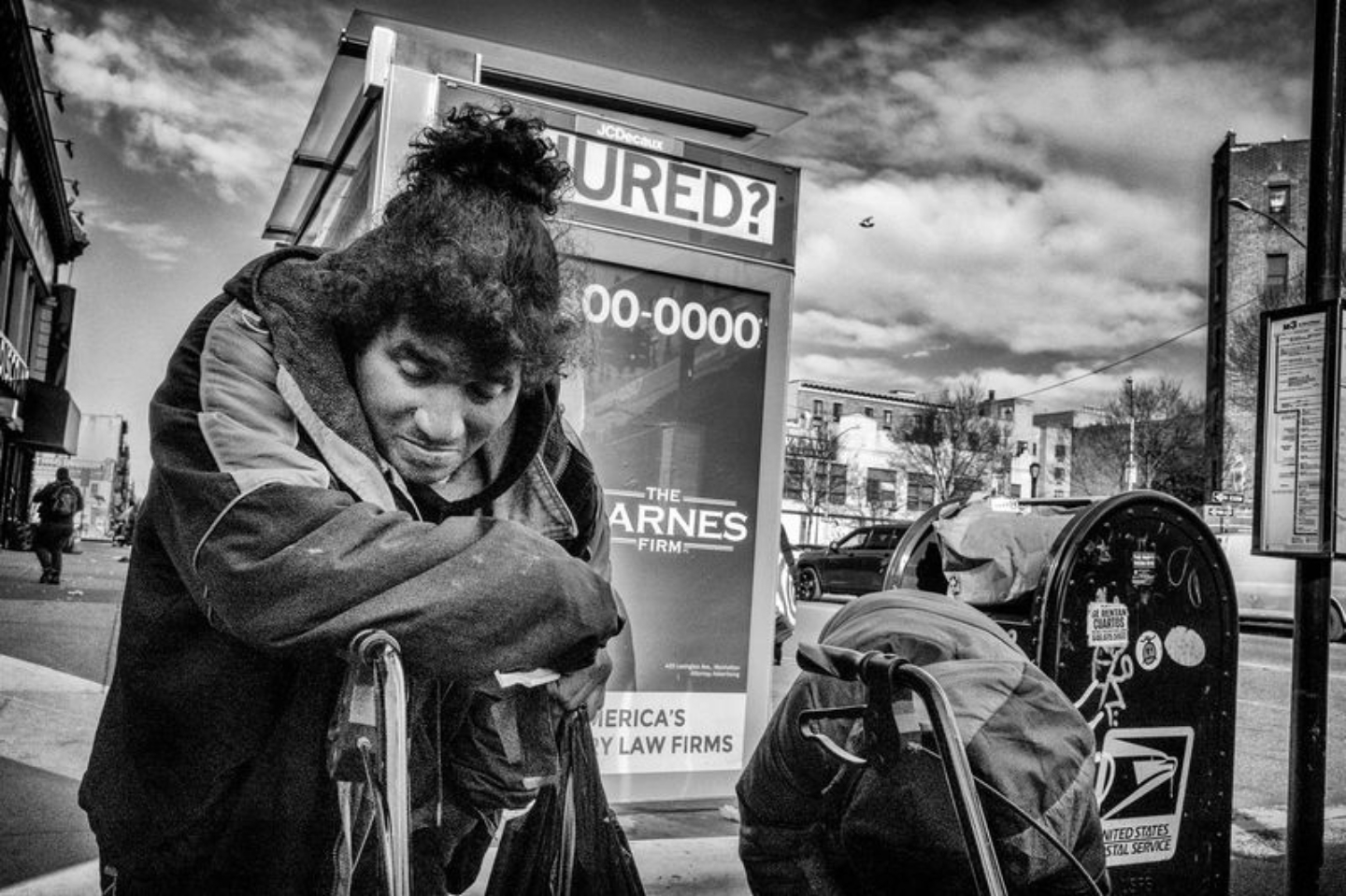
Captured at the bustling intersection of Amsterdam Avenue, 162nd Street, and St. Nicholas Avenue, this photograph isolates a moment of profound stillness amidst urban chaos. The photographer observed an elderly woman resting with her walker outside a local bodega, drawn to the serene expression on her face that stood in stark contrast to the surrounding city activity. By utilizing a wide-angle perspective, the image frames the subject within her environment, emphasizing the quiet dignity of the individual against the backdrop of a busy subway stop and triangular park. This poignant juxtaposition of tranquility and motion elevates the street portrait into a compelling narrative of human resilience.
Keith Goldstein
Born in Brooklyn, New York, Keith Goldstein developed a lifelong passion for art, heavily influenced by his mother's early encouragement. After pursuing formal education at the School of Visual Arts and the Cranbrook Academy of Art, he refined his emotive approach to the medium. With an extensive exhibition history dating back to 1980, Goldstein has established himself as a versatile fine art and commercial photographer, consistently favoring a minimalist, unencumbered approach to capturing the world around him.
Resonance Score Breakdown
Transparency Note: The resonance score (6.8/20) is calculated based on social engagement metrics collected before the award announcement.
Expert Photography Reviews · 7
The Stillness Within the Rush
There is a rhythm to the city that demands we move in time with its pulse. We are taught to walk with purpose, to keep our eyes fixed on the destination, and to treat the sidewalk as a bridge to somewhere else.
Read the reflection →The Quiet Center
I sat on a bench at the park this morning, waiting for a friend who was running late. The city around me felt like a drum beating too fast. People were rushing toward the subway, cars were honking, and the wind was whipping trash across the sidewalk.
Read the reflection →Reviews & Comments
Share your thoughts about this award-winning photograph. Your reviews contribute to the community engagement score.
The sharp, geometric shadows of the bodega awning slice across the pavement, grounding this woman in the relentless grid of New York. It’s the grit of the concrete and the blurred motion of the street that make her stillness feel so heavy, so earned. I’m genuinely moved by how the wide lens forces the city to press in on her. She isn’t just resting; she’s anchoring the entire intersection. It’s a beautiful, quiet defiance.
The urban fabric here is a jagged collision of datum lines, yet the frame finds a rare, quiet threshold. Goldstein’s 28mm lens captures how the harsh, raking light defines the bodega’s mass against the void of the street. It’s not just a portrait; it’s a study of scale. Seeing that woman anchored against the relentless geometry of the intersection makes me feel a sudden, sharp ache for the stillness we lose in our own frantic designs.
Amsterdam Avenue demands more than a picturesque contrast. Goldstein frames this woman’s stillness against urban chaos, but does he grant her agency or merely use her as a prop for his narrative of resilience? I feel a sharp discomfort seeing her vulnerability commodified for a street aesthetic. Why is her rest framed as a spectacle? Does the wide angle capture her world, or does it push her further into the margins of the city she inhabits?
Goldstein’s frame doesn’t just capture a woman; it traps her in a geometry of indifference. The shadows beneath the bodega awning aren’t merely dark—they’re a heavy, ontological silence swallowing the city’s frantic pulse. I’ve stared at her hands resting on that walker, and it’s haunting how the light refuses to touch her grief. It’s a brutal, honest collision. When the sun hits the pavement like that, you realize the darkness is the only thing keeping her upright.
The 28mm lens here echoes the aggressive intimacy of William Klein, yet Goldstein avoids his chaotic frenzy. Instead, he finds a stillness reminiscent of Helen Levitt’s New York street observations. It’s a delicate balance; the wide-angle distortion doesn’t mock the subject but anchors her dignity within the urban geometry. I’ve spent decades cataloging such intersections, yet the way light catches her expression against that subway backdrop genuinely stopped me. It’s a quiet, necessary addition to the canon.
The shutter snaps, and the city’s frantic rhythm hits a wall. It’s a wide, breathless frame. The 28mm lens swallows the intersection, yet the elderly woman remains the only thing in focus. She’s an anchor in a sea of blur. I’ve spent hours watching street footage, but this stillness? It’s rare. It’s the shot the editor keeps because it’s the only one that breathes. I honestly felt my own pulse slow down just looking at her.
The shutter speed is fast enough, but the timing misses the physiological peak. The woman’s posture is static, yet the city blur behind her lacks the kinetic tension I look for. It’s a quiet frame, sure, but it feels like the moment after the effort. I’ve spent my life chasing that singular, explosive millisecond of total alignment. This isn’t it. It’s a decent composition, but it doesn’t capture the heartbeat of the intersection.